
Zygote 作为 Android 世界的受精卵,在成功繁殖出 system_server 进程之后并没有完全功成身退,仍然承担着受精卵的责任。Zygote 通过调用其持有的 ZygoteServer 对象的 runSelectLoop() 方法开始等待客户端的呼唤,有求必应。客户端的请求无非是创建应用进程,以 startActivity() 为例,假如开启的是一个尚未创建进程的应用,那么就会向 Zygote 请求创建进程。下面将从 客户端发送请求 和 服务端处理请求 两方面来进行解析。
客户端发送请求
startActivity() 的具体流程这里就不分析了,系列后续文章会写到。我们直接看到创建进程的 startProcess() 方法,该方法在 ActivityManagerService 中,后面简称 AMS。
Process.startProcess()
1> ActivityManagerService.java
2
3private ProcessStartResult startProcess(String hostingType, String entryPoint,
4        ProcessRecord app, int uid, int[] gids, int runtimeFlags, int mountExternal,
5        String seInfo, String requiredAbi, String instructionSet, String invokeWith,
6        long startTime) {
7    try {
8        checkTime(startTime, "startProcess: asking zygote to start proc");
9        final ProcessStartResult startResult;
10        if (hostingType.equals("webview_service")) {
11            startResult = startWebView(entryPoint,
12                    app.processName, uid, uid, gids, runtimeFlags, mountExternal,
13                    app.info.targetSdkVersion, seInfo, requiredAbi, instructionSet,
14                    app.info.dataDir, null,
15                    new String[] {PROC_START_SEQ_IDENT + app.startSeq});
16        } else {
17            // 新建进程
18            startResult = Process.start(entryPoint,
19                    app.processName, uid, uid, gids, runtimeFlags, mountExternal,
20                    app.info.targetSdkVersion, seInfo, requiredAbi, instructionSet,
21                    app.info.dataDir, invokeWith,
22                    new String[] {PROC_START_SEQ_IDENT + app.startSeq});
23        }
24        checkTime(startTime, "startProcess: returned from zygote!");
25        return startResult;
26    } finally {
27        Trace.traceEnd(Trace.TRACE_TAG_ACTIVITY_MANAGER);
28    }
29}
调用 Process.start() 方法新建进程,继续追进去:
1> Process.java
2
3public static final ProcessStartResult start(
4                // android.app.ActivityThread,创建进程后会调用其 main() 方法
5                final String processClass,
6                final String niceName, // 进程名
7                int uid, int gid, int[] gids,
8                int runtimeFlags, int mountExternal,
9                int targetSdkVersion,
10                String seInfo,
11                String abi,
12                String instructionSet,
13                String appDataDir,
14                String invokeWith, // 一般新建应用进程时,此参数不为 null
15                String[] zygoteArgs) {
16        return zygoteProcess.start(processClass, niceName, uid, gid, gids,
17                    runtimeFlags, mountExternal, targetSdkVersion, seInfo,
18                    abi, instructionSet, appDataDir, invokeWith, zygoteArgs);
19    }
继续调用 zygoteProcess.start() :
1> ZygoteProess.java
2
3public final Process.ProcessStartResult start(final String processClass,
4                                              final String niceName,
5                                              int uid, int gid, int[] gids,
6                                              int runtimeFlags, int mountExternal,
7                                              int targetSdkVersion,
8                                              String seInfo,
9                                              String abi,
10                                              String instructionSet,
11                                              String appDataDir,
12                                              String invokeWith,
13                                              String[] zygoteArgs) {
14    try {
15        return startViaZygote(processClass, niceName, uid, gid, gids,
16                runtimeFlags, mountExternal, targetSdkVersion, seInfo,
17                abi, instructionSet, appDataDir, invokeWith, false /* startChildZygote */,
18                zygoteArgs);
19    } catch (ZygoteStartFailedEx ex) {
20        Log.e(LOG_TAG,
21                "Starting VM process through Zygote failed");
22        throw new RuntimeException(
23                "Starting VM process through Zygote failed", ex);
24    }
25}
调用 startViaZygote() 方法。终于看到 Zygote 的身影了。
startViaZygote()
1> ZygoteProcess.java
2
3private Process.ProcessStartResult startViaZygote(final String processClass,
4                                                  final String niceName,
5                                                  final int uid, final int gid,
6                                                  final int[] gids,
7                                                  int runtimeFlags, int mountExternal,
8                                                  int targetSdkVersion,
9                                                  String seInfo,
10                                                  String abi,
11                                                  String instructionSet,
12                                                  String appDataDir,
13                                                  String invokeWith,
14                                                  boolean startChildZygote, // 是否克隆 zygote 进程的所有状态
15                                                  String[] extraArgs)
16                                                  throws ZygoteStartFailedEx {
17    ArrayList<String> argsForZygote = new ArrayList<String>();
18
19    // --runtime-args, --setuid=, --setgid=,
20    // and --setgroups= must go first
21    // 处理参数
22    argsForZygote.add("--runtime-args");
23    argsForZygote.add("--setuid=" + uid);
24    argsForZygote.add("--setgid=" + gid);
25    argsForZygote.add("--runtime-flags=" + runtimeFlags);
26    if (mountExternal == Zygote.MOUNT_EXTERNAL_DEFAULT) {
27        argsForZygote.add("--mount-external-default");
28    } else if (mountExternal == Zygote.MOUNT_EXTERNAL_READ) {
29        argsForZygote.add("--mount-external-read");
30    } else if (mountExternal == Zygote.MOUNT_EXTERNAL_WRITE) {
31        argsForZygote.add("--mount-external-write");
32    }
33    argsForZygote.add("--target-sdk-version=" + targetSdkVersion);
34
35    // --setgroups is a comma-separated list
36    if (gids != null && gids.length > 0) {
37        StringBuilder sb = new StringBuilder();
38        sb.append("--setgroups=");
39
40        int sz = gids.length;
41        for (int i = 0; i < sz; i++) {
42            if (i != 0) {
43                sb.append(',');
44            }
45            sb.append(gids[i]);
46        }
47
48        argsForZygote.add(sb.toString());
49    }
50
51    if (niceName != null) {
52        argsForZygote.add("--nice-name=" + niceName);
53    }
54
55    if (seInfo != null) {
56        argsForZygote.add("--seinfo=" + seInfo);
57    }
58
59    if (instructionSet != null) {
60        argsForZygote.add("--instruction-set=" + instructionSet);
61    }
62
63    if (appDataDir != null) {
64        argsForZygote.add("--app-data-dir=" + appDataDir);
65    }
66
67    if (invokeWith != null) {
68        argsForZygote.add("--invoke-with");
69        argsForZygote.add(invokeWith);
70    }
71
72    if (startChildZygote) {
73        argsForZygote.add("--start-child-zygote");
74    }
75
76    argsForZygote.add(processClass);
77
78    if (extraArgs != null) {
79        for (String arg : extraArgs) {
80            argsForZygote.add(arg);
81        }
82    }
83
84    synchronized(mLock) {
85        // 和 Zygote 进程进行 socket 通信
86        return zygoteSendArgsAndGetResult(openZygoteSocketIfNeeded(abi), argsForZygote);
87    }
88}
前面一大串代码都是在处理参数,大致浏览即可。核心在于最后的 openZygoteSocketIfNeeded() 和 zygoteSendArgsAndGetResult() 这两个方法。从方法命名就可以看出来,这里要和 Zygote 进行 socket 通信了。还记得 ZygoteInit.main() 方法中调用的 registerServerSocketFromEnv() 方法吗?它在 Zygote 进程中创建了服务端 socket。
openZygoteSocketIfNeeded()
先来看看 openZygoteSocketIfNeeded() 方法。
1> ZygoteProcess.java
2
3private ZygoteState openZygoteSocketIfNeeded(String abi) throws ZygoteStartFailedEx {
4    Preconditions.checkState(Thread.holdsLock(mLock), "ZygoteProcess lock not held");
5
6    // 未连接或者连接已关闭
7    if (primaryZygoteState == null || primaryZygoteState.isClosed()) {
8        try {
9            // 开启 socket 连接
10            primaryZygoteState = ZygoteState.connect(mSocket);
11        } catch (IOException ioe) {
12            throw new ZygoteStartFailedEx("Error connecting to primary zygote", ioe);
13        }
14        maybeSetApiBlacklistExemptions(primaryZygoteState, false);
15        maybeSetHiddenApiAccessLogSampleRate(primaryZygoteState);
16    }
17    if (primaryZygoteState.matches(abi)) {
18        return primaryZygoteState;
19    }
20
21    // 当主 zygote 没有匹配成功,尝试 connect 第二个 zygote
22    if (secondaryZygoteState == null || secondaryZygoteState.isClosed()) {
23        try {
24            secondaryZygoteState = ZygoteState.connect(mSecondarySocket);
25        } catch (IOException ioe) {
26            throw new ZygoteStartFailedEx("Error connecting to secondary zygote", ioe);
27        }
28        maybeSetApiBlacklistExemptions(secondaryZygoteState, false);
29        maybeSetHiddenApiAccessLogSampleRate(secondaryZygoteState);
30    }
31
32    if (secondaryZygoteState.matches(abi)) {
33        return secondaryZygoteState;
34    }
35
36    throw new ZygoteStartFailedEx("Unsupported zygote ABI: " + abi);
37}
如果与 Zygote 进程的 socket 连接未开启,则尝试开启,可能会产生阻塞和重试。连接调用的是 ZygoteState.connect() 方法,ZygoteState 是 ZygoteProcess 的内部类。
1> ZygoteProcess.java
2
3public static class ZygoteState {
4       final LocalSocket socket;
5       final DataInputStream inputStream;
6       final BufferedWriter writer;
7       final List<String> abiList;
8
9       boolean mClosed;
10
11       private ZygoteState(LocalSocket socket, DataInputStream inputStream,
12               BufferedWriter writer, List<String> abiList) {
13           this.socket = socket;
14           this.inputStream = inputStream;
15           this.writer = writer;
16           this.abiList = abiList;
17       }
18
19       public static ZygoteState connect(LocalSocketAddress address) throws IOException {
20           DataInputStream zygoteInputStream = null;
21           BufferedWriter zygoteWriter = null;
22           final LocalSocket zygoteSocket = new LocalSocket();
23
24           try {
25               zygoteSocket.connect(address);
26
27               zygoteInputStream = new DataInputStream(zygoteSocket.getInputStream());
28
29               zygoteWriter = new BufferedWriter(new OutputStreamWriter(
30                       zygoteSocket.getOutputStream()), 256);
31           } catch (IOException ex) {
32               try {
33                   zygoteSocket.close();
34               } catch (IOException ignore) {
35               }
36
37               throw ex;
38           }
39
40           String abiListString = getAbiList(zygoteWriter, zygoteInputStream);
41           Log.i("Zygote", "Process: zygote socket " + address.getNamespace() + "/"
42                   + address.getName() + " opened, supported ABIS: " + abiListString);
43
44           return new ZygoteState(zygoteSocket, zygoteInputStream, zygoteWriter,
45                   Arrays.asList(abiListString.split(",")));
46       }
47   ...
48}
通过 socket 连接 Zygote 远程服务端。
再回头看之前的 zygoteSendArgsAndGetResult() 方法。
zygoteSendArgsAndGetResult()
1 > ZygoteProcess.java
2
3private static Process.ProcessStartResult zygoteSendArgsAndGetResult(
4       ZygoteState zygoteState, ArrayList<String> args)
5       throws ZygoteStartFailedEx {
6   try {
7       ...
8       final BufferedWriter writer = zygoteState.writer;
9       final DataInputStream inputStream = zygoteState.inputStream;
10
11       writer.write(Integer.toString(args.size()));
12       writer.newLine();
13
14       // 向 zygote 进程发送参数
15       for (int i = 0; i < sz; i++) {
16           String arg = args.get(i);
17           writer.write(arg);
18           writer.newLine();
19       }
20
21       writer.flush();
22
23       // 是不是应该有一个超时时间?
24       Process.ProcessStartResult result = new Process.ProcessStartResult();
25
26       // Always read the entire result from the input stream to avoid leaving
27       // bytes in the stream for future process starts to accidentally stumble
28       // upon.
29       // 读取 zygote 进程返回的子进程 pid
30       result.pid = inputStream.readInt();
31       result.usingWrapper = inputStream.readBoolean();
32
33       if (result.pid < 0) { // pid 小于 0 ,fork 失败
34           throw new ZygoteStartFailedEx("fork() failed");
35       }
36       return result;
37   } catch (IOException ex) {
38       zygoteState.close();
39       throw new ZygoteStartFailedEx(ex);
40   }
41}
通过 socket 发送请求参数,然后等待 Zygote 进程返回子进程 pid 。客户端的工作到这里就暂时完成了,我们再追踪到服务端,看看服务端是如何处理客户端请求的。
Zygote 处理客户端请求
Zygote 处理客户端请求的代码在 ZygoteServer.runSelectLoop() 方法中。
1> ZygoteServer.java
2
3Runnable runSelectLoop(String abiList) {
4   ...
5
6   while (true) {
7      ...
8       try {
9           // 有事件来时往下执行,没有时就阻塞
10           Os.poll(pollFds, -1);
11       } catch (ErrnoException ex) {
12           throw new RuntimeException("poll failed", ex);
13       }
14       for (int i = pollFds.length - 1; i >= 0; --i) {
15           if ((pollFds[i].revents & POLLIN) == 0) {
16               continue;
17           }
18
19           if (i == 0) { // 有新客户端连接
20               ZygoteConnection newPeer = acceptCommandPeer(abiList);
21               peers.add(newPeer);
22               fds.add(newPeer.getFileDesciptor());
23           } else { // 处理客户端请求
24               try {
25                   ZygoteConnection connection = peers.get(i);
26                   // fork 子进程,并返回包含子进程 main() 函数的 Runnable 对象
27                   final Runnable command = connection.processOneCommand(this);
28
29                   if (mIsForkChild) {
30                       // 位于子进程
31                       if (command == null) {
32                           throw new IllegalStateException("command == null");
33                       }
34
35                       return command;
36                   } else {
37                       // 位于父进程
38                       if (command != null) {
39                           throw new IllegalStateException("command != null");
40                       }
41
42                       if (connection.isClosedByPeer()) {
43                           connection.closeSocket();
44                           peers.remove(i);
45                           fds.remove(i);
46                       }
47                   }
48               } catch (Exception e) {
49                   ...
50               } finally {
51                   mIsForkChild = false;
52               }
53           }
54       }
55   }
56}
acceptCommandPeer() 方法用来响应新客户端的 socket 连接请求。processOneCommand() 方法用来处理客户端的一般请求。
processOneCommand()
1> ZygoteConnection.java
2
3Runnable processOneCommand(ZygoteServer zygoteServer) {
4    String args[];
5    Arguments parsedArgs = null;
6    FileDescriptor[] descriptors;
7
8    try {
9        // 1\. 读取 socket 客户端发送过来的参数列表
10        args = readArgumentList();
11        descriptors = mSocket.getAncillaryFileDescriptors();
12    } catch (IOException ex) {
13        throw new IllegalStateException("IOException on command socket", ex);
14    }
15
16    ...
17
18    // 2\. fork 子进程
19    pid = Zygote.forkAndSpecialize(parsedArgs.uid, parsedArgs.gid, parsedArgs.gids,
20            parsedArgs.runtimeFlags, rlimits, parsedArgs.mountExternal, parsedArgs.seInfo,
21            parsedArgs.niceName, fdsToClose, fdsToIgnore, parsedArgs.startChildZygote,
22            parsedArgs.instructionSet, parsedArgs.appDataDir);
23
24    try {
25        if (pid == 0) {
26            // 处于进子进程
27            zygoteServer.setForkChild();
28            // 关闭服务端 socket
29            zygoteServer.closeServerSocket();
30            IoUtils.closeQuietly(serverPipeFd);
31            serverPipeFd = null;
32            // 3\. 处理子进程事务
33            return handleChildProc(parsedArgs, descriptors, childPipeFd,
34                    parsedArgs.startChildZygote);
35        } else {
36            // 处于 Zygote 进程
37            IoUtils.closeQuietly(childPipeFd);
38            childPipeFd = null;
39            // 4\. 处理父进程事务
40            handleParentProc(pid, descriptors, serverPipeFd);
41            return null;
42        }
43    } finally {
44        IoUtils.closeQuietly(childPipeFd);
45        IoUtils.closeQuietly(serverPipeFd);
46    }
47}
processOneCommand() 方法大致可以分为五步,下面逐步分析。
readArgumentList()
1> ZygoteConnection.java
2
3private String[] readArgumentList()
4        throws IOException {
5
6    int argc;
7
8    try {
9        // 逐行读取参数
10        String s = mSocketReader.readLine();
11
12        if (s == null) {
13            // EOF reached.
14            return null;
15        }
16        argc = Integer.parseInt(s);
17    } catch (NumberFormatException ex) {
18        throw new IOException("invalid wire format");
19    }
20
21    // See bug 1092107: large argc can be used for a DOS attack
22    if (argc > MAX_ZYGOTE_ARGC) {
23        throw new IOException("max arg count exceeded");
24    }
25
26    String[] result = new String[argc];
27    for (int i = 0; i < argc; i++) {
28        result[i] = mSocketReader.readLine();
29        if (result[i] == null) {
30            // We got an unexpected EOF.
31            throw new IOException("truncated request");
32        }
33    }
34
35    return result;
36}
读取客户端发送过来的请求参数。
forkAndSpecialize()
1> Zygote.java
2
3public static int forkAndSpecialize(int uid, int gid, int[] gids, int runtimeFlags,
4      int[][] rlimits, int mountExternal, String seInfo, String niceName, int[] fdsToClose,
5      int[] fdsToIgnore, boolean startChildZygote, String instructionSet, String appDataDir) {
6    VM_HOOKS.preFork();
7    // Resets nice priority for zygote process.
8    resetNicePriority();
9    int pid = nativeForkAndSpecialize(
10              uid, gid, gids, runtimeFlags, rlimits, mountExternal, seInfo, niceName, fdsToClose,
11              fdsToIgnore, startChildZygote, instructionSet, appDataDir);
12    // Enable tracing as soon as possible for the child process.
13    if (pid == 0) {
14        Trace.setTracingEnabled(true, runtimeFlags);
15
16        // Note that this event ends at the end of handleChildProc,
17        Trace.traceBegin(Trace.TRACE_TAG_ACTIVITY_MANAGER, "PostFork");
18    }
19    VM_HOOKS.postForkCommon();
20    return pid;
21}
nativeForkAndSpecialize() 是一个 native 方法,在底层 fork 了一个新进程,并返回其 pid。不要忘记了这里的 一次fork,两次返回 。pid > 0 说明还是父进程。pid = 0 说明进入了子进程。子进程中会调用 handleChildProc,而父进程中会调用 handleParentProc()。
handleChildProc()
1> ZygoteConnection.java
2
3private Runnable handleChildProc(Arguments parsedArgs, FileDescriptor[] descriptors,
4        FileDescriptor pipeFd, boolean isZygote) {
5    closeSocket(); // 关闭 socket 连接
6    ...
7
8    if (parsedArgs.niceName != null) {
9        // 设置进程名
10        Process.setArgV0(parsedArgs.niceName);
11    }
12
13    if (parsedArgs.invokeWith != null) {
14        WrapperInit.execApplication(parsedArgs.invokeWith,
15                parsedArgs.niceName, parsedArgs.targetSdkVersion,
16                VMRuntime.getCurrentInstructionSet(),
17                pipeFd, parsedArgs.remainingArgs);
18
19        // Should not get here.
20        throw new IllegalStateException("WrapperInit.execApplication unexpectedly returned");
21    } else {
22        if (!isZygote) { // 新建应用进程时 isZygote 参数为 false
23            return ZygoteInit.zygoteInit(parsedArgs.targetSdkVersion, parsedArgs.remainingArgs,
24                    null /* classLoader */);
25        } else {
26            return ZygoteInit.childZygoteInit(parsedArgs.targetSdkVersion,
27                    parsedArgs.remainingArgs, null /* classLoader */);
28        }
29    }
30}
当看到 ZygoteInit.zygoteInit() 时你应该感觉很熟悉了,接下来的流程就是:
ZygoteInit.zygoteInit()->RuntimeInit.applicationInit()->findStaticMain()
和 SystemServer 进程的创建流程一致。这里要找的 main 方法就是 ActivityThrad.main() 。ActivityThread虽然并不是一个线程,但你可以把它理解为应用的主线程。
handleParentProc()
1> ZygoteConnection.java
2
3private void handleParentProc(int pid, FileDescriptor[] descriptors, FileDescriptor pipeFd) {
4        if (pid > 0) {
5            setChildPgid(pid);
6        }
7
8        if (descriptors != null) {
9            for (FileDescriptor fd: descriptors) {
10                IoUtils.closeQuietly(fd);
11            }
12        }
13
14        boolean usingWrapper = false;
15        if (pipeFd != null && pid > 0) {
16            int innerPid = -1;
17            try {
18                // Do a busy loop here. We can't guarantee that a failure (and thus an exception
19                // bail) happens in a timely manner.
20                final int BYTES_REQUIRED = 4;  // Bytes in an int.
21
22                StructPollfd fds[] = new StructPollfd[] {
23                        new StructPollfd()
24                };
25
26                byte data[] = new byte[BYTES_REQUIRED];
27
28                int remainingSleepTime = WRAPPED_PID_TIMEOUT_MILLIS;
29                int dataIndex = 0;
30                long startTime = System.nanoTime();
31
32                while (dataIndex < data.length && remainingSleepTime > 0) {
33                    fds[0].fd = pipeFd;
34                    fds[0].events = (short) POLLIN;
35                    fds[0].revents = 0;
36                    fds[0].userData = null;
37
38                    int res = android.system.Os.poll(fds, remainingSleepTime);
39                    long endTime = System.nanoTime();
40                    int elapsedTimeMs = (int)((endTime - startTime) / 1000000l);
41                    remainingSleepTime = WRAPPED_PID_TIMEOUT_MILLIS - elapsedTimeMs;
42
43                    if (res > 0) {
44                        if ((fds[0].revents & POLLIN) != 0) {
45                            // Only read one byte, so as not to block.
46                            int readBytes = android.system.Os.read(pipeFd, data, dataIndex, 1);
47                            if (readBytes < 0) {
48                                throw new RuntimeException("Some error");
49                            }
50                            dataIndex += readBytes;
51                        } else {
52                            // Error case. revents should contain one of the error bits.
53                            break;
54                        }
55                    } else if (res == 0) {
56                        Log.w(TAG, "Timed out waiting for child.");
57                    }
58                }
59
60                if (dataIndex == data.length) {
61                    DataInputStream is = new DataInputStream(new ByteArrayInputStream(data));
62                    innerPid = is.readInt();
63                }
64
65                if (innerPid == -1) {
66                    Log.w(TAG, "Error reading pid from wrapped process, child may have died");
67                }
68            } catch (Exception ex) {
69                Log.w(TAG, "Error reading pid from wrapped process, child may have died", ex);
70            }
71
72            // Ensure that the pid reported by the wrapped process is either the
73            // child process that we forked, or a descendant of it.
74            if (innerPid > 0) {
75                int parentPid = innerPid;
76                while (parentPid > 0 && parentPid != pid) {
77                    parentPid = Process.getParentPid(parentPid);
78                }
79                if (parentPid > 0) {
80                    Log.i(TAG, "Wrapped process has pid " + innerPid);
81                    pid = innerPid;
82                    usingWrapper = true;
83                } else {
84                    Log.w(TAG, "Wrapped process reported a pid that is not a child of "
85                            + "the process that we forked: childPid=" + pid
86                            + " innerPid=" + innerPid);
87                }
88            }
89        }
90
91        try {
92            mSocketOutStream.writeInt(pid);
93            mSocketOutStream.writeBoolean(usingWrapper);
94        } catch (IOException ex) {
95            throw new IllegalStateException("Error writing to command socket", ex);
96        }
97    }
主要进行一些资源清理的工作。到这里,子进程就创建完成了。
总结
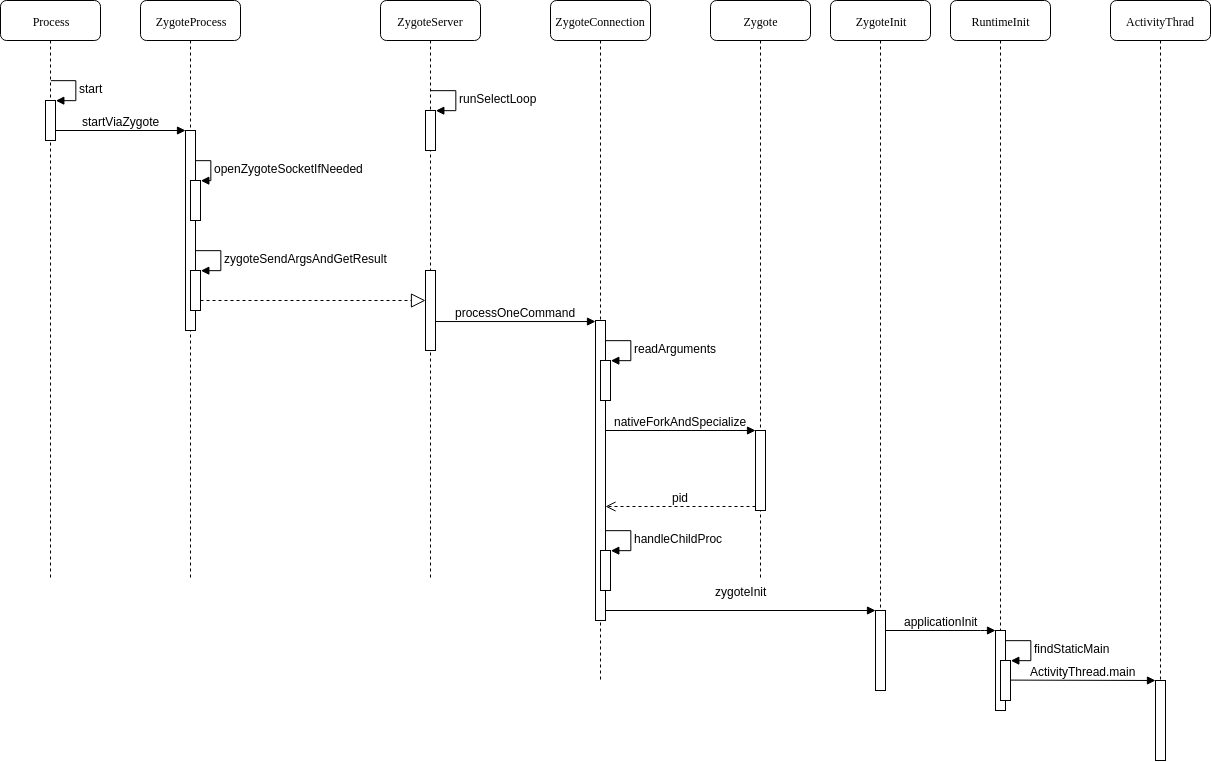
- 调用
Process.start()创建应用进程 ZygoteProcess负责和Zygote进程建立 socket 连接,并将创建进程需要的参数发送给 Zygote 的 socket 服务端Zygote服务端接收到参数之后调用ZygoteConnection.processOneCommand()处理参数,并 fork 进程- 最后通过
findStaticMain()找到ActivityThread类的 main() 方法并执行,子进程就启动了