
参考雷神的代码:
1/**
2* 最简单的SDL2播放音频的例子(SDL2播放PCM)
3* Simplest Audio Play SDL2 (SDL2 play PCM)
4*
5* 本程序使用SDL2播放PCM音频采样数据。SDL实际上是对底层绘图
6* API(Direct3D,OpenGL)的封装,使用起来明显简单于直接调用底层
7* API。
8*
9* 函数调用步骤如下:
10*
11* [初始化]
12* SDL_Init(): 初始化SDL。
13* SDL_OpenAudio(): 根据参数(存储于SDL_AudioSpec)打开音频设备。
14* SDL_PauseAudio(): 播放音频数据。
15*
16* [循环播放数据]
17* SDL_Delay(): 延时等待播放完成。
18*
19* This software plays PCM raw audio data using SDL2.
20* SDL is a wrapper of low-level API (DirectSound).
21* Use SDL is much easier than directly call these low-level API.
22*
23* The process is shown as follows:
24*
25* [Init]
26* SDL_Init(): Init SDL.
27* SDL_OpenAudio(): Opens the audio device with the desired
28*                  parameters (In SDL_AudioSpec).
29* SDL_PauseAudio(): Play Audio.
30*
31* [Loop to play data]
32* SDL_Delay(): Wait for completetion of playback.
33*/
34
35#include <stdio.h>
36#include <tchar.h>
37
38extern "C"
39{
40#include "SDL.h"
41};
42
43Uint32  audio_len;//音频数据大小
44Uint8  *audio_pos;//指向音频数据的指针
45
46
47/**回调函数(由系统调用)
48*  函数声明:typedef void (SDLCALL * SDL_AudioCallback)
49*            (void *userdata, Uint8 * stream, int len);
50*  This function is called when the audio device needs more data.
51*
52*  userdata: An application-specific parameter saved in the SDL_AudioSpec structure(SDL_AudioSpec结构中的用户自定义数据,一般情况下可以不用)
53*  stream:   A pointer to the audio data buffer.(该指针指向需要填充的音频缓冲区)
54*  len:      The length of that buffer in bytes.(音频缓冲区的大小,以字节为单位)
55*
56*  Once the callback returns, the buffer will no longer be valid.
57*  Stereo samples are stored in a LRLRLR ordering.
58*
59*  You can choose to avoid callbacks and use SDL_QueueAudio() instead, if
60*  you like. Just open your audio device with a NULL callback.
61*/
62
63void  fill_audio(void *userdata, Uint8 *stream, int len)
64{
65	//SDL2中必须首先使用SDL_memset()将stream中的数据设置为0
66	SDL_memset(stream, 0, len);
67	if (audio_len == 0)		/*  Only  play  if  we  have  data  left  */
68	{
69		return;
70	}
71	len = (len > audio_len ? audio_len : len);	/*  Mix  as  much  data  as  possible  */
72
73	/**
74	*  函数声明:extern DECLSPEC void SDLCALL
75	*  SDL_MixAudio(Uint8 * dst, const Uint8 * src, Uint32 len, int volume);
76	*  This takes two audio buffers of the playing audio format and mixes
77	*  them, performing addition, volume adjustment, and overflow clipping.
78	*  The volume ranges from 0 - 128, and should be set to ::SDL_MIX_MAXVOLUME
79	*  for full audio volume.  Note this does not change hardware volume.
80	*  This is provided for convenience -- you can mix your own audio data.
81	*
82	*  #define SDL_MIX_MAXVOLUME 128
83	*/
84
85	SDL_MixAudio(stream, audio_pos, len, SDL_MIX_MAXVOLUME);
86	audio_pos += len;
87	audio_len -= len;
88}
89
90int main(int argc, char* argv[])
91{
92	//初始化SDL
93	if (SDL_Init(SDL_INIT_AUDIO))
94	{
95		printf("Could not initialize SDL - %s\n", SDL_GetError());
96		return -1;
97	}
98
99	//SDL_AudioSpec初始化
100	SDL_AudioSpec wanted_spec;
101	wanted_spec.freq = 44100;			//音频数据的采样率(常用的有48000,44100等)
102	wanted_spec.format = AUDIO_S16SYS;//音频数据的格式
103	wanted_spec.channels = 2;			//声道数(例如单声道取值为1,立体声取值为2)
104	wanted_spec.silence = 0;			//设置静音的值
105	wanted_spec.samples = 1024;		//音频缓冲区中的采样个数(要求必须是2的n次方)
106	wanted_spec.callback = fill_audio;//填充音频缓冲区的回调函数
107
108	//打开音频
109	if (SDL_OpenAudio(&wanted_spec, NULL) < 0)
110	{
111		printf("can't open audio.\n");
112		return -1;
113	}
114
115	FILE *fp_pcm = fopen("..\\FFmpeg_PCM\\output.pcm", "rb");
116	if (fp_pcm == NULL)
117	{
118		printf("cannot open this file\n");
119		return -1;
120	}
121
122	int pcm_buffer_size = 4096;//每次读取4096字节的数据,同时也是音频帧大小
123	char *pcm_buffer = (char *)malloc(pcm_buffer_size);
124	int data_count = 0;
125
126	//播放音频数据
127	SDL_PauseAudio(0);
128
129	while (true)
130	{
131		int ret = fread(pcm_buffer, 1, pcm_buffer_size, fp_pcm);
132		if (ret != pcm_buffer_size)
133		{
134			//这里有可能是会有剩余音频数据的,不知道这样改对不对?
135			audio_pos = (Uint8 *)pcm_buffer;
136			audio_len = ret;
137			while (audio_len > 0)
138			{
139				SDL_Delay(1);
140			}
141
142			//退出
143			break;
144
145			//循环播放
146			fseek(fp_pcm, 0, SEEK_SET);
147			fread(pcm_buffer, 1, pcm_buffer_size, fp_pcm);
148			data_count = 0;
149		}
150		printf("Now Playing %10d Bytes data.\n", data_count);
151		data_count += pcm_buffer_size;
152
153
154		audio_pos = (Uint8 *)pcm_buffer;
155		//Audio buffer length
156		audio_len = pcm_buffer_size;
157
158
159		while (audio_len > 0)//Wait until finish
160		{
161			SDL_Delay(1);
162		}
163	}
164	free(pcm_buffer);
165	fclose(fp_pcm);
166	SDL_Quit();
167	return 0;
168}
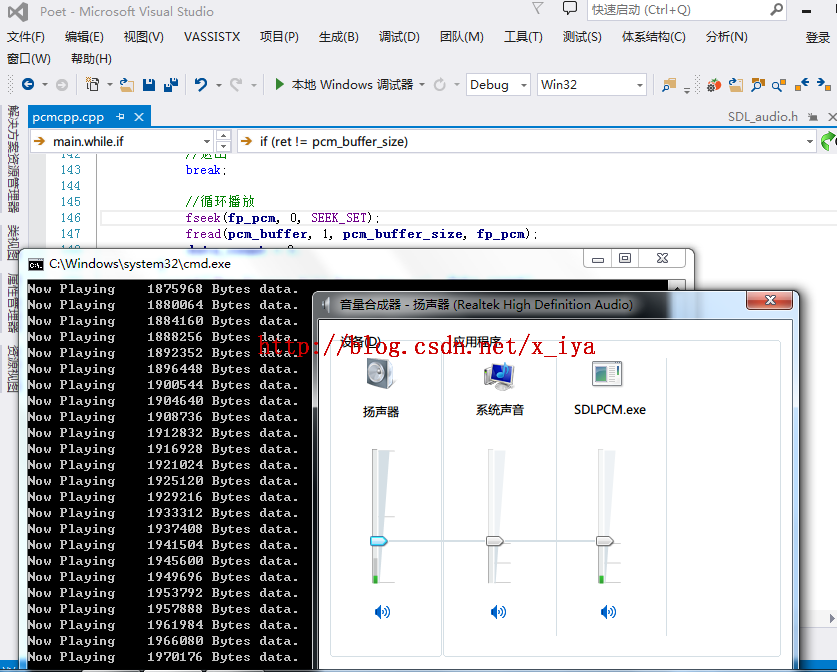
雷神代码中if (fread(pcm_buffer, 1, pcm_buffer_size, fp) != pcm_buffer_size){}
如果获取不到4096个字节的音频数据,就从头接着播放了,当然这意味着读到末尾了,但是剩下的音频数据没有做处理?
疑问:
wanted_spec.silence = 0; //设置静音的值
wanted_spec.samples = 1024; //音频缓冲区中的采样个数(要求必须是2的n次方)
int pcm_buffer_size = 4096;//每次读取4096字节的数据,同时也是音频帧大小