
本文基于 OpenJDK 11, HotSpot 虚拟机
在开发过程中我们可能会经常接触到hashcode这个方法来生成哈希码,那么底层是如何实现的?使用时有何注意点呢?
hashcode() 方法底层实现
hashcode()是Object的方法:
1@HotSpotIntrinsicCandidate
2public native int hashCode();
它是一个native的方法,并且被@HotSpotIntrinsicCandidate注解修饰,证明它是一个在HotSpot中有一套高效的实现,该高效实现基于CPU指令。
具体的实现参考源码synchronizer.cpp:
1static inline intptr_t get_next_hash(Thread* self, oop obj) {
2  intptr_t value = 0;
3  if (hashCode == 0) {
4    value = os::random();
5  } else if (hashCode == 1) {
6    intptr_t addr_bits = cast_from_oop<intptr_t>(obj) >> 3;
7    value = addr_bits ^ (addr_bits >> 5) ^ GVars.stw_random;
8  } else if (hashCode == 2) {
9    value = 1;
10  } else if (hashCode == 3) {
11    value = ++GVars.hc_sequence;
12  } else if (hashCode == 4) {
13    value = cast_from_oop<intptr_t>(obj);
14  } else {
15    unsigned t = self->_hashStateX;
16    t ^= (t << 11);
17    self->_hashStateX = self->_hashStateY;
18    self->_hashStateY = self->_hashStateZ;
19    self->_hashStateZ = self->_hashStateW;
20    unsigned v = self->_hashStateW;
21    v = (v ^ (v >> 19)) ^ (t ^ (t >> 8));
22    self->_hashStateW = v;
23    value = v;
24  }
25
26  value &= markWord::hash_mask;
27  if (value == 0) value = 0xBAD;
28  assert(value != markWord::no_hash, "invariant");
29  return value;
30}
可以看出,根据hashcode这个全局变量的取值,决定用何种策略生成哈希值,查看globals.hpp来看是哪一种变量:
experimental(intx, hashCode, 5, "(Unstable) select hashCode generation algorithm")
发现是一个experimental的 JVM 变量,这样的话,想要修改,必须添加额外的参数,如下所示:
-XX:+UnlockExperimentalVMOptions -XX:hashCode=2
并且,这个hashCode默认为5。
哈希值是每次hashcode()方法调用重计算么?
对于没有覆盖hashcode()方法的类,实例每次调用hashcode()方法,只有第一次计算哈希值,之后哈希值会存储在对象头的 标记字(MarkWord) 中。
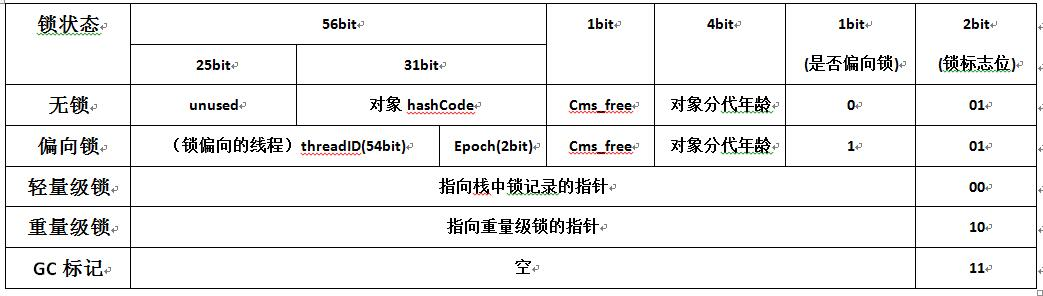 (上图来自于:https://www.cnblogs.com/helloworldcode/p/11914053.html)
如果进入各种锁状态,那么会缓存在其他地方,一般是获取锁的线程里面存储,恢复无锁(即释放锁)会改回原有的哈希值。
关于对象头结构,以及对象存储结构,感兴趣的话,可以参考:Java GC详解 - 1. 理解Java对象结构
-XX:hashCode=0 利用 Park-Miller 伪随机数生成器生成哈希值
1if (hashCode == 0) {
2    value = os::random();
3}
调用 os 的 random 方法生成随机数。这个方法的实现方式是: os.cpp:
1//初始seed,默认是1
2volatile unsigned int os::_rand_seed = 1;
3
4static int random_helper(unsigned int rand_seed) {
5  /* standard, well-known linear congruential random generator with
6   * next_rand = (16807*seed) mod (2**31-1)
7   * see
8   * (1) "Random Number Generators: Good Ones Are Hard to Find",
9   *      S.K. Park and K.W. Miller, Communications of the ACM 31:10 (Oct 1988),
10   * (2) "Two Fast Implementations of the 'Minimal Standard' Random
11   *     Number Generator", David G. Carta, Comm. ACM 33, 1 (Jan 1990), pp. 87-88.
12  */
13  const unsigned int a = 16807;
14  const unsigned int m = 2147483647;
15  const int q = m / a;        assert(q == 127773, "weird math");
16  const int r = m % a;        assert(r == 2836, "weird math");
17
18  // compute az=2^31p+q
19  unsigned int lo = a * (rand_seed & 0xFFFF);
20  unsigned int hi = a * (rand_seed >> 16);
21  lo += (hi & 0x7FFF) << 16;
22
23  // if q overflowed, ignore the overflow and increment q
24  if (lo > m) {
25    lo &= m;
26    ++lo;
27  }
28  lo += hi >> 15;
29
30  // if (p+q) overflowed, ignore the overflow and increment (p+q)
31  if (lo > m) {
32    lo &= m;
33    ++lo;
34  }
35  return lo;
36}
37
38int os::random() {
39  // Make updating the random seed thread safe.
40  while (true) {
41    unsigned int seed = _rand_seed;
42    unsigned int rand = random_helper(seed);
43    //CAS更新
44    if (Atomic::cmpxchg(&_rand_seed, seed, rand) == seed) {
45      return static_cast<int>(rand);
46    }
47  }
48}
其中,random_helper 就是随机数的生成公式的实现,公式是:  这里,a=16807, c=0, m=2^31-1
由于这些随机数都是采用的同一个生成器,会 CAS 更新同一个 seed,如果有大量的生成的新对象并且都调用hashcode()方法的话,可能会有性能问题。重复调用同一个对象的hashcode()方法不会有问题,因为之前提到了是有缓存的。
-XX:hashCode=1或者4 基于对象指针 OOPs
OOPs(Ordinary Object Pointers)对象指针是对象头的一部分。关于对象头结构,以及对象存储结构,感兴趣的话,可以参考:Java GC详解 - 1. 理解Java对象结构。可以简单理解为对象在内存中的地址的描述。
1else if (hashCode == 1) {
2    // This variation has the property of being stable (idempotent)
3    // between STW operations.  This can be useful in some of the 1-0
4    // synchronization schemes.
5    intptr_t addr_bits = cast_from_oop<intptr_t>(obj) >> 3;
6    value = addr_bits ^ (addr_bits >> 5) ^ GVars.stw_random;
7}
8else if (hashCode == 4) {
9    value = cast_from_oop<intptr_t>(obj);
10}
cast_from_oop很简单,就是获取oop的实现基类oopDesc的指向地址(oopDesc描述了OOP的基本组成,感兴趣可以参考:Java GC详解 - 1. 理解Java对象结构):
1template <class T> inline T cast_from_oop(oop o) {
2  return (T)(CHECK_UNHANDLED_OOPS_ONLY((oopDesc*))o);
3}
当-XX:hashCode=4,直接用oop的地址作为哈希值。-XX:hashCode=1则是经过变换的,每次发生 Stop The World (STW)stw_random会发生改变,通过这个addr_bits ^ (addr_bits >> 5) ^ GVars.stw_random变换减少哈希碰撞,让哈希值更散列化。
想更深入了解 Stop the world,可以参考:JVM相关 - SafePoint 与 Stop The World 全解(基于OpenJDK 11版本)
-XX:hashCode=2 敏感测试,恒定为1
1else if (hashCode == 2) {
2    value = 1;            // for sensitivity testing
3}
主要用于测试某些集合是否对于哈希值敏感。
-XX:hashCode=3 自增序列
1else if (hashCode == 3) {
2    value = ++GVars.hc_sequence;
3}
4
5struct SharedGlobals {
6  // omitted
7  DEFINE_PAD_MINUS_SIZE(1, DEFAULT_CACHE_LINE_SIZE, sizeof(volatile int) * 2);
8  // Hot RW variable -- Sequester to avoid false-sharing
9  volatile int hc_sequence;
10  DEFINE_PAD_MINUS_SIZE(2, DEFAULT_CACHE_LINE_SIZE, sizeof(volatile int));
11};
12static SharedGlobals GVars;
每创建一个新对象,调用哈希值,这个自增数+1,可以看出,散列性极差,很容易哈希碰撞。
-XX:hashCode=5 默认实现
1else {
2    // Marsaglia's xor-shift scheme with thread-specific state
3    // This is probably the best overall implementation -- we'll
4    // likely make this the default in future releases.
5    unsigned t = self->_hashStateX;
6    t ^= (t << 11);
7    self->_hashStateX = self->_hashStateY;
8    self->_hashStateY = self->_hashStateZ;
9    self->_hashStateZ = self->_hashStateW;
10    unsigned v = self->_hashStateW;
11    v = (v ^ (v >> 19)) ^ (t ^ (t >> 8));
12    self->_hashStateW = v;
13    value = v;
14}
采用的算法是 Marsaglia's xor-shift 随机数生成法。主要是这篇论文提出的一种快速并且散列性好的哈希算法。
特殊的哈希值导致某些场景的问题
我们经常使用某个对象或者某个字段的哈希值,通过对于某个数组长度取模,获取到下标,取出数组对应下标的对象,进行进一步处理。这在负载均衡,任务调度,线程分配很常见。那下面这段代码是否有问题呢?
1//获取userId这个字符串的哈希值的绝对值
2int index = Math.abs(userId.hashCode());
3//返回哈希值取模之后的下标的对象
4return userAvatarList.get(index % userAvatarList.size()).getUrl();
通常大多数情况下,是没有问题的,但是假设userId是这几个哈希值为Integer.MIN_VALUE的字符串:
1System.out.println("polygenelubricants".hashCode());
2System.out.println("GydZG_".hashCode());
3System.out.println("DESIGNING WORKHOUSES".hashCode());
输出:
1-2147483648
2-2147483648
3-2147483648
对于这些值,如果你用Math.abs()取绝对值的话,我们知道Math.abs(Integer.MIN_VALUE)还是等于Integer.MIN_VALUE,这是因为底层实现:
1public static int abs(int a) {
2    return (a < 0) ? -a : a;
3}
-Integer.MIN_VALUE和Integer.MIN_VALUE是相等的。Integer.MIN_VALUE取模还是负数,这样取下标对应的对象的时候,就会报异常。
所以,需要修改为:
1int index = Math.abs(userId.hashCode() % userAvatarList.size());
2return userAvatarList.get(index).getUrl();