
一、引言
海外商城从印度做起,慢慢的会有一些其他国家的诉求,这个时候需要我们针对当前的商城做一个改造,可以支撑多个国家的商城,这里会涉及多个问题,多语言,多国家,多时区,本地化等等。在多国家的情况下如何把识别出来的国家信息传递下去,一层一层直到代码执行的最后一步。甚至还有一些多线程的场景需要处理。
二、背景技术
2.1 ThreadLocal
ThreadLocal是最容易想到了,入口识别到国家信息后,丢进ThreadLocal,这样后续代码、redis、DB等做国家区分的时候都能使用到。
这里先简单介绍一下ThreadLocal:
1/**
2 * Sets the current thread's copy of this thread-local variable
3 * to the specified value.  Most subclasses will have no need to
4 * override this method, relying solely on the {@link #initialValue}
5 * method to set the values of thread-locals.
6 *
7 * @param value the value to be stored in the current thread's copy of
8 *        this thread-local.
9 */
10public void set(T value) {
11    Thread t = Thread.currentThread();
12    ThreadLocalMap map = getMap(t);
13    if (map != null)
14        map.set(this, value);
15    else
16        createMap(t, value);
17}
18
19
20/**
21 * Returns the value in the current thread's copy of this
22 * thread-local variable.  If the variable has no value for the
23 * current thread, it is first initialized to the value returned
24 * by an invocation of the {@link #initialValue} method.
25 *
26 * @return the current thread's value of this thread-local
27 */
28public T get() {
29    Thread t = Thread.currentThread();
30    ThreadLocalMap map = getMap(t);
31    if (map != null) {
32        ThreadLocalMap.Entry e = map.getEntry(this);
33        if (e != null) {
34            @SuppressWarnings("unchecked")
35            T result = (T)e.value;
36            return result;
37        }
38    }
39    return setInitialValue();
40}
41
42
43/**
44 * Get the map associated with a ThreadLocal. Overridden in
45 * InheritableThreadLocal.
46 *
47 * @param  t the current thread
48 * @return the map
49 */
50ThreadLocalMap getMap(Thread t) {
51    return t.threadLocals;
52}
53
54
55/**
56 * Get the entry associated with key.  This method
57 * itself handles only the fast path: a direct hit of existing
58 * key. It otherwise relays to getEntryAfterMiss.  This is
59 * designed to maximize performance for direct hits, in part
60 * by making this method readily inlinable.
61 *
62 * @param  key the thread local object
63 * @return the entry associated with key, or null if no such
64 */
65private Entry getEntry(ThreadLocal<?> key) {
66    int i = key.threadLocalHashCode & (table.length - 1);
67    Entry e = table[i];
68    if (e != null && e.get() == key)
69        return e;
70    else
71        return getEntryAfterMiss(key, i, e);
72}
-
每一个Thread线程都有属于自己的threadLocals(ThreadLocalMap),里面有一个弱引用的Entry(ThreadLocal,Object)。
-
get方法首先通过Thread.currentThread得到当前线程,然后拿到线程的threadLocals(ThreadLocalMap),再从Entry中取得当前线程存储的value。
-
set值的时候更改当前线程的threadLocals(ThreadLocalMap)中Entry对应的value值。
实际使用中除了同步方法之外,还有起异步线程处理的场景,这个时候就需要把ThreadLocal的内容从父线程传递给子线程,这个怎么办呢?
不急,Java 还有InheritableThreadLocal来帮我们解决这个问题。
2.2 InheritableThreadLoca
1public class InheritableThreadLocal<T> extends ThreadLocal<T> {
2    /**
3     * Computes the child's initial value for this inheritable thread-local
4     * variable as a function of the parent's value at the time the child
5     * thread is created.  This method is called from within the parent
6     * thread before the child is started.
7     * <p>
8     * This method merely returns its input argument, and should be overridden
9     * if a different behavior is desired.
10     *
11     * @param parentValue the parent thread's value
12     * @return the child thread's initial value
13     */
14    protected T childValue(T parentValue) {
15        return parentValue;
16    }
17
18    /**
19     * Get the map associated with a ThreadLocal.
20     *
21     * @param t the current thread
22     */
23    ThreadLocalMap getMap(Thread t) {
24       return t.inheritableThreadLocals;
25    }
26
27    /**
28     * Create the map associated with a ThreadLocal.
29     *
30     * @param t the current thread
31     * @param firstValue value for the initial entry of the table.
32     */
33    void createMap(Thread t, T firstValue) {
34        t.inheritableThreadLocals = new ThreadLocalMap(this, firstValue);
35    }
36}
-
java.lang.Thread#init(java.lang.ThreadGroup, java.lang.Runnable, java.lang.String, long, java.security.AccessControlContext, boolean)
if (inheritThreadLocals && parent.inheritableThreadLocals != null) this.inheritableThreadLocals = ThreadLocal.createInheritedMap(parent.inheritableThreadLocals);
-
InheritableThreadLocal操作的是inheritableThreadLocals这个变量,而不是ThreadLocal操作的threadLocals变量。
-
创建新线程的时候会检查父线程中parent.inheritableThreadLocals变量是否为null,如果不为null则复制一份parent.inheritableThreadLocals的数据到子线程的this.inheritableThreadLocals中去。
-
因为复写了getMap(Thread)和CreateMap()方法直接操作inheritableThreadLocals,这样就实现了在子线程中获取父线程ThreadLocal值。
现在在使用多线程的时候,都是通过线程池来做的,这个时候用InheritableThreadLocal可以吗?会有什么问题吗?先看下下面的代码的执行情况:
-
test
static InheritableThreadLocal<String> inheritableThreadLocal = new InheritableThreadLocal<>();
public static void main(String[] args) throws InterruptedException {
1ExecutorService executorService = Executors.newFixedThreadPool(1);
2
3inheritableThreadLocal.set("i am a inherit parent");
4executorService.execute(new Runnable() {
5    @Override
6    public void run() {
7
8        System.out.println(inheritableThreadLocal.get());
9    }
10});
11
12TimeUnit.SECONDS.sleep(1);
13inheritableThreadLocal.set("i am a new inherit parent");// 设置新的值
14
15executorService.execute(new Runnable() {
16    @Override
17    public void run() {
18
19        System.out.println(inheritableThreadLocal.get());
20    }
21});
}
i am a inherit parent i am a inherit parent
public static void main(String[] args) throws InterruptedException {
1ExecutorService executorService = Executors.newFixedThreadPool(1);
2
3inheritableThreadLocal.set("i am a inherit parent");
4executorService.execute(new Runnable() {
5    @Override
6    public void run() {
7
8        System.out.println(inheritableThreadLocal.get());
9        inheritableThreadLocal.set("i am a old inherit parent");// 子线程中设置新的值
10
11
12    }
13});
14
15TimeUnit.SECONDS.sleep(1);
16inheritableThreadLocal.set("i am a new inherit parent");// 主线程设置新的值
17
18executorService.execute(new Runnable() {
19    @Override
20    public void run() {
21
22        System.out.println(inheritableThreadLocal.get());
23    }
24});
}
i am a inherit parent i am a old inherit parent
这里看第一个执行结果,发现主线程第二次设置的值,没有改掉,还是第一次设置的值“i am a inherit parent”,这是什么原因呢?
再看第二个例子的执行结果,发现在第一个任务中设置的“i am a old inherit parent"的值,在第二个任务中打印出来了。这又是什么原因呢?
回过头来看看上面的源码,在线程池的情况下,第一次创建线程的时候会从父线程中copy inheritableThreadLocals中的数据,所以第一个任务成功拿到了父线程设置的”i am a inherit parent“,第二个任务执行的时候复用了第一个任务的线程,并不会触发复制父线程中的inheritableThreadLocals操作,所以即使在主线程中设置了新的值,也会不生效。同时get()方法是直接操作inheritableThreadLocals这个变量的,所以就直接拿到了第一个任务设置的值。
那遇到线程池应该怎么办呢?
2.3 TransmittableThreadLocal
TransmittableThreadLocal(TTL)这个时候就派上用场了。这是阿里开源的一个组件,我们来看看它怎么解决线程池的问题,先来一段代码,在上面的基础上修改一下,使用TransmittableThreadLocal。
1static TransmittableThreadLocal<String> transmittableThreadLocal = new TransmittableThreadLocal<>();// 使用TransmittableThreadLocal
2
3
4public static void main(String[] args) throws InterruptedException {
5
6    ExecutorService executorService = Executors.newFixedThreadPool(1);
7    executorService = TtlExecutors.getTtlExecutorService(executorService); // 用TtlExecutors装饰线程池
8
9    transmittableThreadLocal.set("i am a transmittable parent");
10    executorService.execute(new Runnable() {
11        @Override
12        public void run() {
13
14            System.out.println(transmittableThreadLocal.get());
15            transmittableThreadLocal.set("i am a old transmittable parent");// 子线程设置新的值
16
17        }
18    });
19    System.out.println(transmittableThreadLocal.get());
20
21    TimeUnit.SECONDS.sleep(1);
22    transmittableThreadLocal.set("i am a new transmittable parent");// 主线程设置新的值
23
24    executorService.execute(new Runnable() {
25        @Override
26        public void run() {
27
28            System.out.println(transmittableThreadLocal.get());
29        }
30    });
31}
32
33
34i am a transmittable parent
35i am a transmittable parent
36i am a new transmittable parent
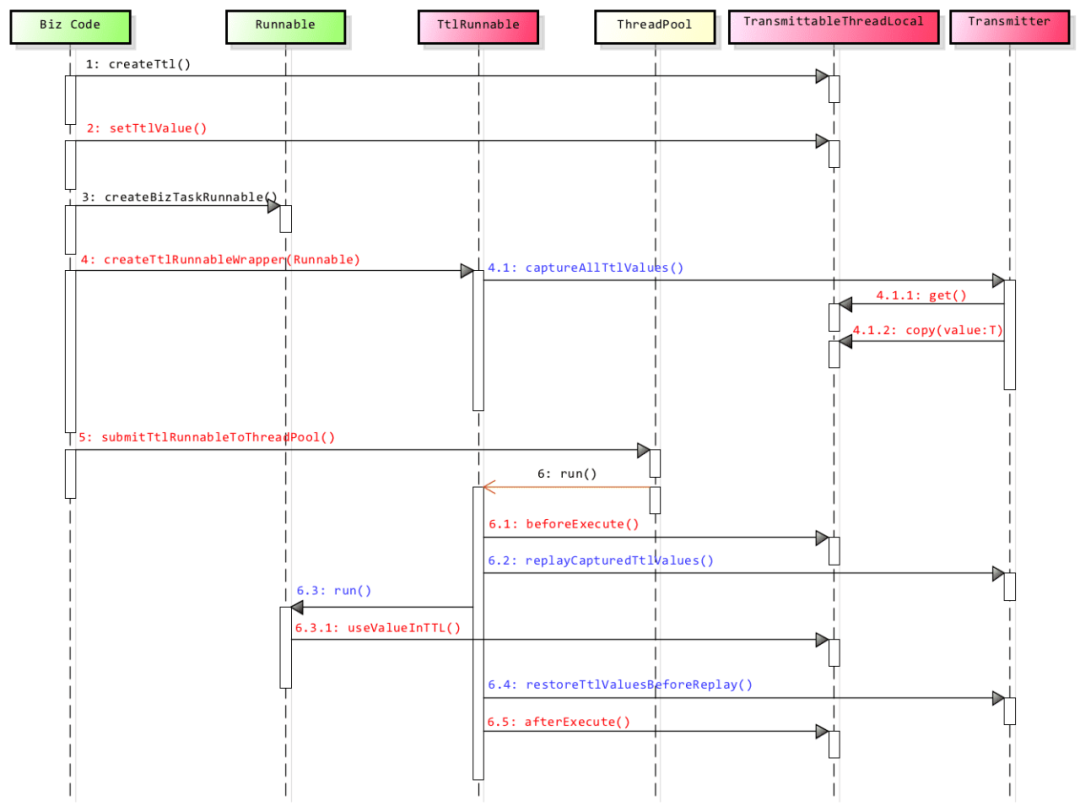
执行代码后发现,使用TransmittableThreadLocalTtlExecutors.getTtlExecutorService(executorService)装饰线程池之后,在每次调用任务的时,都会将当前的主线程的TransmittableThreadLocal数据copy到子线程里面,执行完成后,再清除掉。同时子线程里面的修改回到主线程时其实并没有生效。这样可以保证每次任务执行的时候都是互不干涉的。这是怎么做到的呢?来看源码。
-
TtlExecutors和TransmittableThreadLocal源码
private TtlRunnable(Runnable runnable, boolean releaseTtlValueReferenceAfterRun) { this.capturedRef = new AtomicReference<Object>(capture()); this.runnable = runnable; this.releaseTtlValueReferenceAfterRun = releaseTtlValueReferenceAfterRun; }
com.alibaba.ttl.TtlRunnable#run /**
-
wrap method {@link Runnable#run()}. */ @Override public void run() { Object captured = capturedRef.get();// 获取线程的ThreadLocalMap if (captured == null || releaseTtlValueReferenceAfterRun && !capturedRef.compareAndSet(captured, null)) { throw new IllegalStateException("TTL value reference is released after run!"); }
Object backup = replay(captured);// 暂存当前子线程的ThreadLocalMap到backup try { runnable.run(); } finally { restore(backup);// 恢复线程执行时被改版的Threadlocal对应的值 } }
com.alibaba.ttl.TransmittableThreadLocal.Transmitter#replay
/**
-
Replay the captured {@link TransmittableThreadLocal} values from {@link #capture()},
-
and return the backup {@link TransmittableThreadLocal} values in current thread before replay.
-
@param captured captured {@link TransmittableThreadLocal} values from other thread from {@link #capture()}
-
@return the backup {@link TransmittableThreadLocal} values before replay
-
@see #capture()
-
@since 2.3.0 */ public static Object replay(Object captured) { @SuppressWarnings("unchecked") Map<TransmittableThreadLocal<?>, Object> capturedMap = (Map<TransmittableThreadLocal<?>, Object>) captured; Map<TransmittableThreadLocal<?>, Object> backup = new HashMap<TransmittableThreadLocal<?>, Object>();
for (Iterator<? extends Map.Entry<TransmittableThreadLocal<?>, ?>> iterator = holder.get().entrySet().iterator(); iterator.hasNext(); ) { Map.Entry<TransmittableThreadLocal<?>, ?> next = iterator.next(); TransmittableThreadLocal<?> threadLocal = next.getKey();
1 // backup
2 backup.put(threadLocal, threadLocal.get());
3
4 // clear the TTL value only in captured
5 // avoid extra TTL value in captured, when run task.
6 if (!capturedMap.containsKey(threadLocal)) {
7     iterator.remove();
8     threadLocal.superRemove();
9 }
}
// set value to captured TTL for (Map.Entry<TransmittableThreadLocal<?>, Object> entry : capturedMap.entrySet()) { @SuppressWarnings("unchecked") TransmittableThreadLocal<Object> threadLocal = (TransmittableThreadLocal<Object>) entry.getKey(); threadLocal.set(entry.getValue()); }
// call beforeExecute callback doExecuteCallback(true);
return backup; }
com.alibaba.ttl.TransmittableThreadLocal.Transmitter#restore
/**
-
Restore the backup {@link TransmittableThreadLocal} values from {@link Transmitter#replay(Object)}.
-
@param backup the backup {@link TransmittableThreadLocal} values from {@link Transmitter#replay(Object)}
-
@since 2.3.0 */ public static void restore(Object backup) { @SuppressWarnings("unchecked") Map<TransmittableThreadLocal<?>, Object> backupMap = (Map<TransmittableThreadLocal<?>, Object>) backup; // call afterExecute callback doExecuteCallback(false);
for (Iterator<? extends Map.Entry<TransmittableThreadLocal<?>, ?>> iterator = holder.get().entrySet().iterator(); iterator.hasNext(); ) { Map.Entry<TransmittableThreadLocal<?>, ?> next = iterator.next(); TransmittableThreadLocal<?> threadLocal = next.getKey();
1 // clear the TTL value only in backup
2 // avoid the extra value of backup after restore
3 if (!backupMap.containsKey(threadLocal)) {
4     iterator.remove();
5     threadLocal.superRemove();
6 }
}
// restore TTL value for (Map.Entry<TransmittableThreadLocal<?>, Object> entry : backupMap.entrySet()) { @SuppressWarnings("unchecked") TransmittableThreadLocal<Object> threadLocal = (TransmittableThreadLocal<Object>) entry.getKey(); threadLocal.set(entry.getValue()); } }
-
可以看下整个过程的完整时序图:
OK,既然问题都解决了,来看看实际使用吧,有两种使用,先看第一种,涉及HTTP请求、Dubbo请求和 job,采用的是数据级别的隔离。
三、 TTL 在海外商城的实际应用
3.1 不分库,分数据行 + SpringMVC
用户 HTTP 请求,首先我们要从url或者cookie中解析出国家编号,然后在TransmittableThreadLocal中存放国家信息,在 MyBatis 的拦截器中读取国家数据,进行sql改造,最终操作指定的国家数据,多线程场景下用TtlExecutors包装原有自定义线程池,保障在使用线程池的时候能够正确将国家信息传递下去。
- HTTP 请求
public class ShopShardingHelperUtil {
1    private static TransmittableThreadLocal<String> countrySet = new TransmittableThreadLocal<>();
2
3    /**
4     * 获取threadLocal中设置的国家标志
5     * @return
6     */
7    public static String getCountry() {
8        return countrySet.get();
9    }
10
11    /**
12     * 设置threadLocal中设置的国家
13     */
14    public static void setCountry (String country) {
15        countrySet.set(country.toLowerCase());
16    }
17
18
19    /**
20     * 清除标志
21     */
22    public static void clear () {
23        countrySet.remove();
24    }
25}
26
27
28
29/** 拦截器对cookie和url综合判断国家信息,放入到TransmittableThreadLocal中 **/
30// 设置线程中的国家标志
31String country = localeContext.getLocale().getCountry().toLowerCase();
32
33ShopShardingHelperUtil.setCountry(country);
34
35
36/** 自定义线程池,用TtlExecutors包装原有自定义线程池 **/
37public static Executor getExecutor() {
38
39    if (executor == null) {
40        synchronized (TransmittableExecutor.class) {
41            if (executor == null) {
42                executor = TtlExecutors.getTtlExecutor(initExecutor());// 用TtlExecutors装饰Executor,结合TransmittableThreadLocal解决异步线程threadlocal传递问题
43            }
44        }
45    }
46
47    return executor;
48}
49
50
51/** 实际使用线程池的地方,直接调用执行即可**/
52TransmittableExecutor.getExecutor().execute(new BatchExeRunnable(param1,param2));
53
54
55
56/** mybatis的Interceptor代码, 使用TransmittableThreadLocal的国家信息,改造原有sql,加上国家参数,在增删改查sql中区分国家数据 **/
57public Object intercept(Invocation invocation) throws Throwable {
58
59    StatementHandler statementHandler = (StatementHandler) invocation.getTarget();
60    BoundSql boundSql = statementHandler.getBoundSql();
61
62    String originalSql = boundSql.getSql();
63
64    Statement statement = (Statement) CCJSqlParserUtil.parse(originalSql);
65
66    String threadCountry = ShopShardingHelperUtil.getCountry();
67
68    // 线程中的国家不为空才进行处理
69    if (StringUtils.isNotBlank(threadCountry)) {
70
71        if (statement instanceof Select) {
72
73            Select selectStatement = (Select) statement;
74            VivoSelectVisitor vivoSelectVisitor = new VivoSelectVisitor(threadCountry);
75            vivoSelectVisitor.init(selectStatement);
76        } else if (statement instanceof Insert) {
77
78            Insert insertStatement = (Insert) statement;
79            VivoInsertVisitor vivoInsertVisitor = new VivoInsertVisitor(threadCountry);
80            vivoInsertVisitor.init(insertStatement);
81
82        } else if (statement instanceof Update) {
83
84            Update updateStatement = (Update) statement;
85            VivoUpdateVisitor vivoUpdateVisitor = new VivoUpdateVisitor(threadCountry);
86            vivoUpdateVisitor.init(updateStatement);
87
88        } else if (statement instanceof Delete) {
89
90            Delete deleteStatement = (Delete) statement;
91            VivoDeleteVisitor vivoDeleteVisitor = new VivoDeleteVisitor(threadCountry);
92            vivoDeleteVisitor.init(deleteStatement);
93        }
94
95
96        Field boundSqlField = BoundSql.class.getDeclaredField("sql");
97        boundSqlField.setAccessible(true);
98        boundSqlField.set(boundSql, statement.toString());
99    } else {
100
101        logger.error("----------- intercept not-add-country sql.... ---------" + statement.toString());
102    }
103
104    logger.info("----------- intercept query new sql.... ---------" + statement.toString());
105    // 调用方法,实际上就是拦截的方法
106    Object result = invocation.proceed();
107
108    return result;
109}
对于 Dubbo 接口和无法判断国家信息的 HTTP 接口,在入参部分增加国家信息参数,通过拦截器或者手动set国家信息到TransmittableThreadLocal。
对于定时任务 job,因为所有国家都需要执行,所以会把所有国家进行遍历执行,这也可以通过简单的注解来解决。
这个版本的改造,点检测试也基本通过了,自动化脚本验证也是没问题的,不过因为业务发展问题最终没上线。
3.2 分库 + SpringBoot
后续在建设新的国家商城的时候,分库分表方案调整为每个国家独立数据库,同时整体开发框架升级到SpringBoot,我们把这套方案做了升级,总体思路是一样的,只是在实现细节上略有不同。
SpringBoot 里面的异步一般通过**@Async这个注解来实现,通过自定义线程池来包装,使用时在 HTTP 请求判断locale信息的写入国家信息,后续完成切DB的操作。**
对于 Dubbo 接口和无法判断国家信息的 HTTP 接口,在入参部分增加国家信息参数,通过拦截器或者手动set国家信息到TransmittableThreadLocal。
1@Bean
2public ThreadPoolTaskExecutor threadPoolTaskExecutor(){
3    return TtlThreadPoolExecutors.getAsyncExecutor();
4}
5
6
7public class TtlThreadPoolExecutors {
8
9    private static final String COMMON_BUSINESS = "COMMON_EXECUTOR";
10
11    public static final int QUEUE_CAPACITY = 20000;
12
13    public static ExecutorService getExecutorService() {
14        return TtlExecutorServiceMananger.getExecutorService(COMMON_BUSINESS);
15    }
16
17    public static ExecutorService getExecutorService(String threadGroupName) {
18        return TtlExecutorServiceMananger.getExecutorService(threadGroupName);
19    }
20
21    public static ThreadPoolTaskExecutor getAsyncExecutor() {
22        // 用TtlExecutors装饰Executor,结合TransmittableThreadLocal解决异步线程threadlocal传递问题
23        return getTtlThreadPoolTaskExecutor(initTaskExecutor());
24    }
25
26    private static ThreadPoolTaskExecutor initTaskExecutor () {
27        return initTaskExecutor(TtlThreadPoolFactory.DEFAULT_CORE_SIZE, TtlThreadPoolFactory.DEFAULT_POOL_SIZE, QUEUE_CAPACITY);
28    }
29
30    private static ThreadPoolTaskExecutor initTaskExecutor (int coreSize, int poolSize, int executorQueueCapacity) {
31        ThreadPoolTaskExecutor taskExecutor = new ThreadPoolTaskExecutor();
32        taskExecutor.setCorePoolSize(coreSize);
33        taskExecutor.setMaxPoolSize(poolSize);
34        taskExecutor.setQueueCapacity(executorQueueCapacity);
35        taskExecutor.setKeepAliveSeconds(120);
36        taskExecutor.setAllowCoreThreadTimeOut(true);
37        taskExecutor.setThreadNamePrefix("TaskExecutor-ttl");
38        taskExecutor.initialize();
39        return taskExecutor;
40    }
41
42    private static ThreadPoolTaskExecutor getTtlThreadPoolTaskExecutor(ThreadPoolTaskExecutor executor) {
43        if (null == executor || executor instanceof ThreadPoolTaskExecutorWrapper) {
44            return executor;
45        }
46        return new ThreadPoolTaskExecutorWrapper(executor);
47    }
48}
49
50
51
52
53/**
54 * @ClassName : LocaleContextHolder
55 * @Description : 本地化信息上下文holder
56 */
57public class LocalizationContextHolder {
58    private static TransmittableThreadLocal<LocalizationContext> localizationContextHolder = new TransmittableThreadLocal<>();
59    private static LocalizationInfo defaultLocalizationInfo = new LocalizationInfo();
60
61    private LocalizationContextHolder(){}
62
63    public static LocalizationContext getLocalizationContext() {
64        return localizationContextHolder.get();
65    }
66
67    public static void resetLocalizationContext () {
68        localizationContextHolder.remove();
69    }
70
71    public static void setLocalizationContext (LocalizationContext localizationContext) {
72        if(localizationContext == null) {
73            resetLocalizationContext();
74        } else {
75            localizationContextHolder.set(localizationContext);
76        }
77    }
78
79    public static void setLocalizationInfo (LocalizationInfo localizationInfo) {
80        LocalizationContext localizationContext = getLocalizationContext();
81        String brand = (localizationContext instanceof BrandLocalizationContext ?
82                ((BrandLocalizationContext) localizationContext).getBrand() : null);
83        if(StringUtils.isNotEmpty(brand)) {
84            localizationContext = new SimpleBrandLocalizationContext(localizationInfo, brand);
85        } else if(localizationInfo != null) {
86            localizationContext = new SimpleLocalizationContext(localizationInfo);
87        } else {
88            localizationContext = null;
89        }
90        setLocalizationContext(localizationContext);
91    }
92
93    public static void setDefaultLocalizationInfo(@Nullable LocalizationInfo localizationInfo) {
94        LocalizationContextHolder.defaultLocalizationInfo = localizationInfo;
95    }
96
97    public static LocalizationInfo getLocalizationInfo () {
98        LocalizationContext localizationContext = getLocalizationContext();
99        if(localizationContext != null) {
100            LocalizationInfo localizationInfo = localizationContext.getLocalizationInfo();
101            if(localizationInfo != null) {
102                return localizationInfo;
103            }
104        }
105        return defaultLocalizationInfo;
106    }
107
108    public static String getCountry(){
109        return getLocalizationInfo().getCountry();
110    }
111
112    public static String getTimezone(){
113        return getLocalizationInfo().getTimezone();
114    }
115
116    public static String getBrand(){
117        return getBrand(getLocalizationContext());
118    }
119
120    public static String getBrand(LocalizationContext localizationContext) {
121        if(localizationContext == null) {
122            return null;
123        }
124        if(localizationContext instanceof BrandLocalizationContext) {
125            return ((BrandLocalizationContext) localizationContext).getBrand();
126        }
127        throw new LocaleException("unsupported localizationContext type");
128    }
129}
130    @Override
131    public LocaleContext resolveLocaleContext(final HttpServletRequest request) {
132        parseLocaleCookieIfNecessary(request);
133        LocaleContext localeContext = new TimeZoneAwareLocaleContext() {
134            @Override
135            public Locale getLocale() {
136                return (Locale) request.getAttribute(LOCALE_REQUEST_ATTRIBUTE_NAME);
137            }
138            @Override
139            public TimeZone getTimeZone() {
140                return (TimeZone) request.getAttribute(TIME_ZONE_REQUEST_ATTRIBUTE_NAME);
141            }
142        };
143        // 设置线程中的国家标志
144        setLocalizationInfo(request, localeContext.getLocale());
145        return localeContext;
146    }
147
148    private void setLocalizationInfo(HttpServletRequest request, Locale locale) {
149        String country = locale!=null?locale.getCountry():null;
150        String language = locale!=null?(locale.getLanguage() + "_" + locale.getVariant()):null;
151        LocaleRequestMessage localeRequestMessage = localeRequestParser.parse(request);
152        final String countryStr = country;
153        final String languageStr = language;
154        final String brandStr = localeRequestMessage.getBrand();
155        LocalizationContextHolder.setLocalizationContext(new BrandLocalizationContext() {
156            @Override
157            public String getBrand() {
158                return brandStr;
159            }
160
161            @Override
162            public LocalizationInfo getLocalizationInfo() {
163                return LocalizationInfoAssembler.assemble(countryStr, languageStr);
164            }
165        });
166    }
对于定时任务job,因为所有国家都需要执行,所以会把所有国家进行遍历执行,这也可以通过简单的注解和AOP来解决。
四、总结
本文从业务拓展的角度阐述了在复杂业务场景下如何通过ThreadLocal,过渡到InheritableThreadLocal,再通过TransmittableThreadLocal解决实际业务问题。因为海外的业务在不断的探索中前进,技术也在不断的探索中演进,面对这种复杂多变的情况,我们的应对策略是先做国际化,再做本地化,more global才能more local,多国家的隔离只是国际化最基本的起点,未来还有很多业务和技术等着我们去挑战。
作者:vivo 官网商城开发团队