
面试的时候经常会遇见诸如:“java中的HashMap是怎么工作的”,“HashMap的get和put内部的工作原理”这样的问题。本文将用一个简单的例子来解释下HashMap内部的工作原理。首先我们从一个例子开始,而不仅仅是从理论上,这样,有助于更好地理解,然后,我们来看下get和put到底是怎样工作的。
我们来看个非常简单的例子。有一个”国家”(Country)类,我们将要用Country对象作为key,它的首都的名字(String类型)作为value。下面的例子有助于我们理解key-value对在HashMap中是如何存储的。
1. Country.java
1package org.arpit.javapostsforlearning;
2public class Country {
3
4 String name;
5 long population;
6
7 public Country(String name, long population) {
8  super();
9  this.name = name;
10  this.population = population;
11 }
12 public String getName() {
13  return name;
14 }
15 public void setName(String name) {
16  this.name = name;
17 }
18 public long getPopulation() {
19  return population;
20 }
21 public void setPopulation(long population) {
22  this.population = population;
23 }
24
25 // If length of name in country object is even then return 31(any random number) and if odd then return 95(any random number).
26 // This is not a good practice to generate hashcode as below method but I am doing so to give better and easy understanding of hashmap.
27 @Override
28 public int hashCode() {
29  if(this.name.length()%2==0)
30   return 31;
31  else
32   return 95;
33 }
34 @Override
35 public boolean equals(Object obj) {
36
37  Country other = (Country) obj;
38   if (name.equalsIgnoreCase((other.name)))
39   return true;
40  return false;
41 }
42
43}
2. HashMapStructure.java(main class)
1import java.util.HashMap;
2import java.util.Iterator;
3
4public class HashMapStructure {
5
6    /**
7     * @author Arpit Mandliya
8     */
9    public static void main(String[] args) {
10
11        Country india=new Country("India",1000);
12        Country japan=new Country("Japan",10000);
13
14        Country france=new Country("France",2000);
15        Country russia=new Country("Russia",20000);
16
17        HashMap<country,string> countryCapitalMap=new HashMap<country,string>();
18        countryCapitalMap.put(india,"Delhi");
19        countryCapitalMap.put(japan,"Tokyo");
20        countryCapitalMap.put(france,"Paris");
21        countryCapitalMap.put(russia,"Moscow");
22
23        Iterator<country> countryCapitalIter=countryCapitalMap.keySet().iterator();//put debug point at this line
24        while(countryCapitalIter.hasNext())
25        {
26            Country countryObj=countryCapitalIter.next();
27            String capital=countryCapitalMap.get(countryObj);
28            System.out.println(countryObj.getName()+"----"+capital);
29            }
30        }
31
32
33}
现在,在第23行设置一个断点,在项目上右击->调试运行(debug as)->java应用(java application)。程序会停在23行,然后在countryCapitalMap上右击,选择“查看”(watch)。将会看到如下的结构:
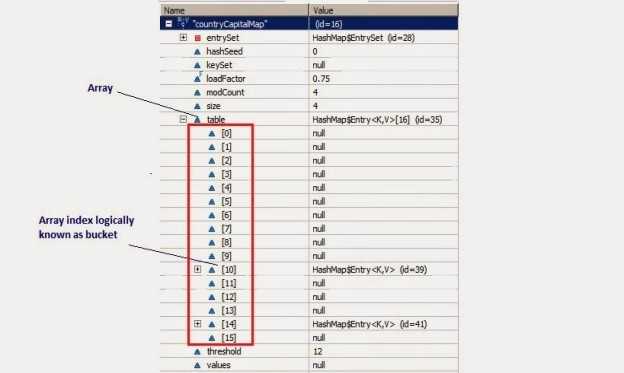
从上图可以观察到以下几点:
1. 有一个叫做table大小是16的Entry数组。
2. 这个table数组存储了Entry类的对象。HashMap类有一个叫做Entry的内部类。这个Entry类包含了key-value作为实例变量。我们来看下Entry类的结构。Entry类的结构:
1static class Entry implements Map.Entry
2{
3        final K key;
4        V value;
5        Entry next;
6        final int hash;
7        ...//More code goes here
8}   `
3. 每当往hashmap里面存放key-value对的时候,都会为它们实例化一个Entry对象,这个Entry对象就会存储在前面提到的Entry数组table中。现在你一定很想知道,上面创建的Entry对象将会存放在具体哪个位置(在table中的精确位置)。答案就是,根据key的hashcode()方法计算出来的hash值(来决定)。hash值用来计算key在Entry数组的索引。
4. 现在,如果你看下上图中数组的索引10,它有一个叫做HashMap$Entry的Entry对象。
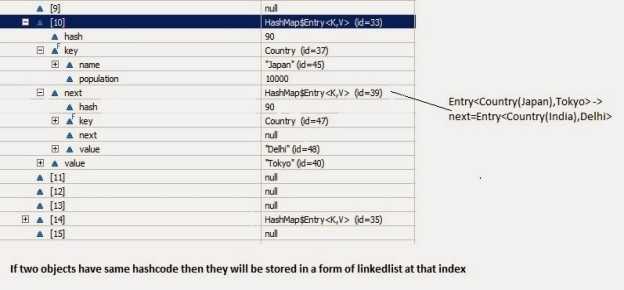
5. 我们往hashmap放了4个key-value对,但是看上去好像只有2个元素!!!这是因为,如果两个元素有相同的hashcode,它们会被放在同一个索引上。问题出现了,该怎么放呢?原来它是以链表(LinkedList)的形式来存储的(逻辑上)。
上面的country对象的key-value的hash值是如何计算出来的。
<code>Japan的Hash值是95,它的长度是奇数。
India的Hash值是95,它的长度是奇数。
Russia的Hash值是31,它的长度是偶数。
France,它的长度是偶数。
</code>
下图会清晰的从概念上解释下链表。
所以,现在假如你已经很好地了解了hashmap的结构,让我们看下put和get方法。
Put :
让我们看下put方法的实现:
1/**
2  * Associates the specified value with the specified key in this map. If the
3  * map previously contained a mapping for the key, the old value is
4  * replaced.
5  *
6  * @param key
7  *            key with which the specified value is to be associated
8  * @param value
9  *            value to be associated with the specified key
10  * @return the previous value associated with <tt>key</tt>, or <tt>null</tt>
11  *         if there was no mapping for <tt>key</tt>. (A <tt>null</tt> return
12  *         can also indicate that the map previously associated
13  *         <tt>null</tt> with <tt>key</tt>.)
14  */
15 public V put(K key, V value) {
16  if (key == null)
17   return putForNullKey(value);
18  int hash = hash(key.hashCode());
19  int i = indexFor(hash, table.length);
20  for (Entry<k , V> e = table[i]; e != null; e = e.next) {
21   Object k;
22   if (e.hash == hash && ((k = e.key) == key || key.equals(k))) {
23    V oldValue = e.value;
24    e.value = value;
25    e.recordAccess(this);
26    return oldValue;
27   }
28  }
29
30  modCount++;
31  addEntry(hash, key, value, i);
32  return null;
33 }
现在我们一步一步来看下上面的代码。
- 对key做null检查。如果key是null,会被存储到table[0],因为null的hash值总是0。
- key的hashcode()方法会被调用,然后计算hash值。hash值用来找到存储Entry对象的数组的索引。有时候hash函数可能写的很不好,所以JDK的设计者添加了另一个叫做hash()的方法,它接收刚才计算的hash值作为参数。
- indexFor(hash,table.length)用来计算在table数组中存储Entry对象的精确的索引。
- 在我们的例子中已经看到,如果两个key有相同的hash值(也叫冲突),他们会以链表的形式来存储。所以,这里我们就迭代链表。
- 如果在刚才计算出来的索引位置没有元素,直接把Entry对象放在那个索引上。
- 如果索引上有元素,然后会进行迭代,一直到Entry->next是null。当前的Entry对象变成链表的下一个节点。
- 如果我们再次放入同样的key会怎样呢?逻辑上,它应该替换老的value。事实上,它确实是这么做的。在迭代的过程中,会调用equals()方法来检查key的相等性(key.equals(k)),如果这个方法返回true,它就会用当前Entry的value来替换之前的value。
Get:
现在我们来看下get方法的实现:
1/**
2  * Returns the value to which the specified key is mapped, or {@code null}
3  * if this map contains no mapping for the key.
4  *
5  * <p>
6  * More formally, if this map contains a mapping from a key {@code k} to a
7  * value {@code v} such that {@code (key==null ? k==null :
8  * key.equals(k))}, then this method returns {@code v}; otherwise it returns
9  * {@code null}. (There can be at most one such mapping.)
10  *
11  * </p><p>
12  * A return value of {@code null} does not <i>necessarily</i> indicate that
13  * the map contains no mapping for the key; it's also possible that the map
14  * explicitly maps the key to {@code null}. The {@link #containsKey
15  * containsKey} operation may be used to distinguish these two cases.
16  *
17  * @see #put(Object, Object)
18  */
19 public V get(Object key) {
20  if (key == null)
21   return getForNullKey();
22  int hash = hash(key.hashCode());
23  for (Entry<k , V> e = table[indexFor(hash, table.length)]; e != null; e = e.next) {
24   Object k;
25   if (e.hash == hash && ((k = e.key) == key || key.equals(k)))
26    return e.value;
27  }
28  return null;
29 }
当你理解了hashmap的put的工作原理,理解get的工作原理就非常简单了。当你传递一个key从hashmap总获取value的时候:
- 对key进行null检查。如果key是null,table[0]这个位置的元素将被返回。
- key的hashcode()方法被调用,然后计算hash值。
- indexFor(hash,table.length)用来计算要获取的Entry对象在table数组中的精确的位置,使用刚才计算的hash值。
- 在获取了table数组的索引之后,会迭代链表,调用equals()方法检查key的相等性,如果equals()方法返回true,get方法返回Entry对象的value,否则,返回null。
要牢记以下关键点:
- HashMap有一个叫做Entry的内部类,它用来存储key-value对。
- 上面的Entry对象是存储在一个叫做table的Entry数组中。
- table的索引在逻辑上叫做“桶”(bucket),它存储了链表的第一个元素。
- key的hashcode()方法用来找到Entry对象所在的桶。
- 如果两个key有相同的hash值,他们会被放在table数组的同一个桶里面。
- key的equals()方法用来确保key的唯一性。
- value对象的equals()和hashcode()方法根本一点用也没有。
- Java学习交流QQ群:589809992 我们一起学Java!
我有一个微信公众号,经常会分享一些Java技术相关的干货。如果你喜欢我的分享,可以用微信搜索“Java团长”或者“javatuanzhang”关注。