本文源码:GitHub·点这里 || GitEE·点这里
一、生活场景
1、文件系统
下图是常见的计算机文件系统的一部分。
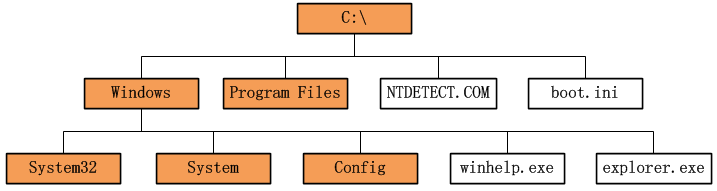
文件系统是一个树结构,树上长有节点。树的节点有两种:
- 树枝节点
即文件夹,有内部树结构,在图中涂有颜色;
- 树叶节点
另一种是文件,即树叶节点,没有内部树结构。
2、打印文件树结构
1public class C01_InScene {
2    public static void main(String[] args) {
3        File file = new File("F:\\tree") ;
4        fileTree(file, 0);
5    }
6    private static void fileTree(File file, int floor) {
7        // 判断是否存在
8        if (file.exists()) {
9            if (floor > 0) {
10                // 循环打空格
11                for (int i = 0; i < floor; i++) {
12                    System.out.print(" ");
13                }
14            }
15            if (file.isDirectory()) {
16                System.out.println("+" + file.getName());
17                // 列出所有文件及文件夹
18                File[] files = file.listFiles();
19                if (null != files) {
20                    // 循环递归
21                    for (File dirFile : files) {
22                        fileTree(dirFile, floor + 1);
23                    }
24                }
25            } else {
26                System.out.println("-" + file.getName());
27            }
28        }
29    }
30}
执行效果:+代表文件夹,-代表文件。
1+tree
2 +dir1
3  +dir2
4   -dir2Leaf.txt
5  -leaf1.txt
6  -leaf2.txt
7 -OneLeaf.txt
8 -TwoLeaf.txt
3、组合模式描述
组合模式属于对象的结构模式,有时又叫做“部分——整体”模式。组合模式将对象组织到树结构中,可以用来描述整体与部分的关系。组合模式可以使客户端将单纯元素与复合元素同等看待。
二、组合模式-安全式
1、基础概念
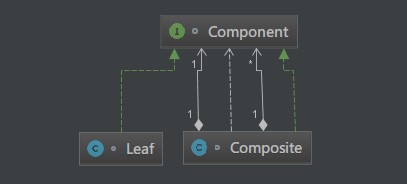
安全式的组合模式要求管理聚集的方法只出现在树枝构件类中,而不出现在树叶构件类中。涉及到三个角色:
- 抽象构件(Component)角色
它给组合的对象定义出公共的接口及其默认行为,可以用来管理所有的子对象。组合对象通常把它所包含的子对象当做类型为Component的对象。在安全式的组合模式里,构件角色并不定义出管理子对象的方法,这一定义由树枝构件对象给出。
- 树叶构件(Leaf)角色
树叶对象是没有下级子对象的对象,定义出参加组合的原始对象的行为。
- 树枝构件(Composite)角色
代表参加组合的有下级子对象的对象。树枝构件类给出所有的管理子对象的方法,如add()、remove()以及getChild()。
2、模式图解
3、源代码实现
1public class C02_Security_Model {
2    public static void main(String[] args) {
3        Composite root = new Composite("服装");
4        Composite composite1 = new Composite("男装");
5        Leaf manCoat = new Leaf("上衣");
6        Leaf manBottom = new Leaf("下衣");
7        composite1.addChild(manCoat);
8        composite1.addChild(manBottom);
9        Composite composite2 = new Composite("女装");
10        Leaf leaf1 = new Leaf("鞋子");
11        Leaf leaf2 = new Leaf("帽子");
12        root.addChild(leaf1);
13        root.addChild(leaf2);
14        root.addChild(composite1);
15        root.addChild(composite2);
16        root.printStruct("");
17    }
18}
19// 抽象构件角色类
20interface Component {
21    /*
22     * 输出组件自身的名称
23     */
24    void printStruct(String preStr);
25}
26// 树枝构件角色类
27class Composite implements Component{
28    // 用来存储组合对象中包含的子组件对象
29    private List<Component> childComponents = new ArrayList<Component>();
30    // 输出对象的名称
31    private String name;
32    // 构造方法,传入组合对象的名字
33    public Composite (String name){
34        this.name = name;
35    }
36    /**
37     * 聚集管理方法,增加一个子构件对象
38     * @param child 子构件对象
39     */
40    public void addChild(Component child){
41        childComponents.add(child);
42    }
43    /**
44     * 聚集管理方法,删除一个子构件对象
45     * @param index 子构件对象的下标
46     */
47    public void removeChild(int index){
48        childComponents.remove(index);
49    }
50    /**
51     * 聚集管理方法,返回所有子构件对象
52     */
53    public List getChild(){
54        return childComponents ;
55    }
56    /**
57     * 输出对象的自身结构
58     * @param preStr 前缀,主要是按照层级拼接空格,实现向后缩进
59     */
60    @Override
61    public void printStruct(String preStr) {
62        //先输出自己
63        System.out.println(preStr+"+"+this.name);
64        //如果还包含有子组件,那么就输出这些子组件对象
65        if (this.childComponents != null){
66            //添加两个空格,表示向后缩进两个空格
67            preStr = preStr+"  ";
68            //输出当前的子对象:使用函数递归的原理
69            for (Component c : childComponents) {
70                c.printStruct(preStr);
71            }
72        }
73    }
74}
75class Leaf implements Component{
76    // 输出叶子对象的名称
77    private String name;
78    // 构造方法,传入叶子对象的名称
79    public Leaf (String name){
80        this.name = name ;
81    }
82    /**
83     * 输出叶子对象的结构,叶子对象没有子对象,也就是输出叶子对象的名字
84     * @param preStr 前缀,主要是按照层级拼接的空格,实现向后缩进
85     */
86    @Override
87    public void printStruct(String preStr) {
88        System.out.println(preStr+"-"+name);
89    }
90}
-
输出结果
+服装 -鞋子 -帽子 +男装 -上衣 -下衣 +女装
三、组合模式-透明式
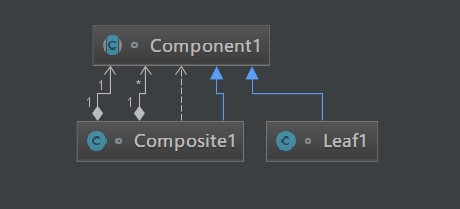
1、概念图解
与安全式的组合模式不同的是,透明式的组合模式要求所有的具体构件类,不论树枝构件还是树叶构件,均符合一个固定接口。
2、源代码实现
1public class C03_Transparent_Model {
2    public static void main(String[] args) {
3        Component1 root = new Composite1("服装");
4        Component1 c1 = new Composite1("男装");
5        Component1 c2 = new Composite1("女装");
6        Component1 leaf1 = new Leaf1("衬衫");
7        Component1 leaf2 = new Leaf1("夹克");
8        Component1 leaf3 = new Leaf1("裙子");
9        Component1 leaf4 = new Leaf1("套装");
10        root.addChild(c1);
11        root.addChild(c2);
12        c1.addChild(leaf1);
13        c1.addChild(leaf2);
14        c2.addChild(leaf3);
15        c2.addChild(leaf4);
16        root.printStruct("");
17    }
18}
19abstract class Component1 {
20    /**
21     * 输出组件自身的名称
22     */
23    public abstract void printStruct(String preStr);
24    // 聚集管理方法,增加一个子构件对象
25    public void addChild(Component1 child){
26        /**
27         * 缺省实现,抛出异常,因为叶子对象没有此功能
28         * 或者子组件没有实现这个功能
29         */
30        throw new UnsupportedOperationException("对象不支持此功能");
31    }
32    // 聚集管理方法,删除一个子构件对象
33    public void removeChild(int index){
34        /**
35         * 缺省实现,抛出异常,因为叶子对象没有此功能
36         * 或者子组件没有实现这个功能
37         */
38        throw new UnsupportedOperationException("对象不支持此功能");
39    }
40    // 聚集管理方法,返回所有子构件对象
41    public List<Component1> getChild(){
42        /**
43         * 缺省实现,抛出异常,因为叶子对象没有此功能
44         * 或者子组件没有实现这个功能
45         */
46        throw new UnsupportedOperationException("对象不支持此功能");
47    }
48}
49class Composite1 extends Component1 {
50    // 用来存储组合对象中包含的子组件对象
51    private List<Component1> childComponents = new ArrayList<Component1>();
52    // 输出对象名称
53    private String name ;
54    public Composite1 (String name){
55        this.name = name;
56    }
57    /**
58     * 聚集管理方法,增加一个子构件对象
59     * @param child 子构件对象
60     */
61    public void addChild(Component1 child){
62        childComponents.add(child);
63    }
64    /**
65     * 聚集管理方法,删除一个子构件对象
66     * @param index 子构件对象的下标
67     */
68    public void removeChild(int index){
69        childComponents.remove(index);
70    }
71    // 聚集管理方法,返回所有子构件对象
72    public List<Component1> getChild(){
73        return childComponents ;
74    }
75    /**
76     * 输出对象的自身结构
77     * @param preStr 前缀,主要是按照层级拼接空格,实现向后缩进
78     */
79    @Override
80    public void printStruct(String preStr) {
81        // 首先输出自己名称
82        System.out.println(preStr+"+"+this.name);
83        // 如果还包含有子组件,那么就输出这些子组件对象
84        preStr = preStr + "  ";
85        if (this.childComponents != null) {
86            // 添加两个空格,表示向后缩进
87            for (Component1 c : childComponents) {
88                ////递归输出每个子对象
89                c.printStruct(preStr);
90            }
91        }
92    }
93}
94class Leaf1 extends Component1 {
95    private String name;
96    public Leaf1 (String name){
97        this.name = name;
98    }
99    /**
100     * 输出叶子对象的结构,叶子对象没有子对象,也就是输出叶子对象的名字
101     * @param preStr 前缀,主要是按照层级拼接的空格,实现向后缩进
102     */
103    @Override
104    public void printStruct(String preStr) {
105        System.out.println(preStr+"-"+name);
106    }
107}
四、JDK中应用
1、HashMap结构图
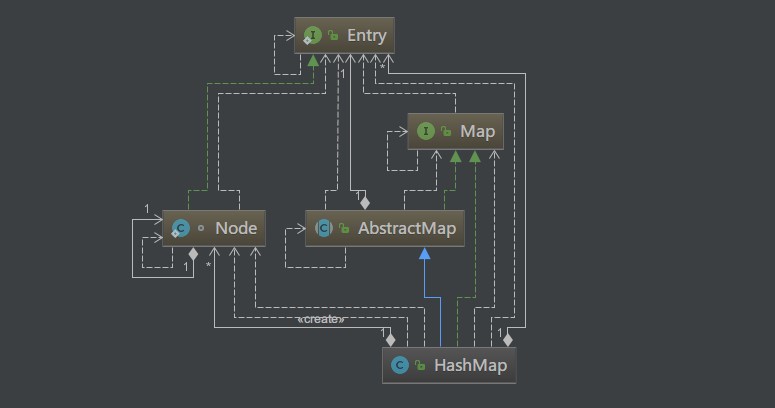
2、分层结构
- interface Map
- class AbstractMap implements Map
- HashMap extends AbstractMap implements Map
- interface Map.Entry
- Node implements Map.Entry
3、源代码
-
存储叶子节点
public V put(K var1, V var2) { return this.putVal(hash(var1), var1, var2, false, true); } final V putVal(int var1, K var2, V var3, boolean var4, boolean var5) { HashMap.Node[] var6 = this.table; ....... }
-
存储树枝节点
public void putAll(Map<? extends K, ? extends V> var1) { this.putMapEntries(var1, true); }
五、源代码地址
1GitHub·地址
2https://github.com/cicadasmile/model-arithmetic-parent
3GitEE·地址
4https://gitee.com/cicadasmile/model-arithmetic-parent