
正如文章AElf共识合约标准中所述,GetConsensusCommand接口用于获取某个公钥下一次生产区块的时间等信息。
在AEDPoS的实现中,其输入仅为一个公钥(public key),该接口实现方法的调用时间另外作为参考(其实也是一个重要的输入)。AElf区块链中,当系统内部调用只读交易时,合约执行的上下文是自行构造出来的,调用时间也就是通过C#自带函数库的DateTime.UtcNow生成了一个时间,然后把这个时间转化为protobuf提供的时间戳数据类型Timestamp,传入合约执行的上下文中。
事实上,无论要执行的交易是否为只读交易,合约代码中都可以通过Context.CurrentBlockTime来获取当前合约执行上下文传进来的时间戳。
本文主要解释AEDPoS共识如何实现GetConsensusCommand。在此之前,对不了解AElf共识的聚聚简单介绍一下AEDPoS的流程。
AEDPoS Process
DPoS的基本概念我们不再赘述,假设现在AElf主链通过投票选举出17个节点,我们(暂时地)称之为AElf Core Data Center,简称CDC。(对应eos中的BP即Block Producer这个概念。)
这些CDC是通过全民投票在某个区块高度(或者说时间点)的结果,直接取前17名得到。每次重新统计前17名候选人并重新任命CDC,称为换届(Term)。
在每一届中,所有的CDC按轮(Round)次生产区块。每一轮有17+1个时间槽,每位CDC随机地占据前17个时间槽之一,最后一个时间槽由本轮额外区块生产者负责生产区块。额外区块生产者会根据本轮每个CDC公布的随机数初始化下一轮的信息。18个时间槽后,下一轮开始。如此循环。
Round的数据结构如下:
1// The information of a round.
2message Round {
3    sint64 round_number = 1;
4    map<string, MinerInRound> real_time_miners_information = 2;
5    sint64 main_chain_miners_round_number = 3;
6    sint64 blockchain_age = 4;
7    string extra_block_producer_of_previous_round = 7;
8    sint64 term_number = 8;
9}
10
11// The information of a miner in a specific round.
12message MinerInRound {
13    sint32 order = 1;
14    bool is_extra_block_producer = 2;
15    aelf.Hash in_value = 3;
16    aelf.Hash out_value = 4;
17    aelf.Hash signature = 5;
18    google.protobuf.Timestamp expected_mining_time = 6;
19    sint64 produced_blocks = 7;
20    sint64 missed_time_slots = 8;
21    string public_key = 9;
22    aelf.Hash previous_in_value = 12;
23    sint32 supposed_order_of_next_round = 13;
24    sint32 final_order_of_next_round = 14;
25    repeated google.protobuf.Timestamp actual_mining_times = 15;// Miners must fill actual mining time when they do the mining.
26    map<string, bytes> encrypted_in_values = 16;
27    map<string, bytes> decrypted_previous_inValues = 17;
28    sint32 produced_tiny_blocks = 18;
29}
在AEDPoS合约中有一个map结构,key是long类型的RoundNumber,从1自增,value就是上述的Round结构,CDC产生的每个区块都会更新当前轮或者下一轮的信息,以此推进共识和区块生产,并为共识验证提供基本依据。
AEDPoS的流程大致如此。如果对其中技术细节感兴趣,可见AElf白皮书中的4.2.4节。对实现细节感兴趣,可见Github上AEDPoS共识合约项目。
ConsensusCommand
在AElf共识合约标准中提到过ConsensusCommand的结构:
1message ConsensusCommand {
2    int32 NextBlockMiningLeftMilliseconds = 1;// How many milliseconds left to trigger the mining of next block.
3    int32 LimitMillisecondsOfMiningBlock = 2;// Time limit of mining next block.
4    bytes Hint = 3;// Context of Hint is diverse according to the consensus protocol we choose, so we use bytes.
5    google.protobuf.Timestamp ExpectedMiningTime = 4;
6}
对于AEDPoS共识,Hint为CDC下一次生产什么类型的区块指了一条明路。我们为Hint提供了专门的数据结构AElfConsensusHint:
1message AElfConsensusHint {
2    AElfConsensusBehaviour behaviour = 1;
3}
而区块类型正包含在如下的Behaviour中:
1enum AElfConsensusBehaviour {
2    UpdateValue = 0;
3    NextRound = 1;
4    NextTerm = 2;
5    UpdateValueWithoutPreviousInValue = 3;
6    Nothing = 4;
7    TinyBlock = 5;
8}
逐一解释:
UpdateValue和UpdateValueWithoutPreviousInValue代表该CDC要生产某一轮中的一个普普通通的区块。CDC重点要更新的共识信息包括他前一轮的in_value(previous_in_value),本轮产生的out_value,以及本轮用来产生out_value的in_value的密码片段。(该CDC会用in_value和其他CDC的公钥加密得到16个密码片段,其他CDC只能各自用自己的私钥解密,当解密的片段达到一定数量后,原始的in_value就会被揭露;这是shamir's secret sharing的一个应用,细节可谷歌,AElf主链用了ECDH实现,如果以后有机会可以写文章讨论一下。)除此之外,还要在actual_mining_times中增加一条本次实际触发区块生产行为的时间戳。UpdateValueWithoutPreviousInValue和UpdateValue区别仅在于本次不需要公布上一轮的in_value(previous_in_value),因为当前轮是第一轮,或者刚刚换过届(而该CDC是一个萌新CDC)。
NextRound代表该CDC是本轮的额外区块生产者(或者补救者——当指定的额外区块生产者缺席时),要初始化下一轮信息。下一轮信息包括每个CDC的时间槽排列及根据规则指定的下一轮的额外区块生产者。
NextTerm类似于NextRound,只不过会重新统计选举的前17名,根据新一届的CDC初始化下一轮信息。
Nothing是发现输入的公钥并不是一个CDC。
TinyBlock代表该CDC刚刚已经更新过共识信息,但是他的时间槽还没有过去,他还有时间去出几个额外的块。目前每个时间槽最多可以出8个小块。这样的好处是提高区块验证的效率(eos也是这么做的)。
有一个时间槽的问题需要特别注意,由于AEDPoS选择在创世区块中生成第一轮共识信息(即所有最初的CDC的时间槽等信息),而创世区块对于每一个节点都应该是完全一致的,因此第一轮的共识信息不得不指定给一个统一的时间(否则创世区块的哈希值会不一致):如今这个时间是0001年0点。这样会导致第一轮的时间槽极其不准确(所有的CDC直接错过自己的时间槽两千多年),因此在获取第一轮的ConsensusCommand时会做特殊处理。
GetConsensusBehaviour
AEDPoS合约中,要让GetConsensusCommand方法返回ConsensusCommand,首先会根据输入的公钥和调用时间得到AElfConsensusBehaviour。然后再使用AElfConsensusBehaviour判断下一次出块时间等信息。
这里的逻辑相对比较清晰,也许可以用一张图来解释清楚:
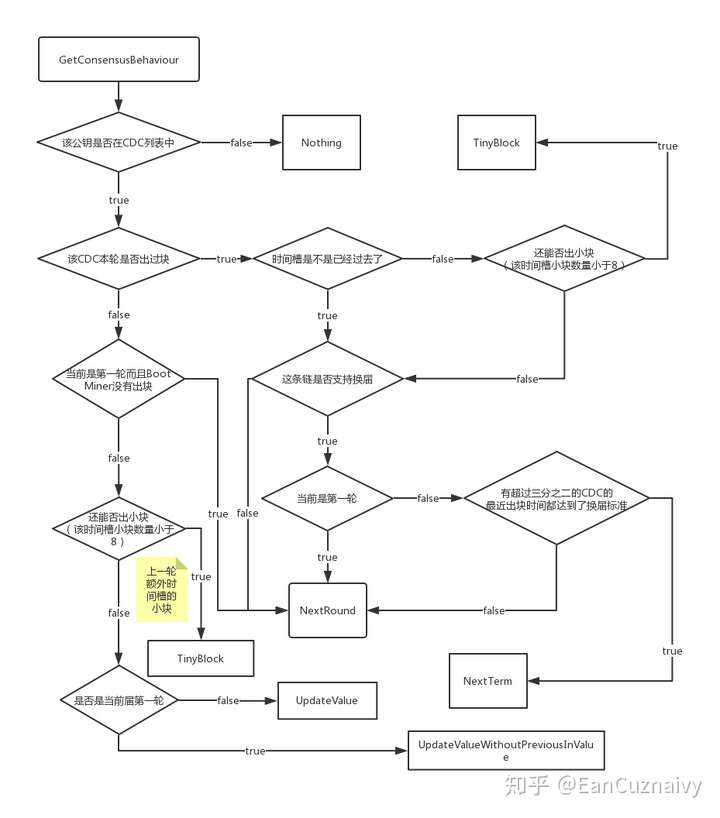
相关完整代码见:
接下来我们逐个讨论每个Behaviour对应的ConsensusCommand。
GetConsensusCommand - UpdateValueWithoutPreviousInValue
AElfConsensusBehaviour.UpdateValueWithoutPreviousInValue的主要作用是实现Commitment Scheme(WiKi词条),仅包含一次_commit phase_,不包含_reveal phase_。对应共识Mining Process的阶段,就是每一届(当然包括第一届,也就是链刚刚启动的时候)的第一轮,CDC要试图产生本轮第一个区块。
如果当前处于第一届的第一轮,则需要从AEDPoS共识的Round.real_time_miners_information信息中读取提供公钥的CDC在本轮中的次序order,预期出块时间即order * mining_interval毫秒之后。mining_interval默认为4000ms。
否则,直接从Round信息中读取expected_mining_time,依据此来返回ConsensusCommand。
1    if (currentRound.RoundNumber == 1)
2    {
3        // To avoid initial miners fork so fast at the very beginning of current chain.
4        nextBlockMiningLeftMilliseconds =
5            currentRound.GetMiningOrder(publicKey).Mul(currentRound.GetMiningInterval());
6        expectedMiningTime = Context.CurrentBlockTime.AddMilliseconds(nextBlockMiningLeftMilliseconds);
7    }
8    else
9    {
10        // As normal as case AElfConsensusBehaviour.UpdateValue.
11        expectedMiningTime = currentRound.GetExpectedMiningTime(publicKey);
12        nextBlockMiningLeftMilliseconds = (int) (expectedMiningTime - Context.CurrentBlockTime).Milliseconds();
13    }
GetConsensusCommand - UpdateValue
AElfConsensusBehaviour.UpdateValue包含一次Commitment Scheme中的_reveal phase_,一次新的_commit phase_。对应共识Mining Process的阶段为每一届的第二轮及以后,CDC试图产生本轮的第一个区块。
直接读取当前轮的Round信息中该CDC的公钥对应的expected_mining_time字段即可。
1 expectedMiningTime = currentRound.GetExpectedMiningTime(publicKey);
2    nextBlockMiningLeftMilliseconds = (int) (expectedMiningTime - currentBlockTime).Milliseconds();
GetConsensusCommand - NextRound
AElfConsensusBehaviour.NextRound会根据本轮各个CDC公布的信息,按照顺序计算规则,生成下一轮各个CDC的顺序和对应时间槽,将RoundNumber往后推进一个数字。
对于本轮指定为额外区块生产者的CDC,直接读取本轮的额外区块生成时间槽即可。
否则,为了防止指定的额外区块生产者掉线或者在另外一个分叉上出块(在网络不稳定的情况下会出现分叉),其他所有的CDC也会得到一个互不相同额外区块生产的时间槽,这些CDC在同步到任何一个CDC生产的额外区块后,会立刻重置自己的调度器,所以不必担心产生冲突。
对于第一届第一轮的特殊处理同AElfConsensusBehaviour.UpdateValueWithoutPreviousInValue。
1 ...
2    var minerInRound = currentRound.RealTimeMinersInformation[publicKey];
3    if (currentRound.RoundNumber == 1)
4    {
5        nextBlockMiningLeftMilliseconds = minerInRound.Order.Add(currentRound.RealTimeMinersInformation.Count).Sub(1)
6                .Mul(currentRound.GetMiningInterval());
7        expectedMiningTime = Context.CurrentBlockTime.AddMilliseconds(nextBlockMiningLeftMilliseconds);
8    }
9    else
10    {
11        expectedMiningTime =
12            currentRound.ArrangeAbnormalMiningTime(minerInRound.PublicKey, Context.CurrentBlockTime);
13        nextBlockMiningLeftMilliseconds = (int) (expectedMiningTime - Context.CurrentBlockTime).Milliseconds();
14    }
15    ...
16
17    /// <summary>
18    /// If one node produced block this round or missed his time slot,
19    /// whatever how long he missed, we can give him a consensus command with new time slot
20    /// to produce a block (for terminating current round and start new round).
21    /// The schedule generated by this command will be cancelled
22    /// if this node executed blocks from other nodes.
23    /// </summary>
24    /// <returns></returns>
25    public Timestamp ArrangeAbnormalMiningTime(string publicKey, Timestamp currentBlockTime)
26    {
27        if (!RealTimeMinersInformation.ContainsKey(publicKey))
28        {
29            return new Timestamp {Seconds = long.MaxValue};
30        }
31
32        miningInterval = GetMiningInterval();
33
34        if (miningInterval <= 0)
35        {
36            // Due to incorrect round information.
37            return new Timestamp {Seconds = long.MaxValue};
38        }
39
40        var minerInRound = RealTimeMinersInformation[publicKey];
41
42        if (GetExtraBlockProducerInformation().PublicKey == publicKey)
43        {
44            var distance = (GetExtraBlockMiningTime().AddMilliseconds(miningInterval) - currentBlockTime).Milliseconds();
45            if (distance > 0)
46            {
47                return GetExtraBlockMiningTime();
48            }
49        }
50
51        var distanceToRoundStartTime = (currentBlockTime - GetStartTime()).Milliseconds();
52        var missedRoundsCount = distanceToRoundStartTime.Div(TotalMilliseconds(miningInterval));
53        var expectedEndTime = GetExpectedEndTime(missedRoundsCount, miningInterval);
54        return expectedEndTime.AddMilliseconds(minerInRound.Order.Mul(miningInterval));
55    }
GetConsensusCommand - NextTerm
AElfConsensusBehaviour.NextTerm会根据当前的选举结果重新选定17位CDC,生成新一届第一轮的信息。方法同AElfConsensusBehaviour.NextRound不对第一届第一轮做特殊处理的情况。
1expectedMiningTime =
2        currentRound.ArrangeAbnormalMiningTime(minerInRound.PublicKey, Context.CurrentBlockTime);
3    nextBlockMiningLeftMilliseconds = (int) (expectedMiningTime - Context.CurrentBlockTime).Milliseconds();
GetConsensusCommand - TinyBlock
AElfConsensusBehaviour.TinyBlock发生在两种情况下:
- 当前CDC为上一轮的额外区块生产者,在生产完包含NextRound交易的区块以后,需要在同一个时间槽里继续生产最多7个区块;
- 当前CDC刚刚生产过包含UpdateValue交易的区块,需要在同一个时间槽继续生产最多7个区块。
基本判断逻辑是,如果当前CDC为本轮出过包含UpdateValue交易的块,即情况2,就结合当前CDC是上一轮额外区块生产者的情况,把一个长度为4000ms的时间槽切分成8个500ms的小块时间槽,进行分配;否则为上述的情况1,直接根据已经出过的小块的数量分配一个合理的小块时间槽。
1/// <summary>
2    /// We have 2 cases of producing tiny blocks:
3    /// 1. After generating information of next round (producing extra block)
4    /// 2. After publishing out value (producing normal block)
5    /// </summary>
6    /// <param name="currentRound"></param>
7    /// <param name="publicKey"></param>
8    /// <param name="nextBlockMiningLeftMilliseconds"></param>
9    /// <param name="expectedMiningTime"></param>
10    private void GetScheduleForTinyBlock(Round currentRound, string publicKey,
11        out int nextBlockMiningLeftMilliseconds, out Timestamp expectedMiningTime)
12    {
13        var minerInRound = currentRound.RealTimeMinersInformation[publicKey];
14        var producedTinyBlocks = minerInRound.ProducedTinyBlocks;
15        var currentRoundStartTime = currentRound.GetStartTime();
16        var producedTinyBlocksForPreviousRound =
17            minerInRound.ActualMiningTimes.Count(t => t < currentRoundStartTime);
18        var miningInterval = currentRound.GetMiningInterval();
19        var timeForEachBlock = miningInterval.Div(AEDPoSContractConstants.TotalTinySlots);//8 for now
20        expectedMiningTime = currentRound.GetExpectedMiningTime(publicKey);
21
22        if (minerInRound.IsMinedBlockForCurrentRound())
23        {
24            // After publishing out value (producing normal block)
25            expectedMiningTime = expectedMiningTime.AddMilliseconds(
26                currentRound.ExtraBlockProducerOfPreviousRound != publicKey
27                    ? producedTinyBlocks.Mul(timeForEachBlock)
28                    // Previous extra block producer can produce double tiny blocks at most.
29                    : producedTinyBlocks.Sub(producedTinyBlocksForPreviousRound).Mul(timeForEachBlock));
30        }
31        else if (TryToGetPreviousRoundInformation(out _))
32        {
33            // After generating information of next round (producing extra block)
34            expectedMiningTime = currentRound.GetStartTime().AddMilliseconds(-miningInterval)
35                .AddMilliseconds(producedTinyBlocks.Mul(timeForEachBlock));
36        }
37
38        if (currentRound.RoundNumber == 1 ||
39            currentRound.RoundNumber == 2 && !minerInRound.IsMinedBlockForCurrentRound())
40        {
41            nextBlockMiningLeftMilliseconds = GetNextBlockMiningLeftMillisecondsForFirstRound(minerInRound, miningInterval);
42        }
43        else
44        {
45            TuneExpectedMiningTimeForTinyBlock(miningInterval,
46                currentRound.GetExpectedMiningTime(publicKey),
47                ref expectedMiningTime);
48
49            nextBlockMiningLeftMilliseconds = (int) (expectedMiningTime - Context.CurrentBlockTime).Milliseconds();
50
51            var toPrint = expectedMiningTime;
52            Context.LogDebug(() =>
53                $"expected mining time: {toPrint}, current block time: {Context.CurrentBlockTime}. " +
54                $"next: {(int) (toPrint - Context.CurrentBlockTime).Milliseconds()}");
55        }
56    }
57
58    /// <summary>
59    /// Finally make current block time in the range of (expected_mining_time, expected_mining_time + time_for_each_block)
60    /// </summary>
61    /// <param name="miningInterval"></param>
62    /// <param name="originExpectedMiningTime"></param>
63    /// <param name="expectedMiningTime"></param>
64    private void TuneExpectedMiningTimeForTinyBlock(int miningInterval, Timestamp originExpectedMiningTime,
65        ref Timestamp expectedMiningTime)
66    {
67        var timeForEachBlock = miningInterval.Div(AEDPoSContractConstants.TotalTinySlots);//8 for now
68        var currentBlockTime = Context.CurrentBlockTime;
69        while (expectedMiningTime < currentBlockTime &&
70               expectedMiningTime < originExpectedMiningTime.AddMilliseconds(miningInterval))
71        {
72            expectedMiningTime = expectedMiningTime.AddMilliseconds(timeForEachBlock);
73            var toPrint = expectedMiningTime.Clone();
74            Context.LogDebug(() => $"Moving to next tiny block time slot. {toPrint}");
75        }
76    }
最后再次调整区块执行时间限制
在根据Behaviour计算出下一次生产区块的时间后,有可能会出现下一次出快时间为负数的情况(即当前时间已经超过理论上的下一次出块时间),此时可以把区块打包时间限制设置为0。最后为了给生成系统交易、网络延时等预留一定的时间,会把区块执行时间限制再乘以一个系数(待优化)。
1private void AdjustLimitMillisecondsOfMiningBlock(Round currentRound, string publicKey,
2        int nextBlockMiningLeftMilliseconds, out int limitMillisecondsOfMiningBlock)
3    {
4        var minerInRound = currentRound.RealTimeMinersInformation[publicKey];
5        var miningInterval = currentRound.GetMiningInterval();
6        var offset = 0;
7        if (nextBlockMiningLeftMilliseconds < 0)
8        {
9            Context.LogDebug(() => "Next block mining left milliseconds is less than 0.");
10            offset = nextBlockMiningLeftMilliseconds;
11        }
12
13        limitMillisecondsOfMiningBlock = miningInterval.Div(AEDPoSContractConstants.TotalTinySlots).Add(offset);
14        limitMillisecondsOfMiningBlock = limitMillisecondsOfMiningBlock < 0 ? 0 : limitMillisecondsOfMiningBlock;
15
16        var currentRoundStartTime = currentRound.GetStartTime();
17        var producedTinyBlocksForPreviousRound =
18            minerInRound.ActualMiningTimes.Count(t => t < currentRoundStartTime);
19
20        if (minerInRound.ProducedTinyBlocks == AEDPoSContractConstants.TinyBlocksNumber ||
21            minerInRound.ProducedTinyBlocks ==
22            AEDPoSContractConstants.TinyBlocksNumber.Add(producedTinyBlocksForPreviousRound))
23        {
24            limitMillisecondsOfMiningBlock = limitMillisecondsOfMiningBlock.Div(2);
25        }
26        else
27        {
28            limitMillisecondsOfMiningBlock = limitMillisecondsOfMiningBlock
29                .Mul(AEDPoSContractConstants.LimitBlockExecutionTimeWeight)//3 for now
30                .Div(AEDPoSContractConstants.LimitBlockExecutionTimeTotalWeight);//5 for now
31        }
32    }
以上完整代码可见:
https://github.com/AElfProject/AElf/tree/dev/contract/AElf.Contracts.Consensus.AEDPoS
可能的优化方向
基于现有逻辑优化条件,有可能的话实现成函数式,以增加代码可读性(也可能更糟)。
本文初衷只是我自己整理之前的代码,看有没有可能优化的地方,果然有一点收获,删掉了一些没有必要的判断。
如果有人能review完代码请务必告诉我。能发现任何问题就感激不尽了……