
直接上一段 Kotlin 的函数式编程的代码:
1package com.easykotlin.lec02
2
3fun sum1(x: Int, y: Int): Int {
4    return x + y
5}
6
7fun sum2(x: Int, y: Int) = x + y
8
9// sum2 函数字面量: 匿名函数
10val sum3 = fun(x: Int, y: Int) = x + y
11val s3 = (fun(x: Int, y: Int) = x + y)(1, 1)
12val s32 = (fun(x: Int, y: Int) = x + y).invoke(1, 1)
13
14// Lambda
15val sum4 = { x: Int, y: Int -> x + y }
16val s4 = { x: Int, y: Int -> x + y }(1, 1)
17val s42 = { x: Int, y: Int -> x + y }.invoke(1, 1)
18
19val sum5: (Int, Int) -> Int = { x, y -> x + y }
20
21// 高阶函数
22fun repeat(n: Int, body: () -> Unit) {
23    for (i in 1..n) {
24        body()
25    }
26}
27
28// 类型别名
29typealias A = (String) -> Int
30
31typealias B = (Int) -> Boolean
32typealias C = (String) -> Boolean
33
34val length: A = { x -> x.length }
35val isOdd: B = { x -> x % 2 == 1 }
36// 高阶函数(复合函数)
37val filterOdd: C = { x ->
38    isOdd(length(x))
39}
40
41fun main(args: Array<String>) {
42    val list = listOf("a", "abc", "abcbdf", "adsfeeff", "qwedddsssssdd")
43    // 过滤出 list 中字符串长度是奇数的元素
44    val result = list.filter(filterOdd)
45    println(result)
46
47    repeat(3) {
48        println("A")
49    }
50
51    // 1 + 2 + 。。。 + 100
52    var sum = 0
53    var i = 1
54    repeat(100) {
55        sum += i
56        i++
57    }
58    println("sum = $sum")
59
60
61
62    sum1(1, 1)
63    sum2(1, 1)
64    sum3(1, 1)
65    sum4(1, 1)
66    sum5(1, 1)
67    println("s3 = $s3")
68    println("s32 = $s32")
69    println("s4 = $s4")
70    println("s42 = $s42")
71}
Java 8:
1public void filter(Filter f, List<Integer> integerList) {
2    for (Integer i : integerList) {
3        if (f.test(i)) {
4            System.out.println(i);
5        }
6    }
7}
8// 定义一个 SAM
9interface Filter {
10    boolean test(int x);
11}
12
13public void lambdaDemo() {
14    filter((x) -> x % 2 == 1, Arrays.asList(1, 2, 3, 4, 5, 6, 7));
15}
Java 在一个拥有两个方法(不含默认方法)的接口中,是不可以使用 Lambda 表达式的,当一个接口中只有一个抽象方法,即达成了SAM(Single Abstract Method)条件时,Lambda表达式才可以使用。
Kotlin:
1fun filter(f: (Int) -> Boolean, integerList: List<Int>) {
2    for (i in integerList) {
3        if (f(i)) {
4            println(i)
5        }
6    }
7}
8
9fun lambdaDemo() {
10    filter({ x -> x % 2 == 1 }, Arrays.asList(1, 2, 3, 4, 5, 6, 7))
11}
在 Kotlin 中,函数 f:(Int)->Boolean 也是一种类型,可以像普通的参数变量一样,在函数入参中传递,当然也可以返回一个函数。
再举个例子:
1fun repeat(times: Int, body: () -> Unit) {
2    for (i in 0 until times) {
3        body()
4    }
5}
6
7
8fun main(args: Array<String>) {
9    repeat(3, {
10        println("A")
11    })
12
13    repeat(3) {
14        println("B")
15    }
16
17    var sum = 0
18    var i = 1
19    repeat(100) {
20        sum += i
21        i++
22    }
23    println(sum)
24}
Function 接口
函数 Function 接口类型只有一个调用方法:invoke() 。
它包含三个动作:传入参数、处理参数、返回结果。
Kotlin定义了kotlin.Function<out R>接口来抽象所有函数,它没有定义任何方法。
关键在于:kotlin.jvm.functions包里定义了
1package kotlin.jvm.functions
2
3/** A function that takes 0 arguments. */
4public interface Function0<out R> : Function<R> {
5    /** Invokes the function. */
6    public operator fun invoke(): R
7}
8/** A function that takes 1 argument. */
9public interface Function1<in P1, out R> : Function<R> {
10    /** Invokes the function with the specified argument. */
11    public operator fun invoke(p1: P1): R
12}
13/** A function that takes 2 arguments. */
14public interface Function2<in P1, in P2, out R> : Function<R> {
15    /** Invokes the function with the specified arguments. */
16    public operator fun invoke(p1: P1, p2: P2): R
17}
18/** A function that takes 3 arguments. */
19public interface Function3<in P1, in P2, in P3, out R> : Function<R> {
20    /** Invokes the function with the specified arguments. */
21    public operator fun invoke(p1: P1, p2: P2, p3: P3): R
22}
23/** A function that takes 4 arguments. */
24public interface Function4<in P1, in P2, in P3, in P4, out R> : Function<R> {
25    /** Invokes the function with the specified arguments. */
26    public operator fun invoke(p1: P1, p2: P2, p3: P3, p4: P4): R
27}
28/** A function that takes 5 arguments. */
29public interface Function5<in P1, in P2, in P3, in P4, in P5, out R> : Function<R> {
30    /** Invokes the function with the specified arguments. */
31    public operator fun invoke(p1: P1, p2: P2, p3: P3, p4: P4, p5: P5): R
32}
33/** A function that takes 6 arguments. */
34public interface Function6<in P1, in P2, in P3, in P4, in P5, in P6, out R> : Function<R> {
35    /** Invokes the function with the specified arguments. */
36    public operator fun invoke(p1: P1, p2: P2, p3: P3, p4: P4, p5: P5, p6: P6): R
37}
38/** A function that takes 7 arguments. */
39public interface Function7<in P1, in P2, in P3, in P4, in P5, in P6, in P7, out R> : Function<R> {
40    /** Invokes the function with the specified arguments. */
41    public operator fun invoke(p1: P1, p2: P2, p3: P3, p4: P4, p5: P5, p6: P6, p7: P7): R
42}
43/** A function that takes 8 arguments. */
44public interface Function8<in P1, in P2, in P3, in P4, in P5, in P6, in P7, in P8, out R> : Function<R> {
45    /** Invokes the function with the specified arguments. */
46    public operator fun invoke(p1: P1, p2: P2, p3: P3, p4: P4, p5: P5, p6: P6, p7: P7, p8: P8): R
47}
48/** A function that takes 9 arguments. */
49public interface Function9<in P1, in P2, in P3, in P4, in P5, in P6, in P7, in P8, in P9, out R> : Function<R> {
50    /** Invokes the function with the specified arguments. */
51    public operator fun invoke(p1: P1, p2: P2, p3: P3, p4: P4, p5: P5, p6: P6, p7: P7, p8: P8, p9: P9): R
52}
53/** A function that takes 10 arguments. */
54public interface Function10<in P1, in P2, in P3, in P4, in P5, in P6, in P7, in P8, in P9, in P10, out R> : Function<R> {
55    /** Invokes the function with the specified arguments. */
56    public operator fun invoke(p1: P1, p2: P2, p3: P3, p4: P4, p5: P5, p6: P6, p7: P7, p8: P8, p9: P9, p10: P10): R
57}
58/** A function that takes 11 arguments. */
59public interface Function11<in P1, in P2, in P3, in P4, in P5, in P6, in P7, in P8, in P9, in P10, in P11, out R> : Function<R> {
60    /** Invokes the function with the specified arguments. */
61    public operator fun invoke(p1: P1, p2: P2, p3: P3, p4: P4, p5: P5, p6: P6, p7: P7, p8: P8, p9: P9, p10: P10, p11: P11): R
62}
63/** A function that takes 12 arguments. */
64public interface Function12<in P1, in P2, in P3, in P4, in P5, in P6, in P7, in P8, in P9, in P10, in P11, in P12, out R> : Function<R> {
65    /** Invokes the function with the specified arguments. */
66    public operator fun invoke(p1: P1, p2: P2, p3: P3, p4: P4, p5: P5, p6: P6, p7: P7, p8: P8, p9: P9, p10: P10, p11: P11, p12: P12): R
67}
68/** A function that takes 13 arguments. */
69public interface Function13<in P1, in P2, in P3, in P4, in P5, in P6, in P7, in P8, in P9, in P10, in P11, in P12, in P13, out R> : Function<R> {
70    /** Invokes the function with the specified arguments. */
71    public operator fun invoke(p1: P1, p2: P2, p3: P3, p4: P4, p5: P5, p6: P6, p7: P7, p8: P8, p9: P9, p10: P10, p11: P11, p12: P12, p13: P13): R
72}
73/** A function that takes 14 arguments. */
74public interface Function14<in P1, in P2, in P3, in P4, in P5, in P6, in P7, in P8, in P9, in P10, in P11, in P12, in P13, in P14, out R> : Function<R> {
75    /** Invokes the function with the specified arguments. */
76    public operator fun invoke(p1: P1, p2: P2, p3: P3, p4: P4, p5: P5, p6: P6, p7: P7, p8: P8, p9: P9, p10: P10, p11: P11, p12: P12, p13: P13, p14: P14): R
77}
78/** A function that takes 15 arguments. */
79public interface Function15<in P1, in P2, in P3, in P4, in P5, in P6, in P7, in P8, in P9, in P10, in P11, in P12, in P13, in P14, in P15, out R> : Function<R> {
80    /** Invokes the function with the specified arguments. */
81    public operator fun invoke(p1: P1, p2: P2, p3: P3, p4: P4, p5: P5, p6: P6, p7: P7, p8: P8, p9: P9, p10: P10, p11: P11, p12: P12, p13: P13, p14: P14, p15: P15): R
82}
83/** A function that takes 16 arguments. */
84public interface Function16<in P1, in P2, in P3, in P4, in P5, in P6, in P7, in P8, in P9, in P10, in P11, in P12, in P13, in P14, in P15, in P16, out R> : Function<R> {
85    /** Invokes the function with the specified arguments. */
86    public operator fun invoke(p1: P1, p2: P2, p3: P3, p4: P4, p5: P5, p6: P6, p7: P7, p8: P8, p9: P9, p10: P10, p11: P11, p12: P12, p13: P13, p14: P14, p15: P15, p16: P16): R
87}
88/** A function that takes 17 arguments. */
89public interface Function17<in P1, in P2, in P3, in P4, in P5, in P6, in P7, in P8, in P9, in P10, in P11, in P12, in P13, in P14, in P15, in P16, in P17, out R> : Function<R> {
90    /** Invokes the function with the specified arguments. */
91    public operator fun invoke(p1: P1, p2: P2, p3: P3, p4: P4, p5: P5, p6: P6, p7: P7, p8: P8, p9: P9, p10: P10, p11: P11, p12: P12, p13: P13, p14: P14, p15: P15, p16: P16, p17: P17): R
92}
93/** A function that takes 18 arguments. */
94public interface Function18<in P1, in P2, in P3, in P4, in P5, in P6, in P7, in P8, in P9, in P10, in P11, in P12, in P13, in P14, in P15, in P16, in P17, in P18, out R> : Function<R> {
95    /** Invokes the function with the specified arguments. */
96    public operator fun invoke(p1: P1, p2: P2, p3: P3, p4: P4, p5: P5, p6: P6, p7: P7, p8: P8, p9: P9, p10: P10, p11: P11, p12: P12, p13: P13, p14: P14, p15: P15, p16: P16, p17: P17, p18: P18): R
97}
98/** A function that takes 19 arguments. */
99public interface Function19<in P1, in P2, in P3, in P4, in P5, in P6, in P7, in P8, in P9, in P10, in P11, in P12, in P13, in P14, in P15, in P16, in P17, in P18, in P19, out R> : Function<R> {
100    /** Invokes the function with the specified arguments. */
101    public operator fun invoke(p1: P1, p2: P2, p3: P3, p4: P4, p5: P5, p6: P6, p7: P7, p8: P8, p9: P9, p10: P10, p11: P11, p12: P12, p13: P13, p14: P14, p15: P15, p16: P16, p17: P17, p18: P18, p19: P19): R
102}
103/** A function that takes 20 arguments. */
104public interface Function20<in P1, in P2, in P3, in P4, in P5, in P6, in P7, in P8, in P9, in P10, in P11, in P12, in P13, in P14, in P15, in P16, in P17, in P18, in P19, in P20, out R> : Function<R> {
105    /** Invokes the function with the specified arguments. */
106    public operator fun invoke(p1: P1, p2: P2, p3: P3, p4: P4, p5: P5, p6: P6, p7: P7, p8: P8, p9: P9, p10: P10, p11: P11, p12: P12, p13: P13, p14: P14, p15: P15, p16: P16, p17: P17, p18: P18, p19: P19, p20: P20): R
107}
108/** A function that takes 21 arguments. */
109public interface Function21<in P1, in P2, in P3, in P4, in P5, in P6, in P7, in P8, in P9, in P10, in P11, in P12, in P13, in P14, in P15, in P16, in P17, in P18, in P19, in P20, in P21, out R> : Function<R> {
110    /** Invokes the function with the specified arguments. */
111    public operator fun invoke(p1: P1, p2: P2, p3: P3, p4: P4, p5: P5, p6: P6, p7: P7, p8: P8, p9: P9, p10: P10, p11: P11, p12: P12, p13: P13, p14: P14, p15: P15, p16: P16, p17: P17, p18: P18, p19: P19, p20: P20, p21: P21): R
112}
113/** A function that takes 22 arguments. */
114public interface Function22<in P1, in P2, in P3, in P4, in P5, in P6, in P7, in P8, in P9, in P10, in P11, in P12, in P13, in P14, in P15, in P16, in P17, in P18, in P19, in P20, in P21, in P22, out R> : Function<R> {
115    /** Invokes the function with the specified arguments. */
116    public operator fun invoke(p1: P1, p2: P2, p3: P3, p4: P4, p5: P5, p6: P6, p7: P7, p8: P8, p9: P9, p10: P10, p11: P11, p12: P12, p13: P13, p14: P14, p15: P15, p16: P16, p17: P17, p18: P18, p19: P19, p20: P20, p21: P21, p22: P22): R
117}
来分别抽象无参到22个参数的函数,它们都继承了kotlin.Function接口,同时定义了一个invoke()函数。
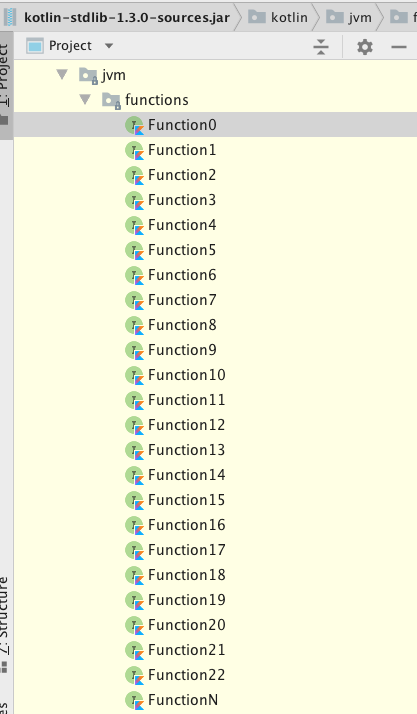
大于22个参数的函数,使用 FunctionN 接口:
1package kotlin.jvm.functions
2
3import kotlin.jvm.internal.FunctionBase
4
5/**
6 * A function that takes N >= 23 arguments.
7 *
8 * This interface must only be used in Java sources to reference a Kotlin function type with more than 22 arguments.
9 */
10@SinceKotlin("1.3")
11interface FunctionN<out R> : Function<R>, FunctionBase<R> {
12    /**
13     * Invokes the function with the specified arguments.
14     *
15     * Must **throw exception** if the length of passed [args] is not equal to the parameter count returned by [arity].
16     *
17     * @param args arguments to the function
18     */
19    operator fun invoke(vararg args: Any?): R
20
21    /**
22     * Returns the number of arguments that must be passed to this function.
23     */
24    override val arity: Int
25}
如下是Function2接口:
1interface Function2<in P1, in P2, out R> : Function<R> {
2  operator fun invoke(p1: P1, p2: P2): R
3}
p1和p2是传入的两个参数类型,R就是返回值类型。因为我们只会向函数传入参数、从函数中取出返回值,所以分别用in和out修饰。
invoke()函数定义了“调用”这个行为,它同时重载了括号操作符,允许用括号来传入参数、得到返回值。
我们可以定义一个匿名函数,然后把它赋值给sum变量:
val sum: (Int, Int) -> Int = fun(a: Int, b: Int) = a + b
由于匿名函数已经定义好参数列表和返回值类型了,我们可以省略sum的类型声明:
val sum = fun(a: Int, b: Int) = a + b
Lambda表达式就是一个匿名函数,可以把这个匿名函数改写为Lambda表达式:
val sum = { a: Int, b: Int -> a + b }
上面定义的sum函数对象,它会被编译为一个Function2类型的对象,(Int,Int)->Int是Function2接口的具体实现类,可以使用invoke()函数来调用它:
println(sum.invoke(1,2))
也可以直接用括号操作符:
println(sum(1,2))
小结
相比之下,Kotlin 对函数式编程的支持更加自然优雅。
Kotlin 开发者社区
国内第一Kotlin 开发者社区公众号,主要分享、交流 Kotlin 编程语言、Spring Boot、Android、React.js/Node.js、函数式编程、编程思想等相关主题。

开发者社区 QRCode.jpg
本文分享 CSDN - 东海陈光剑。
如有侵权,请联系 support@oschina.cn 删除。
本文参与“OSC源创计划”,欢迎正在阅读的你也加入,一起分享。