
什么是函数式接口
函数式接口是Java8引用的一个新特性,是一种特殊的接口:SAM类型的接口(Single Abstract Method)。但是它还是一个接口,只是有些特殊罢了。 函数式接口的出现主要是为了配合Java8的另一个新特性Lamdba表达式来使用。
- 接口中只有一个抽象方法
- 接口中面可以加一个注解*@FunctionalInterface*来检查接口中的方法是不是只有一个抽象方法
- 在接口里面可以加入 默认方法 和 静态方法
- 函数式接口也可以继承,但是继承的时候,抽象方法必须一样
- 函数式接口重写父类的的方法,并不会计入到自己的抽象方法中
自定义函数式接口
1//加入这个注解是为了检测接口中是否符合函数式接口的要求
2@FunctionalInterface
3public interface MyFunctionInterction {
4    //唯一的抽象方法
5    void absoluMethod();
6
7    //重写Object的方法
8    @Override
9    String toString();
10
11    //默认方法
12    default void defaultMethod() {
13        System.out.println("默认方法");
14    }
15
16    //静态方法
17    static void stativMethod() {
18        System.out.println("静态方法");
19    }
20}
函数式接口的简单使用
1里面的默认方法可以直接使用
2
3
4public class TestFunctionIntection {
5    public static void main(String[] args) {
6        TestFunctionIntection testFunctionIntection =
7                new TestFunctionIntection();
8        testFunctionIntection.test(
9                //Lamdba表达式的简单使用
10                () -> System.out.println("函数式接口里面的抽象方法"));
11    }
12
13    /**
14     * 自己定义的一个方法,并使用自定义的一个消费类型的函数式接口
15     * @param myFunctionInterction
16     */
17    public void test(MyFunctionInterction
18                             myFunctionInterction) {
19
20        //函数式接口里面的抽象方法
21        myFunctionInterction.absoluMethod();
22
23        //默认方法
24        myFunctionInterction.defaultMethod();
25
26        //静态方法
27        MyFunctionInterction.stativMethod();
28    }
29}
java8里面自定义的四个核心的函数式接口
上面我自定义的一个接口,就是一个消费类型的函数式接口。其实这类接口在_java.util.function_里面有定义的,就是void Consumer< T >,消费类型接口,上面代码中的test方法里面的接口其实可以换成Consumer< T >接口,也可以用,下面主要就是介绍这四个函数式接口的简单使用。
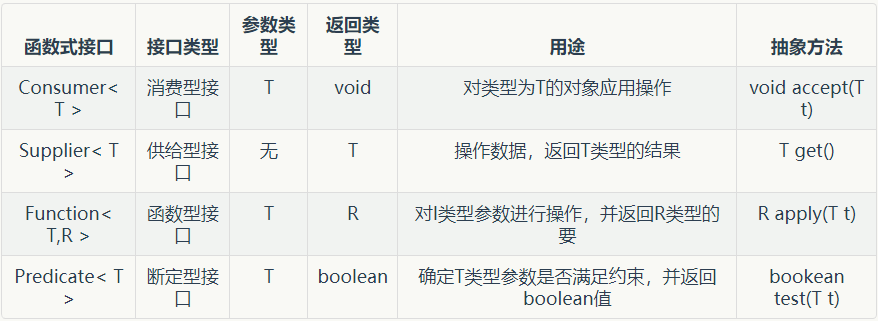
下面是这四个核心接口的简单使用
1public class FunctionTest {
2    //Consumer<T> 消费型接口
3    @Test
4    public void test1() {
5        Consumer<String> consumer = (x) -> System.out.println(x);
6        consumer.accept("消费型接口,没有返回值!");
7    }
8    //输出:消费型接口,没有返回值!
9
10    //供给型接口
11    @Test
12    public void test2() {
13        Supplier<String> supplier = () -> "主要的作用就是创建对象!";
14        String s = supplier.get();
15        System.out.println(s);
16    }
17    //输出:主要的作用就是创建对象!
18
19    //函数型接口
20    //Function<T,R> T 接收的参数,R 返回值类型
21    @Test
22    public void test3() {
23        Function<Integer, String> function = (x) -> x + ":为String类型";
24        String apply = function.apply(7);
25        System.out.println(apply);
26    }
27    //输出:7:为String类型
28
29    //断言型接口
30    @Test
31    public void test4() {
32        Predicate<Integer> predicate = (x) -> x > 10;
33        boolean test = predicate.test(11);
34        System.out.println(test);
35    }
36    //输出:true
37}
Consumer<T> 的应用
1//Consumer<T> 消费型接口
2    @Test
3    public void test1() {
4        //定义一个消费型接口,只输出输入的内容
5        Consumer<String> consumer = (x) -> System.out.println(x);
6        //在输入的内容后面加上·--加上了默认方法·
7        Consumer<String> consumer2 = (x) -> System.out.println(x + "--加上了默认方法");
8        //执行顺序  先执行 accept 后面执行 addThen(然后)
9        consumer.andThen(consumer2).accept("消费型接口,没有返回值!");
10    }
11    //输出:消费型接口,没有返回值                     (accept输出的值)
12    //输出:消费型接口,没有返回值 !--加上了默认方法 (addThen输出的值)
Consumer<T> 的默认方法的源码:
1default Consumer<T> andThen(Consumer<? super T> after) {
2    Objects.requireNonNull(after);
3    return (T t) -> { accept(t); after.accept(t); };
4}
其返回值这一句是重点,先是传入一个Consumer接口,然后返回一个Consumer接口,说明可以用表达式链,然后用这个特性可以把数据进一次进行加工。 (T t) -> { accept(t); after.accept(t); };这一句,返回的顺序首先是调用抽象方法,然后再调用默认方法,说明这个默认方法只可以对数据进行再加工,不能再抽象方法前面。
<hr>Supplier<T> 的应用
1    //供给型接口,这个方法若以用在工厂方法中
2    @Test
3    public void test2() {
4        //跟据一个字符串创建对象
5        Supplier<String> supplier = () -> "主要的作用就是创建对象!";
6        //获取一个对象
7        String s = supplier.get();
8        //获取两个以象
9        String s1 = supplier.get();
10        //两个对象内容一样
11        System.out.println(s.equals(s1));
12        System.out.println(s);
13        //用方法引用的方式创建一个对象
14        Supplier<SupplierTest> testSupplier = SupplierTest::new;
15        //用new的方式创建一个对象
16        Supplier<SupplierTest> supplierTestSupplier = () -> new SupplierTest("张三");
17        //可以通过supplierTestSupplier 来获取一个对象,并且可以调用里面的方法
18        String name = supplierTestSupplier.get().getName();
19        System.out.println(name);
20    }
21    //输出:true
22    //输出:主要的作用就是创建对象!
23    //输出:张三
Supplier< T >接口类型就有一个方法签名。T get()方法,没有默认方法。 <hr>
Function< T,R > 的应用
1//默认主法addThen
2//函数型接口
3    //Function<T,R> T 接收的参数,R 返回值类型
4    @Test
5    public void test3() {
6        Function<String, String> f1 = (x) -> x +"+ ";
7        Function<String, String> f2 = (x) -> x + "- ";
8        //addThen(然后的意思)执行顺序先执行f1,并且把执行后的结果作为f2的输入参数
9        String apply = f1.andThen(f2).apply("1");
10        System.out.println(apply);
11    }
12    //输出:1+ -
addThen的源码:
1default <V> Function<V, R> compose(Function<? super V, ? extends T> before) {
2    Objects.requireNonNull(before);
3    return (V v) -> apply(before.apply(v));
4}
源码中最重要的一句
(V v) -> apply(before.apply(v)); 规定了执行顺序
1    //默认主法compose
2    //函数型接口
3    //Function<T,R> T 接收的参数,R 返回值类型
4    @Test
5    public void test3() {
6        Function<String, String> f1 = (x) -> x +"+ ";
7        Function<String, String> f2 = (x) -> x + "- ";
8        //addThen(然后的意思)执行顺序先执行f2,并且把执行后的结果作为f1的输入参数
9        String apply = f1.compose(f2).apply("1");
10        System.out.println(apply);
11    }
12    //输出:1- +
三个默认方法,但是最后一个用的不多,这里也就不再介绍了。
<hr>Predicate< T > 的应用
1//默主方法negate 非
2//断言型接口
3    @Test
4    public void test4() {
5        Predicate<Integer> predicate = (x) -> x > 10;
6        boolean test = predicate.negate().test(11);
7        System.out.println(test);
8    }
9    //输出:false
10
11
12    //断言型接口
13    //默认方法 or 和 and
14    @Test
15    public void test4() {
16        Predicate<Integer> p1 = (x) -> x > 10;
17        Predicate<Integer> p2 = (x) -> x < 5;
18        //默认方法 or 或
19        boolean test = p1.or(p2).test(3);
20        //默认方法 and 且
21        boolean test2 = p1.and(p2).test(3);
22
23        System.out.println(test);
24        System.out.println(test2);
25    }
26    //输出:true
27    //输出:false
28
函数式接口的使用
函数式接口的的使用,大部分都是在流操作里面进行,现在可以不太理解,但是可以在学习完流操作以后,再过来看,并且跟着写一遍。代码光看是没有用的。如果不写是不知道意思的。
参考的博客:浅浅的函数式接口
<br> <hr> <center>
细节决定成败! 个人愚见,如有不对,恳请扶正!
</center>