
一、静态变量初始化顺序
大家先看两个例子:
(1)


1 1 public class SingleTon {
2 2     public static int count1;
3 3     public static int count2 = 1;
4 4     private static SingleTon singleTon = new SingleTon();
5 5
6 6     private SingleTon() {
7 7         count1++;
8 8         count2++;
9 9     }
1010
1111     public static SingleTon getInstance() {
1212         return singleTon;
1313     }
1414 }
1515
1616 class Test {
1717     public static void main(String[] args) {
1818         SingleTon singleTon = SingleTon.getInstance();
1919         System.out.println("count1=" + singleTon.count1);
2020         System.out.println("count2=" + singleTon.count2);
2121     }
2222 }
View Code
输出
count1=1
count2=2
(2)


1 1 public class SingleTon {
2 2
3 3     private static SingleTon singleTon = new SingleTon(); //(1)这一步初始化后,count1=1,count2=1
4 4     public static int count1; //(2)这一步只是定义了count1变量,并未进行count1初始化,因此count1 =1 count2=1
5 5     public static int count2 = 3;//(3)这一步 进行count2初始化,因此将原来的值覆盖,因此count2=3,count1 =1
6 6
7 7     private SingleTon() {
8 8         count1++; // 此时,count1还未被初始化,因此初始值为0,++后值为1
9 9         count2++; // 此时,count2还未被初始化,因此初始值为0,++后值为1
1010     }
1111
1212     public static SingleTon getInstance() {
1313         return singleTon;
1414     }
1515 }
1616
1717 class Test {
1818     public static void main(String[] args) {
1919         SingleTon singleTon = SingleTon.getInstance();
2020         System.out.println("count1=" + singleTon.count1);
2121         System.out.println("count2=" + singleTon.count2);
2222     }
2323 }
View Code
count1=1
count2=3
在调用类静态成员(不管是方法还是变量)的时候,按顺序初始化静态属性和代码块,之后才会调用静态方法,非静态成员变量因为没有初始化类,故不会初始化。
二、继承中的初始化
看两个例子:
(1)


1 1 class Meal {
2 2     Meal() {
3 3         System.out.println("Meal()");
4 4     }
5 5 }
6 6
7 7 class Bread {
8 8     Bread() {
9 9         System.out.println("Bread()");
1010     }
1111 }
1212
1313 class Cheese {
1414     Cheese() {
1515         System.out.println("Cheese()");
1616     }
1717 }
1818
1919 class Lettuce {
2020     Lettuce() {
2121         System.out.println("Letuce()");
2222     }
2323 }
2424
2525 class Lunch extends Meal {
2626     Lunch() {
2727         System.out.println("Lunch()");
2828     }
2929 }
3030
3131 class PortabLunch extends Lunch {
3232     PortabLunch() {
3333         System.out.println("PortabLunch");
3434     }
3535 }
3636
3737 public class Main extends  PortabLunch{
3838     Bread bread = new Bread();
3939     Cheese cheese = new Cheese();
4040     Lettuce lettuce = new Lettuce();
4141
4242     Main() {
4343         System.out.println("Main");
4444     }
4545
4646     public static void main(String[] args) {
4747         new Main();
4848     }
4949 }
View Code
输出:
1Meal()
2Lunch()
3PortabLunch
4Bread()
5Cheese()
6Letuce()
7Main
说明:子类初始化前要(0)在其他任何事情发生之前,将分配给对象的存储空间初始化为二进制零(1)寻找父类构造器,并且步骤会不断递归,直到找到根类为止。然后自顶向下,逐层调用构造函数,直到最底层的父类构造器。(2)然后按照代码编译顺序依次初始化各成员变量 (3)最后调用本类的构造函数进行初始化。
(2)


1 1 public class Glyph {
2 2     void draw() {
3 3         System.out.println("Glphy draw()");
4 4     }
5 5
6 6     Glyph() {
7 7         System.out.println("Glphy() before draw");
8 8         draw();//当子类调用父类构造器的时候,父类其实尚未初始化,因此调用的是子类的draw方法
9 9         System.out.println("Glphy() after draw");
1010     }
1111 }
1212
1313 class RoundGlyph extends Glyph {
1414     private int radius = 1;
1515
1616     RoundGlyph(int r) {
1717         radius = r;
1818         System.out.println("RoundGlyph.RoundGlyph(),radius:" + radius);
1919     }
2020
2121     void draw() {
2222         System.out.println("RoundGlyph.draw(),radius:" + radius);
2323     }
2424 }
2525
2626 class PolyConstruct {
2727     public static void main(String[] args) {
2828         new RoundGlyph(5);
2929     }
3030 }
View Code
输出
1Glphy() before draw
2RoundGlyph.draw(),radius:0
3Glphy() after draw
4RoundGlyph.RoundGlyph(),radius
说明:在调用父类构造器时,因为draw方法被子类_RoundGlyph覆写,因此在Glyph中调用的是子类的draw方法,并且此时由于radius还未进行初始化,因此其值是默认的初始值0._
(3)


1 1 public class Glyph {
2 2     void draw() {
3 3         System.out.println("Glphy draw()");
4 4     }
5 5
6 6     Glyph() {
7 7         System.out.println("Glphy() before draw");
8 8         draw();//当子类调用父类构造器的时候,父类其实尚未初始化,因此调用的是子类的draw方法
9 9         System.out.println("Glphy() after draw");
1010     }
1111 }
1212
1313 class RoundGlyph extends Glyph {
1414     private int radius = 1;
1515
1616     RoundGlyph(int r) {
1717         radius = r;
1818         System.out.println("RoundGlyph.RoundGlyph(),radius:" + radius);
1919     }
2020
2121 //    void draw() {
2222 //        System.out.println("RoundGlyph.draw(),radius:" + radius);
2323 //    }
2424 }
2525
2626 class PolyConstruct {
2727     public static void main(String[] args) {
2828         new RoundGlyph(5);
2929     }
3030 }
View Code
输出:
1Glphy() before draw
2Glphy draw()
3Glphy() after draw
4RoundGlyph.RoundGlyph(),radius:5
说明:本例子中,子类_RoundGlyph中不包含draw方法,因此也就不存在覆写的问题。所以父类初始化时调用的是本类中的draw方法。_
通过例子(2)(3)说明,在编写构造器时需要遵循一条准则:"用尽可能简单的方法使得对象进入正常状态;如果可以的话,尽量避免调用其他的方法"。在构造器内能够被唯一安全调用的方法是基类中的final方法(或者是private方法,因为它自动属于final方法),这些方法不能被覆盖,因此也不会 出项一些奇怪的问题_。_
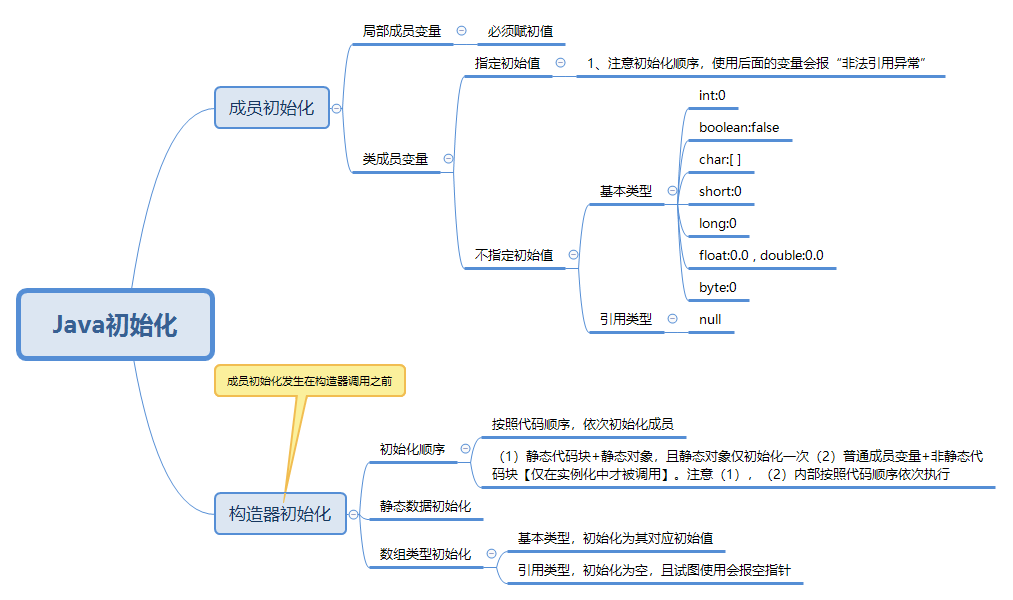
下面附一张,JAVA成员变量初始化思维导图,对于理解这一块的知识很有帮助
详细可参考这一文章:https://blog.csdn.net/fly_grass_fish/article/details/81116348 java静态变量static初始化顺序