
Executor 是JDK5新增的对于线程调度的新框架,主要用途是用来对线程进行调度和管理,
如下是Excutor框架的整体UML关系图;
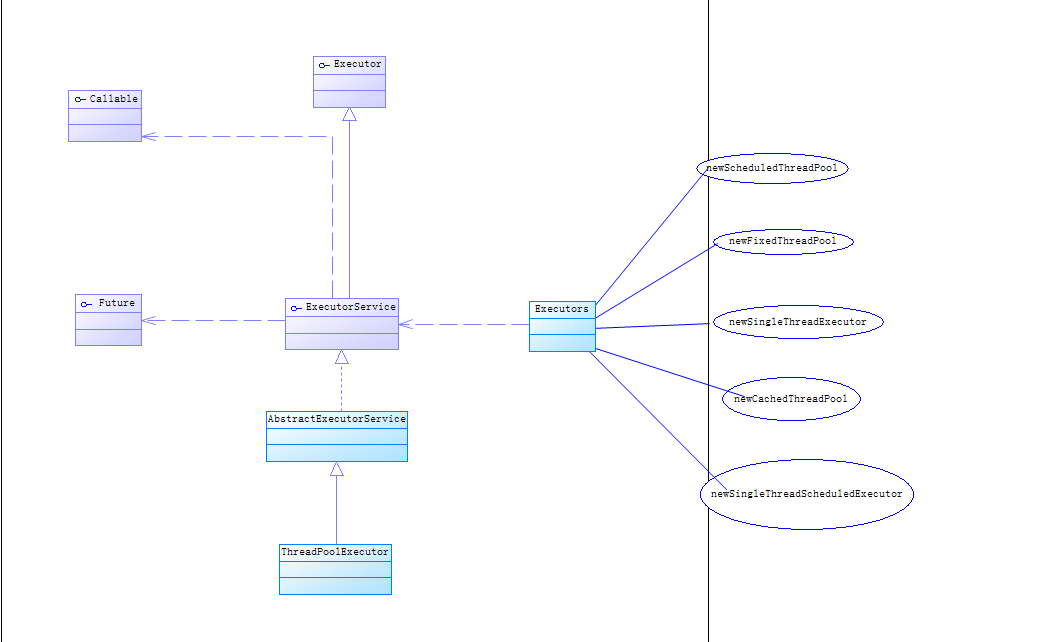
本文将基于以上图片进行线程池测试用例;
1class FetchPicket implements Callable<Integer> {
2
3		@Override
4		public Integer call() throws Exception {
5
6			System.out.println("当前线程名字为:" + Thread.currentThread().getName() + " ~~~");
7			System.out.println("开始时间:"+new SimpleDateFormat("yyyy-MM-dd HH:mm:ss").format(new Date()));
8			Thread.sleep(10000);
9			System.out.println("结束时间:"+new SimpleDateFormat("yyyy-MM-dd HH:mm:ss").format(new Date()));
10			return new Random().nextInt();
11		}
12
13	}
- newCachedThreadPool
newCachedThreadPool 方法的java doc如下:
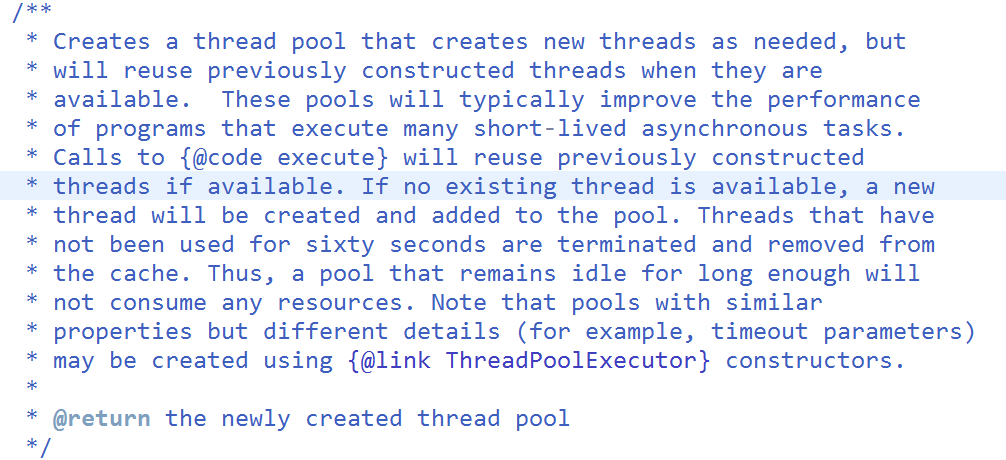
如果没有空闲线程,按照需要创建新的线程,不过当有空闲线程时,会复用已经创建好的线程.
优点:
1,可以提高编程性能,尤其对那些寿命短,异步的任务.
注意对于超过60s未使用的线程,将会从线程池中移除.
代码如下:
1    @Test
2	public void newCachedThreadPool() {
3
4		ExecutorService newCachedThreadPool = Executors.newCachedThreadPool();
5		for (int i = 0; i < LOOP; i++) {
6			// 使用lambada表达式
7			Future<Integer> submit = newCachedThreadPool.submit(new FetchPicket());
8			try {
9				if (submit.get() > 0) {
10					System.out.println("callable 的返回值是:" + submit.get());
11				}
12			} catch (InterruptedException | ExecutionException e) {
13
14				e.printStackTrace();
15			}
16
17		}
18		newCachedThreadPool.shutdown();
19	}
console打印如下:
1当前线程名字为:pool-1-thread-1 ~~~
2开始时间:2017-03-29 14:47:40
3结束时间:2017-03-29 14:47:50
4callable 的返回值是:1172363209
5当前线程名字为:pool-1-thread-1 ~~~
6开始时间:2017-03-29 14:47:50
7结束时间:2017-03-29 14:48:00
8当前线程名字为:pool-1-thread-1 ~~~
9开始时间:2017-03-29 14:48:00
10结束时间:2017-03-29 14:48:10
11callable 的返回值是:822004726
12当前线程名字为:pool-1-thread-2 ~~~
13开始时间:2017-03-29 14:48:10
14结束时间:2017-03-29 14:48:20
15callable 的返回值是:547995146
16当前线程名字为:pool-1-thread-2 ~~~
17开始时间:2017-03-29 14:48:20
18结束时间:2017-03-29 14:48:30
- newFixedThreadPool
Java doc如下:
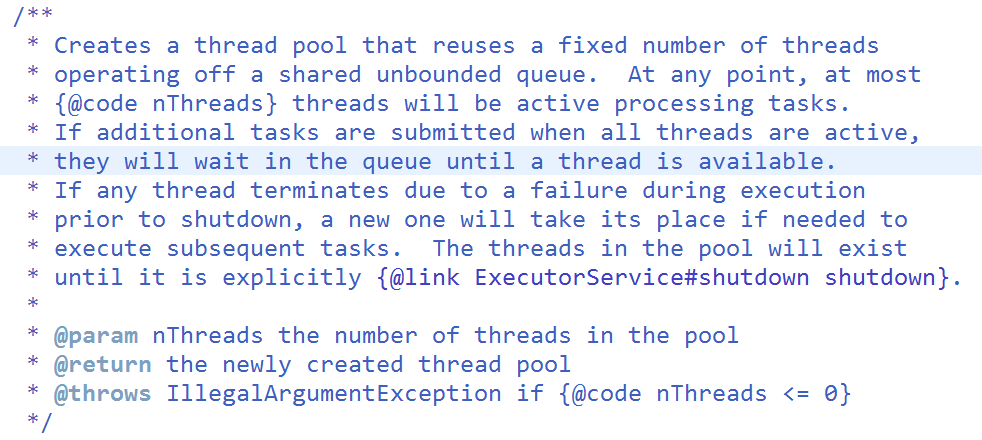
创建一个固定数目可重复利用的线程池,表现出一个共享无序的队列.如果线程池里所有的线程都是active,若在提交新的线程,这个线程将会被加到一个堵塞队列中直到有可用的线程.
1    @Test
2	public void newFixedThreadPool() throws InterruptedException, ExecutionException {
3
4		ExecutorService newFixedThreadPool = Executors.newFixedThreadPool(SIZE);
5		for (int i = 0; i < LOOP; i++) {
6			Future<Integer> submit = newFixedThreadPool.submit(new FetchPicket());
7			try {
8				if (submit.get() > 0) {
9					System.out.println("callable 的返回值是:" + submit.get());
10				}
11			} catch (InterruptedException | ExecutionException e) {
12
13				e.printStackTrace();
14			}
15		}
16		newFixedThreadPool.shutdown();
17	}
console打印如下:
1当前线程名字为:pool-1-thread-1 ~~~
2开始时间:2017-03-29 15:12:19
3结束时间:2017-03-29 15:12:29
4当前线程名字为:pool-1-thread-2 ~~~
5开始时间:2017-03-29 15:12:29
6结束时间:2017-03-29 15:12:39
7callable 的返回值是:360730033
8当前线程名字为:pool-1-thread-1 ~~~
9开始时间:2017-03-29 15:12:39
10结束时间:2017-03-29 15:12:49
11callable 的返回值是:1306633973
12当前线程名字为:pool-1-thread-2 ~~~
13开始时间:2017-03-29 15:12:49
14结束时间:2017-03-29 15:12:59
15当前线程名字为:pool-1-thread-1 ~~~
16开始时间:2017-03-29 15:12:59
17结束时间:2017-03-29 15:13:09
18callable 的返回值是:1154663265
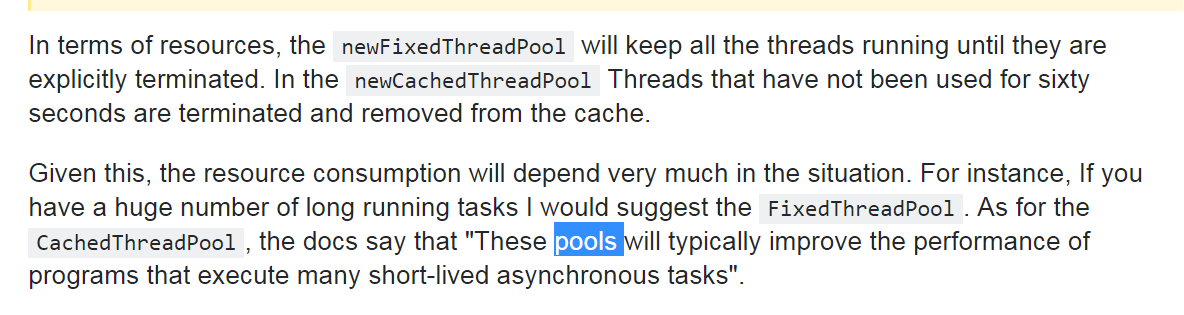
newFixedThreadPool 和 newCachedThreadPool 区别?
1,newFixedThreadPool 的线程是不可复用的,而newCachedThreadPool 线程是可复用的.
2,newFixedThreadPool 将会保持线程池内的线程active除非出现异常,而newCachedThreadPool 只会保持默认时间60s,因此,newFixedThreadPool 会不断的创建线程,有可能导致oom.
3,对于任务时间短异步任务,建议使用newCachedThreadPool,而执行任务时间比较长的建议使用newFixedThreadPool
英文翻译如下:
- newScheduledThreadPool
Java doc如下:
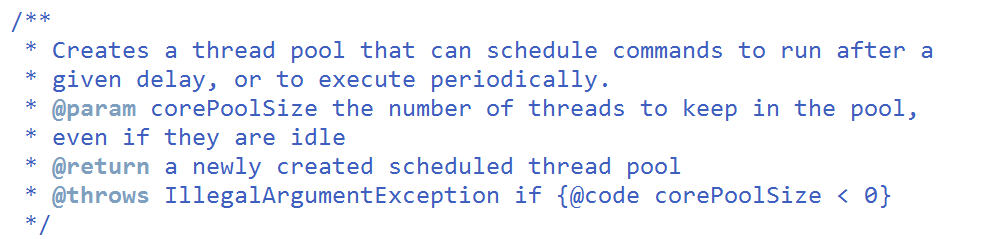
创建一个再给定的延迟时间按日期安排进行的线程池,
代码如下:
1@Test
2	public void newScheduledThreadPool() {
3		ExecutorService newScheduledThreadPool = Executors.newScheduledThreadPool(SIZE);
4
5		for (int i = 0; i < LOOP; i++) {
6			Future<Integer> submit = newScheduledThreadPool.submit(new FetchPicket());
7			try {
8				if (submit.get() > 0) {
9					System.out.println("callable 的返回值是:" + submit.get());
10				}
11			} catch (InterruptedException | ExecutionException e) {
12
13				e.printStackTrace();
14			}
15
16		}
17		newScheduledThreadPool.shutdown();
18	}
console打印如下:
1当前线程名字为:pool-1-thread-1 ~~~
2开始时间:2017-03-29 15:36:03
3结束时间:2017-03-29 15:36:13
4callable 的返回值是:797384947
5当前线程名字为:pool-1-thread-1 ~~~
6开始时间:2017-03-29 15:36:13
7结束时间:2017-03-29 15:36:23
8当前线程名字为:pool-1-thread-2 ~~~
9开始时间:2017-03-29 15:36:23
10结束时间:2017-03-29 15:36:33
11当前线程名字为:pool-1-thread-1 ~~~
12开始时间:2017-03-29 15:36:33
13结束时间:2017-03-29 15:36:43
14callable 的返回值是:1928166459
15当前线程名字为:pool-1-thread-2 ~~~
16开始时间:2017-03-29 15:36:43
17结束时间:2017-03-29 15:36:53
分析日志可以看出,哪个线程处于空闲状态,谁抢到资源,将会执行哪个线程.
- newSingleThreadScheduledExecutor
java doc如下
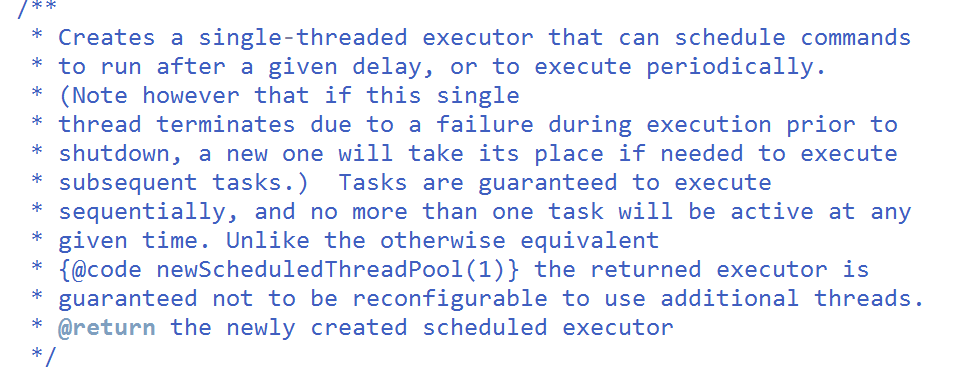
创建一个按照计划执行指令的单线程,如果该线程因为某些原因关闭,新的线程将会创建并替代他的位置.
1   @Test
2	public void newSingleThreadScheduledExecutor() {
3		ExecutorService newScheduledThreadPool = Executors.newSingleThreadScheduledExecutor();
4		for (int i = 0; i < LOOP; i++) {
5			Future<Integer> submit = newScheduledThreadPool.submit(new FetchPicket() );
6			try {
7				if (submit.get() > 0) {
8					System.out.println("callable 的返回值是:" + submit.get());
9				}
10			} catch (InterruptedException | ExecutionException e) {
11
12				e.printStackTrace();
13			}
14
15		}
16		newScheduledThreadPool.shutdown();
17	}
console日志如下:
1当前线程名字为:pool-1-thread-1 ~~~
2开始时间:2017-03-29 15:46:40
3结束时间:2017-03-29 15:46:50
4callable 的返回值是:387305211
5当前线程名字为:pool-1-thread-1 ~~~
6开始时间:2017-03-29 15:46:50
7结束时间:2017-03-29 15:47:00
8callable 的返回值是:1772792044
9当前线程名字为:pool-1-thread-1 ~~~
10开始时间:2017-03-29 15:47:00
11结束时间:2017-03-29 15:47:10
12callable 的返回值是:1354567240
13当前线程名字为:pool-1-thread-1 ~~~
14开始时间:2017-03-29 15:47:10
15结束时间:2017-03-29 15:47:20
16当前线程名字为:pool-1-thread-1 ~~~
17开始时间:2017-03-29 15:47:20
18结束时间:2017-03-29 15:47:30
19callable 的返回值是:1825312382
分析日志可以看出,只有一个线程在打印日志.
- newSingleThreadExecutor
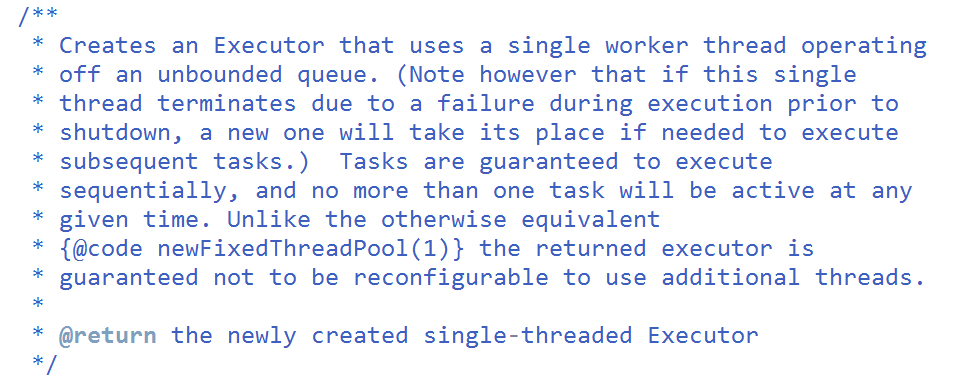
代码如下:
1    @Test
2	public void newSingleThreadExecutor() {
3
4
5		ExecutorService newSingleThreadExecutor = Executors.newSingleThreadExecutor();
6
7		for (int i = 0; i < LOOP; i++) {
8			Future<Integer> submit = newSingleThreadExecutor.submit(new FetchPicket());
9			try {
10				if (submit.get() > 0) {
11					System.out.println("callable 的返回值是:" + submit.get());
12				}
13			} catch (InterruptedException | ExecutionException e) {
14
15				e.printStackTrace();
16			}
17
18		}
19		newSingleThreadExecutor.shutdown();
20	}
console打印如下:
1当前线程名字为:pool-1-thread-1 ~~~
2开始时间:2017-03-29 15:51:33
3结束时间:2017-03-29 15:51:43
4callable 的返回值是:1323389732
5当前线程名字为:pool-1-thread-1 ~~~
6开始时间:2017-03-29 15:51:43
7结束时间:2017-03-29 15:51:53
8callable 的返回值是:1419085557
9当前线程名字为:pool-1-thread-1 ~~~
10开始时间:2017-03-29 15:51:53
11结束时间:2017-03-29 15:52:03
12callable 的返回值是:423848033
13当前线程名字为:pool-1-thread-1 ~~~
14开始时间:2017-03-29 15:52:03
15结束时间:2017-03-29 15:52:13
16callable 的返回值是:1320865693
17当前线程名字为:pool-1-thread-1 ~~~
18开始时间:2017-03-29 15:52:13
19结束时间:2017-03-29 15:52:23
分析日志,只有一个线程在执行任务.