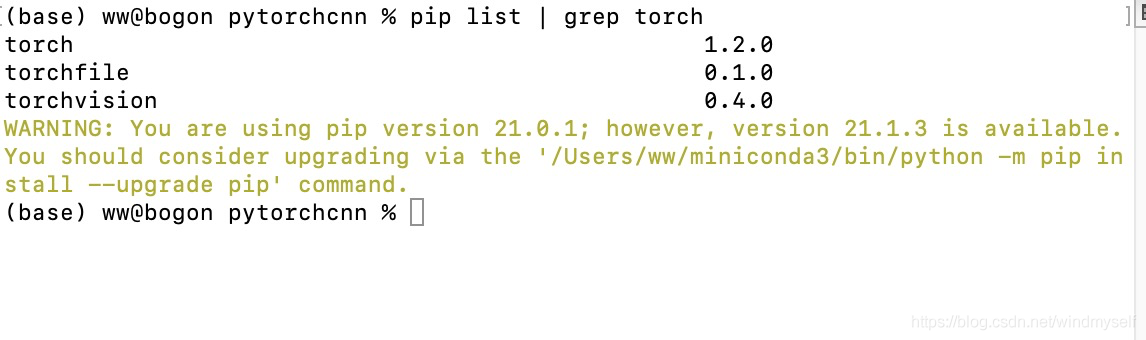
- 环境:python3、torch1.2.0(torch1.5.0也可以)、torchvision0.4.0
- 代码:(注:DOWNLOAD_MNIST = False第一次应该设为True,原因在代码注释里)
1import torch
2from torch.autograd import Variable
3import torch.utils.data as Data
4import torchvision  # 数据库模块
5import torch.nn as nn
6import matplotlib.pyplot as plt
7
8
9LR = 0.001  # 学习率
10BATCH_SIZE = 50  # 表示每次选取50个样本作训练
11EPOCH = 1  # epoch表示整个数据集重复训练次数
12DOWNLOAD_MNIST = False  # 是否下载MNIST,第一次需要设置为True,下载完数据集,以后不需要下载,设置为False就可以了。
13
14train_data = torchvision.datasets.MNIST(root='./mnist',
15					train=True,  # 表示这是训练集
16                                       	transform=torchvision.transforms.ToTensor(),  # 原始数据是array数组,转换为tensor,同时进行归一化
17                                        download=DOWNLOAD_MNIST)
18
19# 打印图片
20print(train_data.data.size())  # 打印训练集的大小
21print(train_data.targets.size())  # 打印训练集标签的大小
22# 使用imshow()函数加载训练集中的图片
23plt.imshow(train_data.data[0].numpy(), cmap='gray')
24plt.title('%i' % train_data.targets[0])
25plt.show()
26
27# 训练
28train_loader = Data.DataLoader(dataset=train_data, batch_size=BATCH_SIZE,
29                              			 shuffle=True, num_workers=2)  # 批量化(包装)处理数据集
30
31test_data = torchvision.datasets.MNIST(root='./mnist', train=False)
32
33'''#测试集shape from (2000, 28, 28) to (2000, 1, 28, 28), value in range(0,1)
34test_x = torch.unsqueeze(test_data.data, dim=[:2000].type(torch.FloatTensor).cuda()/255.
35
36'''#这里使用cuda()表示使用调用GPU加速跑测试集/训练集
37# test_y = test_data.targets[:2000].cuda()
38# test_x = Variable(torch.unsqueeze(test_data.test_data, dim=1), volatile=True).type(torch.FloatTensor)[:2000]/255
39with torch.no_grad():
40    test_x = Variable(torch.unsqueeze(test_data.data, dim=1)).type(torch.FloatTensor)[:2000]/255.# 这行代码中的volatile=True在torch1.5版本以上就不支持了(包括1.5版本)
41
42test_y = test_data.targets[:2000]
43
44# 搭建CNN网络
45if __name__ == '__main__':
46    class CNN(torch.nn.Module):  # 定义一个神经网络层
47        def __init__(self):  # 定义初始化
48            super(CNN, self).__init__()  # 继承初始层
49            self.conv1 = torch.nn.Sequential(
50                nn.Conv2d(in_channels=1,
51                          out_channels=16,  # 卷积核个数
52                          kernel_size=5,  # 卷积核大小
53                          stride=1,  # 卷积核移动步长
54                          padding=2,  # 填充数目
55                          ),  #-->卷积后的图片形状大小(28,28,16)
56                nn.ReLU(),
57                nn.MaxPool2d(kernel_size=2),  #-->池化后的图片形状大小(14,14,16)
58            )
59            self.conv2 = nn.Sequential(
60                nn.Conv2d(16, 32, 5, 1, 2),  #-->第二次卷积后的图片形状大小(14,14,32)
61                nn.ReLU(),
62                nn.MaxPool2d(kernel_size=2)  #-->第二次池化后的图片形状大小(7,7,32)
63                )
64            self.out = nn.Linear(32*7*7, 10)  # 全连接层
65
66        def forward(self, x):
67            x = self.conv1(x)
68            x = self.conv2(x)
69            x = x.view(x.size(0), -1)  # 数据展平为多维后的图片形状大小(batch size,7,7,32)
70            output = self.out(x)
71            return output
72
73    cnn = CNN()
74    print(cnn)  # 打印CNN网络
75    # cnn.cuda()  # CNN模型使用GPU加速
76
77    optimizer = torch.optim.Adam(cnn.parameters(), lr=LR, betas=(0.9, 0.99))  # Adam优化器
78    loss_func = nn.CrossEntropyLoss()  # 损失函数
79
80    # 训练模型
81    for epoch in range(EPOCH):
82        for step, (b_x, b_y) in enumerate(train_loader):
83            # output = cnn(b_x.cuda())  # CNN预测输出
84            output = cnn(b_x) # CNN预测输出
85            # loss = loss_func(output, b_y.cuda())
86            loss = loss_func(output, b_y)
87            optimizer.zero_grad()
88            loss.backward()
89            optimizer.step()
90
91            if step % 50 == 0:
92                # test_output = cnn(test_x.cuda())
93                test_output = cnn(test_x)
94                # test_pred = torch.max(test_output, 1)[1].cuda().data
95                test_pred = torch.max(test_output, 1)[1].data
96                test_accuracy = float((test_pred == test_y).sum().item()) / float(test_y.size(0))
97                print('Epoch:', epoch, 'Train loss:', loss.data.cpu().numpy(), 'Test Accuracy:', test_accuracy)
98
99    # 观察前20个数据误差
100    test_output = cnn(test_x[:20])
101    # pred_y = torch.max(test_output, 1)[1].cuda().data
102    pred_y = torch.max(test_output, 1)[1].data
103    print(pred_y.cpu().numpy(), 'prediction number')
104    print(test_y[:20].cpu().numpy(), 'real number')
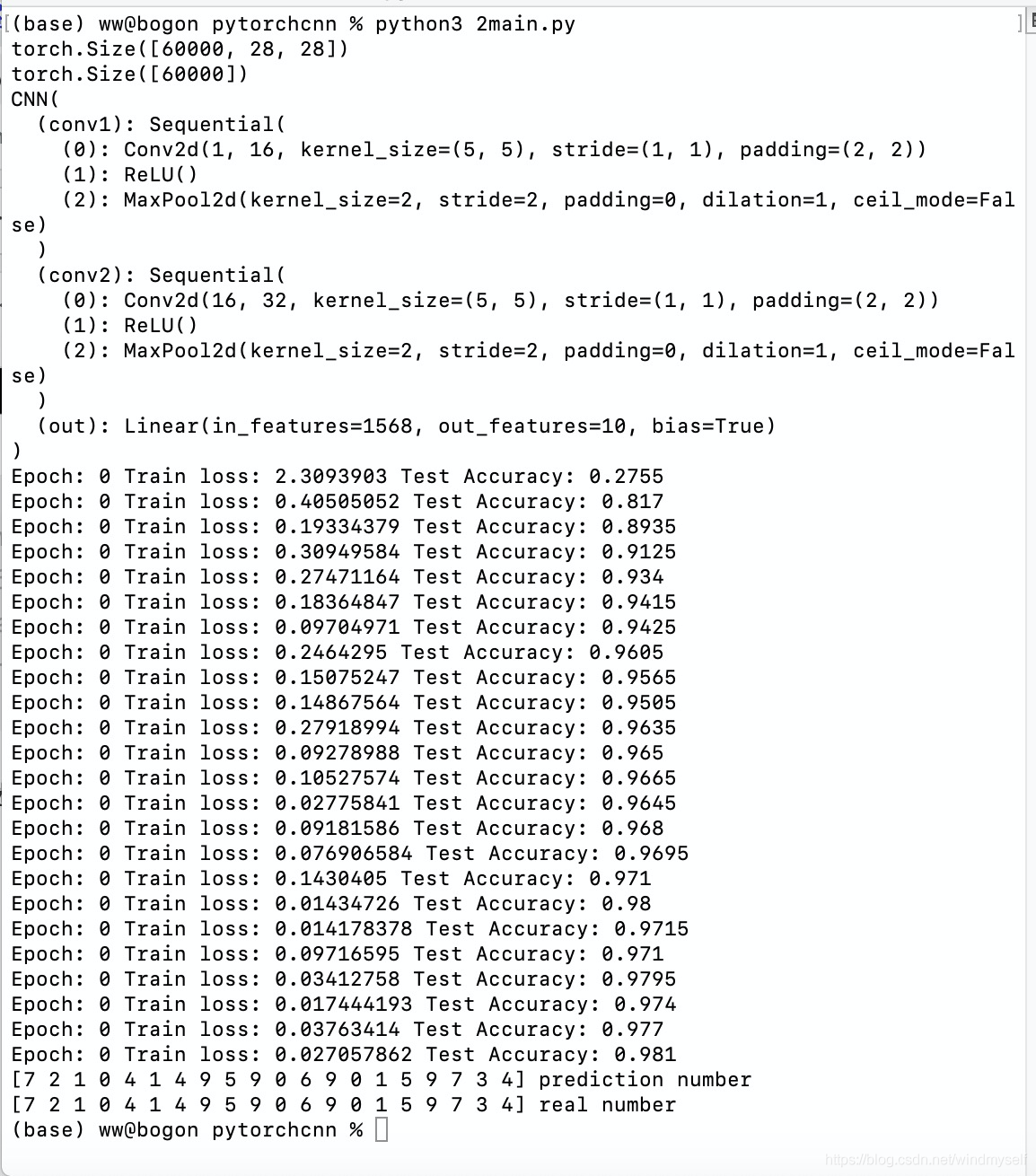
- 代码执行结果:
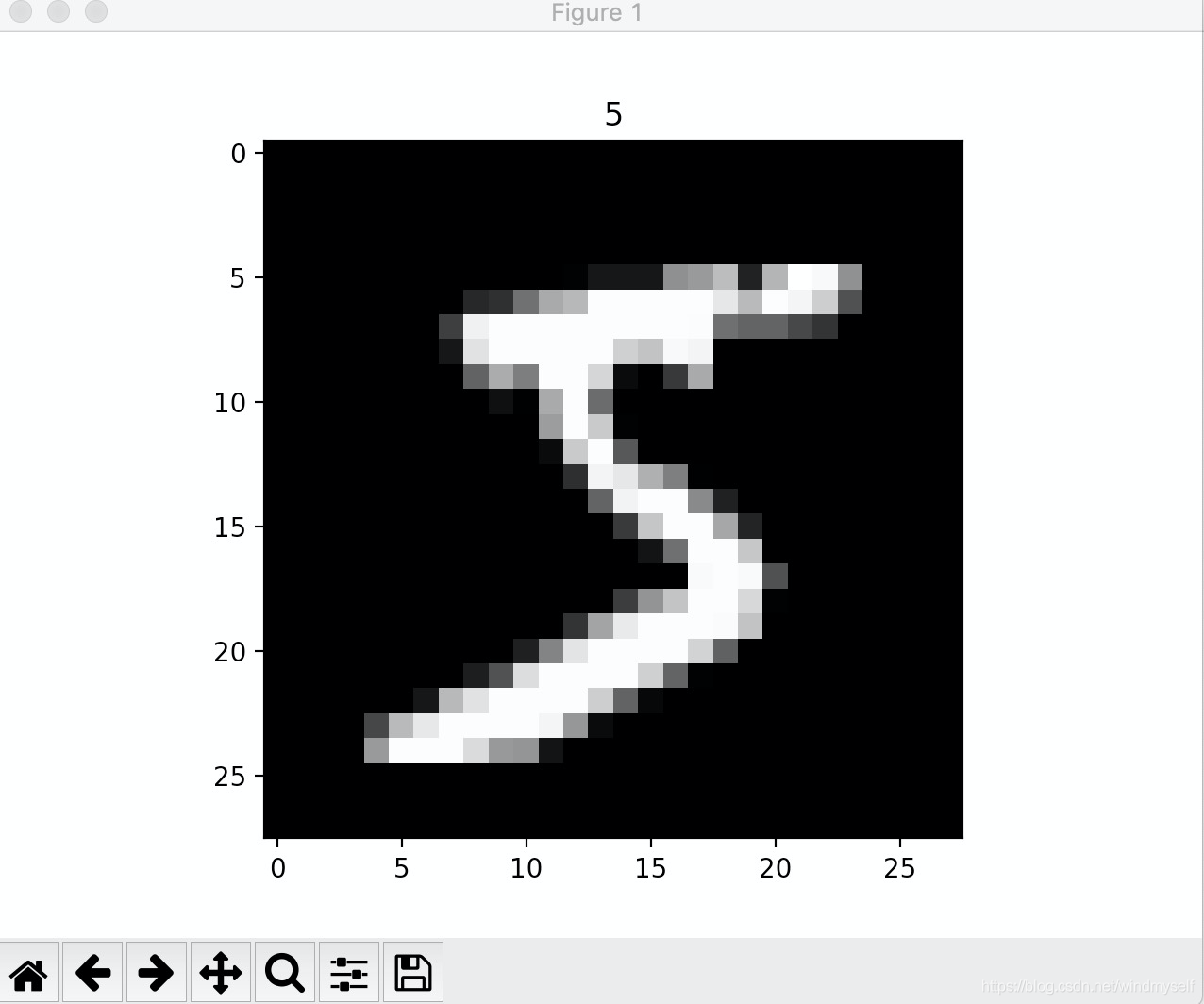
- 关掉显示窗口后程序继续执行