
Set针对复杂对象去重问题
在项目中我们经常使用set,因其可以去重特性,平时使用较多的是基础数据类型,Set<Integer>, Set<Long>等,这些在使用中都没碰到什么问题。最近在项目中碰到自定义对象去重,用后
创建的对象去覆盖set中type相同的对象,于是想到Set这个集合类型,并且重写了自定义对象的equals()和hashCode()方法,但调试阶段发现结果并非所想。
以下代码是自定义的Bean:
1@AllArgsConstructor
2@ToString
3public class Foo implements Serializable {
4
5    private static final long serialVersionUID = -3968061057233768716L;
6    @Getter
7    @Setter
8    private int type;
9
10    @Getter
11    @Setter
12    private String name;
13
14    @Override
15    public boolean equals(Object o) {
16        if (this == o) {
17            return true;
18        }
19        if (o == null || getClass() != o.getClass()) {
20            return false;
21        }
22        Foo foo = (Foo) o;
23        return type == foo.type;
24    }
25
26    @Override
27    public int hashCode() {
28        return Objects.hash(type);
29    }
30}
31
接下来写个单元测试吧
1public class SetTest {
2
3    @Test
4    public void test1() {
5        Set<Foo> set = new HashSet<>();
6        Foo foo = new Foo(1, "1");
7        set.add(foo);
8        foo = new Foo(2, "2");
9        set.add(foo);
10        foo = new Foo(1, "3");
11        set.add(foo);
12        // 输出结果是什么
13        System.out.println("set = " + set);
14
15    }
16
17
第一感觉会输出什么,set.size()=2是毫无疑问的,重点是type=1的对象对应的name是1还是3?当时我用脑子意想出来的name=3。可能会有童鞋认为输出的结果name=1,恭喜你答对了,确实
是name=1。
1set = [Foo(type=1, name=1), Foo(type=2, name=2)]
2
为什么不是3呢,3呢,3呢?接下来我们分析下,我们都知道当我们向HashMap中放入相同key和不同val放入到map中,map会保留最新的val(hashMap源码分析网上有很多解析,这里不再赘
述了,自行Google下),可见map其实也是保证key唯一的,不会出现key对应多个val的值(限:jdk中自带HashMap,Guava中Multimap是可以key对应多个val的,get(key)时返回的是val的集
合),HashSet就是利用HashMap中key唯一不重复的特性来实现的。
jdk1.8源码
1public class HashSet<E> 2 extends AbstractSet<E> 3 implements Set<E>, Cloneable, java.io.Serializable 4{ 5 static final long serialVersionUID = -5024744406713321676L; 6 7 private transient HashMap<E,Object> map; 8 9 // Dummy value to associate with an Object in the backing Map 10 private static final Object PRESENT = new Object(); 11 12 /** 13 * Constructs a new, empty set; the backing <tt>HashMap</tt> instance has 14 * default initial capacity (16) and load factor (0.75). 15 */ 16 public HashSet() { 17 map = new HashMap<>(); 18 } 19 20 -----------add部分 begin-------------------- 21 22 /** 23 * Adds the specified element to this set if it is not already present. 24 * More formally, adds the specified element <tt>e</tt> to this set if 25 * this set contains no element <tt>e2</tt> such that 26 * <tt>(e==null ? e2==null : e.equals(e2))</tt>. 27 * If this set already contains the element, the call leaves the set 28 * unchanged and returns <tt>false</tt>. 29 * 30 * @param e element to be added to this set 31 * @return <tt>true</tt> if this set did not already contain the specified 32 * element 33 */ 34 // 其实这里是有返回值的 35 public boolean add(E e) { 36 return map.put(e, PRESENT)==null; 37 } 38 -----------add部分 end-------------------- 39 40 41 42调用add()实际就是调用HashMap的put方法,注意此时put的val是固定式<font color="red">**PRESENT**</font>是final修饰的一个对象,针对所有key都一样,因为我们是set所有val对我们来说没啥用。但是我们注意到其 43
实add()方法是有返回值的,当调用map.put()方法返回的对象是null的时候则代表新增成功,set中以前不存在此元素。当返回的对象not null的时候代表set中有此对象,而我们关注的其实只是key,
并不关注这个val。
1  public V put(K key, V value) {
2        return putVal(hash(key), key, value, false, true);
3    }
4
5-----------
6
7    final V putVal(int hash, K key, V value, boolean onlyIfAbsent,
8                   boolean evict) {
9    Node<K,V>[] tab; Node<K,V> p; int n, i;
10    if ((tab = table) == null || (n = tab.length) == 0)
11        n = (tab = resize()).length;
12    if ((p = tab[i = (n - 1) & hash]) == null)
13        tab[i] = newNode(hash, key, value, null);
14    else {
15        Node<K,V> e; K k;
16        // 重点在这里
17        if (p.hash == hash &&
18            ((k = p.key) == key || (key != null && key.equals(k))))
19            e = p;
20        else if (p instanceof TreeNode)
21            e = ((TreeNode<K,V>)p).putTreeVal(this, tab, hash, key, value);
22        else {
23            for (int binCount = 0; ; ++binCount) {
24                if ((e = p.next) == null) {
25                    p.next = newNode(hash, key, value, null);
26                    if (binCount >= TREEIFY_THRESHOLD - 1) // -1 for 1st
27                        treeifyBin(tab, hash);
28                    break;
29                }
30                if (e.hash == hash &&
31                    ((k = e.key) == key || (key != null && key.equals(k))))
32                    break;
33                p = e;
34            }
35        }
36
37        // 当我们第二次加入type=1时代码肯定就走到了这里,return oldValue其实也就是returun我们传入的PRESENT not nul
38        if (e != null) { // existing mapping for key
39            V oldValue = e.value;
40            if (!onlyIfAbsent || oldValue == null)
41                e.value = value;
42            afterNodeAccess(e);
43            return oldValue;
44        }
45    }
46    ++modCount;
47    if (++size > threshold)
48        resize();
49    afterNodeInsertion(evict);
50    return null;
51}
52
重点在这里
重点在这里
重点在这里
1if (p.hash == hash &&
2            ((k = p.key) == key || (key != null && key.equals(k))))
3            e = p;
4
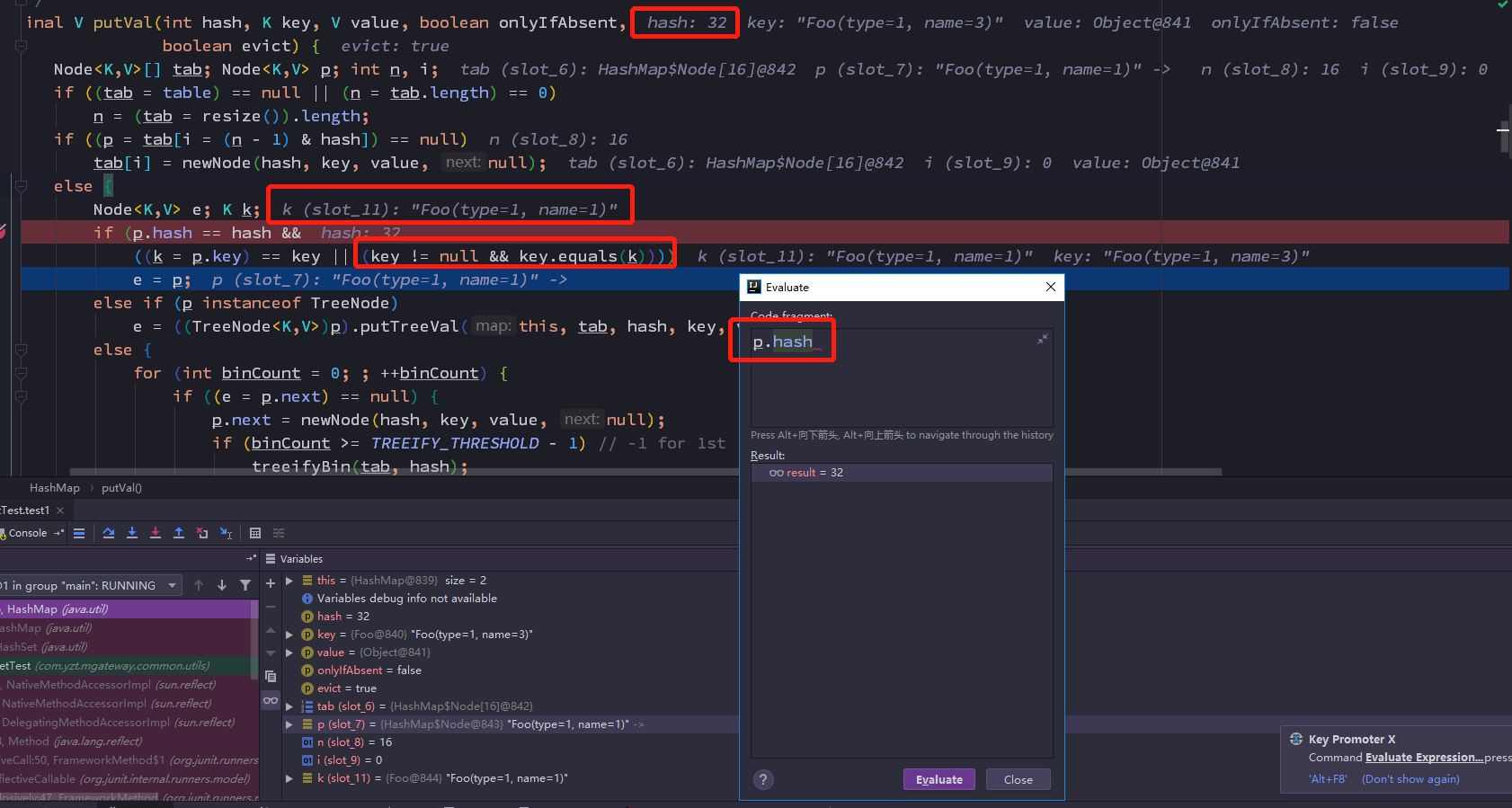
hash相等是肯定的,因为我们重写了Foo对象的hashCode方法,只跟type有关,所有p.hash==hash为true,大括号中(k = p.key) == key部门为false因为对象地址不同,但是
key != null && key.equals(k)是为true的,因为重写了equals()方法也只跟type有关,都为1,所以e = p了,流程判断语句结束,return一个not null的value。其实putVal()流程控制来看,只要我们的key
是存在的都会返回一个not null的val,而新插入的key返回值都是null。
代码调试截图走一波
最后没办法先remove()后add()。。。
注:代码中使用了lombok插件,非常好用哈哈,墙裂推荐。一个@Data搞定所有,不要告诉我idea代码自动生成,想一下,当你开发代码时给对象增加一个属性是不是还要给新属性生成get和set方法,还要toString()是不是也要改,而你加了@Data属性,这些都不需要考虑了。