
AQS是什么?
AbstractQueuedSynchronizer简称AQS是一个抽象同步框架,可以用来实现一个依赖状态的同步器。
Provides a framework for implementing blocking locks and related synchronizers (semaphores, events, etc) that rely on first-in-first-out (FIFO) wait queues. This class is designed to be a useful basis for most kinds of synchronizers that rely on a single atomic int value to represent state.
提供一个框架,用于实现依赖先进先出(FIFO)等待队列的阻塞锁和相关同步器(信号量,事件等)。该类被设计为大多数类型的同步器的有用依据,这些同步器依赖于单个原子int值来表示状态。
This class supports either or both a default exclusive mode and a shared mode.
此类支持默认独占模式和共享模式。
Even though this class is based on an internal FIFO queue, it does not automatically enforce FIFO acquisition policies. The core of exclusive synchronization takes the form:
即使这个类基于内部FIFO队列,它也不会自动执行FIFO采集策略。 排他同步的核心形式如下:
1Acquire: 2 while (!tryAcquire(arg)) { 3 enqueue thread if it is not already queued; 4 possibly block current thread; 5 } 6 7 Release: 8 if (tryRelease(arg)) 9 unblock the first queued thread; 10 11(共享模式类似,但可能包含级联信号。)
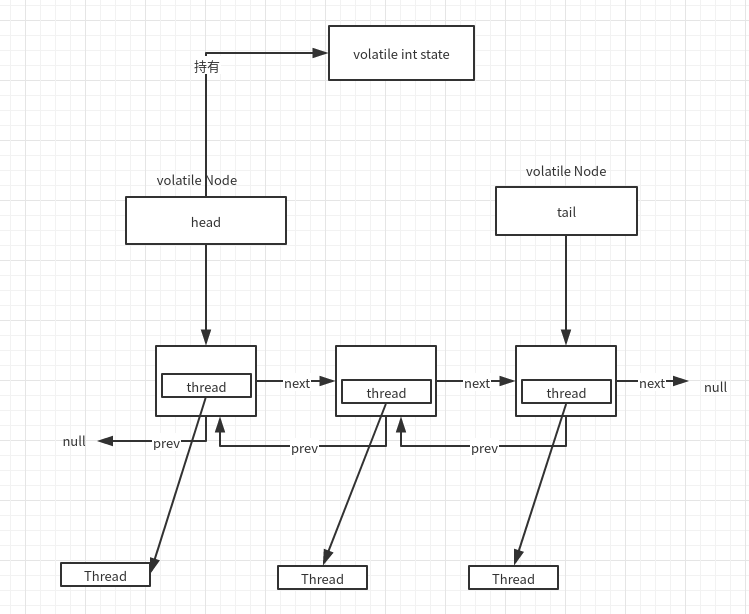
AQS 结构
1 /** 2 * 当前持有独占锁的线程 3 */ 4 private transient Thread exclusiveOwnerThread; 5 6 /** 7 * 等待队列的头结点,一般为当前持有锁的线程 (volatile) 8 */ 9 private transient volatile Node head; 10 11 /** 12 * 等待队列的尾结点,每次新结点进来,都是加到尾部,形成了链表 (volatile) 13 */ 14 private transient volatile Node tail; 15 16 /** 17 * 锁的状态,0 表示没有被占用,具体由子类实现 (volatile) 18 */ 19 private volatile int state; 20 21 // 等待队列的结点 22 static final class Node { 23 // 标识节点当前在共享模式下 24 static final Node SHARED = new Node(); 25 // 标识节点当前在独占模式下 26 static final Node EXCLUSIVE = null; 27 28 // 大于等于0 表明这个结点的线程取消了争抢这个锁,不需要去唤醒 29 /** 30 * The values are arranged numerically to simplify use. 31 * Non-negative values mean that a node doesn't need to 32 * signal. So, most code doesn't need to check for particular 33 * values, just for sign. 34 * 35 * The field is initialized to 0 for normal sync nodes, and 36 * CONDITION for condition nodes. It is modified using CAS 37 * (or when possible, unconditional volatile writes). 38 */ 39 volatile int waitStatus; 40 41 // 前一个结点 42 volatile Node prev; 43 44 // 下一个结点 45 volatile Node next; 46 47 // 等待的线程 48 volatile Thread thread; 49 50 ... 51 }
CLH队列 -- Craig, Landin, and Hagersten lock queue
CLH是一个非阻塞的 FIFO 队列。也就是说往里面插入或移除一个节点的时候,在并发条件下不会阻塞,而是通过自旋锁和 CAS 保证节点插入和移除的原子性。
源码导读:ReentrantLock 公平锁
1 public static void main(String[] args) {
2    ReentrantLock lock = new ReentrantLock(true);
3
4    lock.lock();
5
6    lock.unlock();
7  }
我们先看一下lock, 然后是 unlock
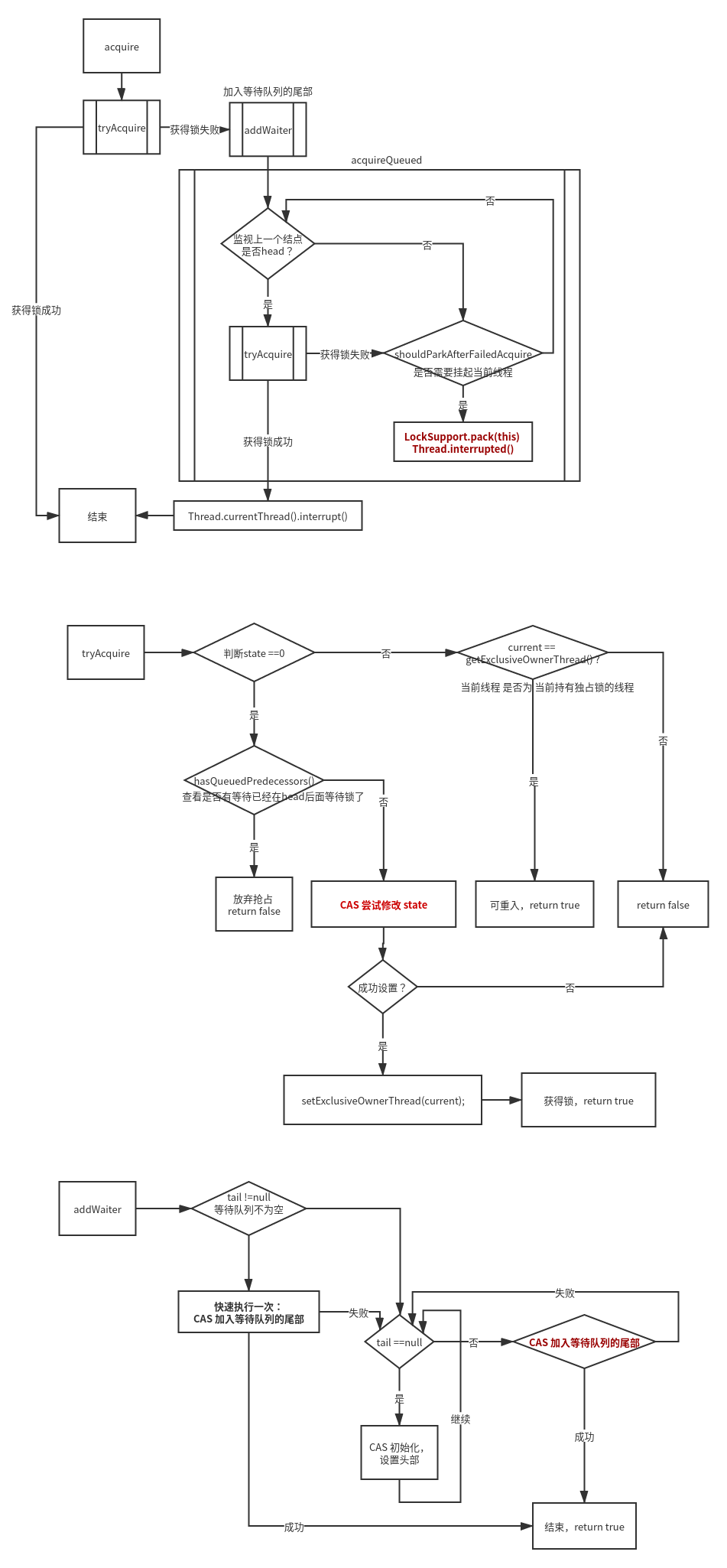
获得锁的流程和源码解读
1// ReentrantLock.FairSync
2	final void lock() {
3            acquire(1);
4     }
5
6// AQS
7	public final void acquire(int arg) {
8        // 1) 当前线程尝试获得锁,如果成功,结束
9        // 2)如果获得锁失败,当前线程加入等待队列,加入后不断循环监视上一个结点状态
10        //     如果上一个结点是头结点head ,-尝试获得锁,获得成功,跳出循环
11        //     否则,根据上一个结点的waitStatus,进行调整,包括挂起当前线程,或调整上一个结点为非取消状态的结点
12        // 3)最后当前线程发起中断 Thread.currentThread().interrupt()
13        if (!tryAcquire(arg) &&
14            acquireQueued(addWaiter(Node.EXCLUSIVE), arg))
15            selfInterrupt();
16    }
17
18// ReentrantLock.FairSync
19// 当前线程尝试获得锁
20// 返回true:1.没有线程在等待锁;2.重入锁,线程本来就持有锁,也就可以理所当然可以直接获取
21	protected final boolean tryAcquire(int acquires) {
22            final Thread current = Thread.currentThread();
23            int c = getState();
24            if (c == 0) {
25                // 1)查看是否有等待已经在head后面等待锁了,如果有当前线程放弃抢占锁
26                // 2)如果没有线程等待,CAS 尝试修改 state, 如果成功,获得锁
27                // 3)设置的当前线程为 当前持有独占锁的线程
28                if (!hasQueuedPredecessors() &&
29                    compareAndSetState(0, acquires)) {
30                    setExclusiveOwnerThread(current);
31                    return true;
32                }
33            }
34        	// 4)如果state不为0, 说明为可重入,只需要判断 当前线程 是否为 当前持有独占锁的线程
35        	// 5)如果是,可重入,state增加
36            else if (current == getExclusiveOwnerThread()) {
37                int nextc = c + acquires;
38                if (nextc < 0)
39                    throw new Error("Maximum lock count exceeded");
40                setState(nextc);
41                return true;
42            }
43        	//6) 其他情况,获得锁失败
44            return false;
45        }
46
47// AQS
48// 构造结点,采用CAS 加入等待队列的尾部
49	private Node addWaiter(Node mode) {
50        Node node = new Node(Thread.currentThread(), mode);
51        Node pred = tail;
52        //1) 如果等待队列不为空,则CAS 将当前线程加入等待队列的尾部
53        if (pred != null) {
54            node.prev = pred;
55            if (compareAndSetTail(pred, node)) {
56                pred.next = node;
57                return node;
58            }
59        }
60        // 2)如果等待队列为空,则CAS 新建初始化CLH队列,并当前线程加入等待队列的尾部
61        enq(node);
62        return node;
63    }
64
65// AQS
66// 如果获得锁失败,当前线程加入等待队列
67    final boolean acquireQueued(final Node node, int arg) {
68        boolean failed = true;
69        try {
70            boolean interrupted = false;
71            // 注意,这是一个循环,只有获得锁,或抛异常才会退出
72            // 如果上一个节点是头结点 head,则尝试获得锁
73            // 否则,如果当前线程需要挂起,则挂起等待锁的释放
74            for (;;) {
75                // 1)查看当前结点的上一个结点,如果是头结点head,尝试获得锁
76                final Node p = node.predecessor();
77                if (p == head && tryAcquire(arg)) {
78                    setHead(node);
79                    p.next = null; // help GC
80                    failed = false;
81                    return interrupted;
82                }
83                // 2)如果当前结点的上一个结点不是头结点head,或获得锁失败,则判断一下是否需求挂起当前线程?
84                // 3)如果需要挂起,则 park 挂起当前线程
85                if (shouldParkAfterFailedAcquire(p, node) &&
86                    parkAndCheckInterrupt())
87                    interrupted = true;
88            }
89        } finally {
90            // 4)如果获得锁失败,并且抛异常,则当前线程取消抢占
91            if (failed)
92                cancelAcquire(node);
93        }
94    }
95
96// AQS
97    private static boolean shouldParkAfterFailedAcquire(Node pred, Node node) {
98        int ws = pred.waitStatus;
99        // 1)如果上一个结点的状态是 -1, 则当前结点 需要挂起
100        if (ws == Node.SIGNAL)
101            return true;
102        // 2)如果上一个结点的状态 大于0,表示取消抢占了, 那么循环往前找到一个结点的状态 <=0,然后将当前结点的上一个结点 设置为 找到的结点
103        if (ws > 0) {
104            do {
105                node.prev = pred = pred.prev;
106            } while (pred.waitStatus > 0);
107            pred.next = node;
108        }
109        // 3)如果上一个结点<=0且不等于-1, 那么结点状态为 0(加入等待队列的初始状态), -2,-3,
110        //		此时需要 用CAS将上一个节点的waitStatus设置为Node.SIGNAL(也就是-1)
111        else {
112            compareAndSetWaitStatus(pred, ws, Node.SIGNAL);
113        }
114        return false;
115    }
116
117// AQS
118// 挂起当前线程,并测试返回当前线程是否中断状态
119	private final boolean parkAndCheckInterrupt() {
120        LockSupport.park(this);
121        return Thread.interrupted();
122    }
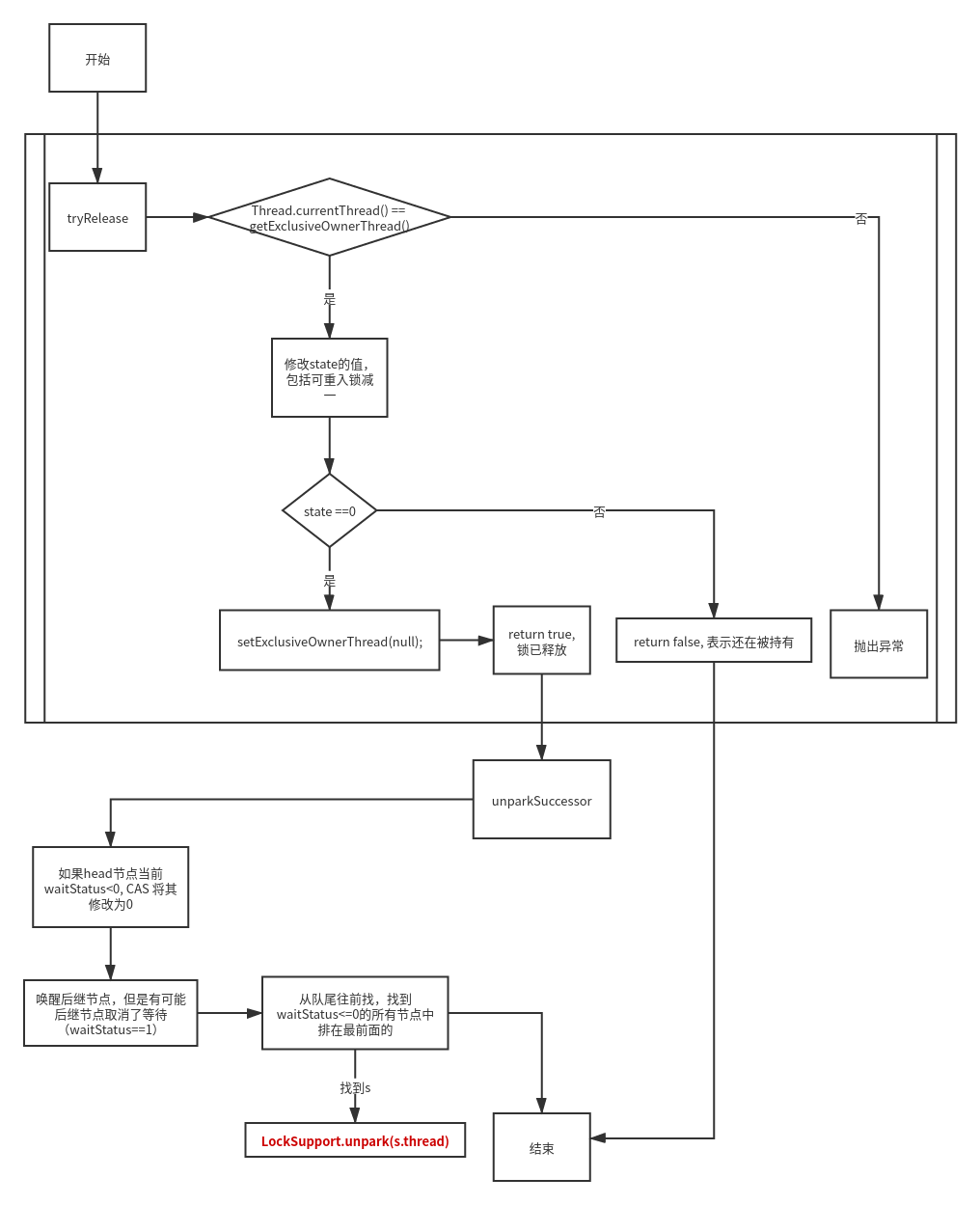
释放锁的流程和源码解读
1// ReentrantLock
2	final void unlock() {
3          sync.release(1);
4     }
5
6// AQS
7	public final boolean release(int arg) {
8        // 1)释放锁,尝试修改state的值
9        if (tryRelease(arg)) {
10            Node h = head;
11            // 2)如果等待队列有线程,则将头部的结点状态修正,并唤醒头结点的下一个不是取消状态的线程
12            if (h != null && h.waitStatus != 0)
13                unparkSuccessor(h);
14            return true;
15        }
16        return false;
17    }
18
19// ReentrantLock
20// 判断当前线程  是否为 当前持有独占锁的线程
21// 如果是,修改state的值,包括可重入锁减一
22// 如果不是,抛出异常
23	protected final boolean tryRelease(int releases) {
24            int c = getState() - releases;
25            if (Thread.currentThread() != getExclusiveOwnerThread())
26                throw new IllegalMonitorStateException();
27            boolean free = false;
28            if (c == 0) {
29                free = true;
30                setExclusiveOwnerThread(null);
31            }
32            setState(c);
33            return free;
34        }
35
36// AQS
37    private void unparkSuccessor(Node node) {
38        /*
39         * If status is negative (i.e., possibly needing signal) try
40         * to clear in anticipation of signalling.  It is OK if this
41         * fails or if status is changed by waiting thread.
42         */
43        int ws = node.waitStatus;
44        // 如果head节点当前waitStatus<0, CAS 将其修改为0
45        if (ws < 0)
46            compareAndSetWaitStatus(node, ws, 0);
47
48        /*
49         * Thread to unpark is held in successor, which is normally
50         * just the next node.  But if cancelled or apparently null,
51         * traverse backwards from tail to find the actual
52         * non-cancelled successor.
53         */
54        // 唤醒后继节点,但是有可能后继节点取消了等待(waitStatus==1)
55   		// 从队尾往前找,找到waitStatus<=0的所有节点中排在最前面的
56        Node s = node.next;
57        if (s == null || s.waitStatus > 0) {
58            s = null;
59            for (Node t = tail; t != null && t != node; t = t.prev)
60                if (t.waitStatus <= 0)
61                    s = t;
62        }
63        if (s != null)
64             // 唤醒线程
65            LockSupport.unpark(s.thread);
66    }
by 斯武丶风晴 https://my.oschina.net/langxSpirit