
一.类加载器及双亲委派机制
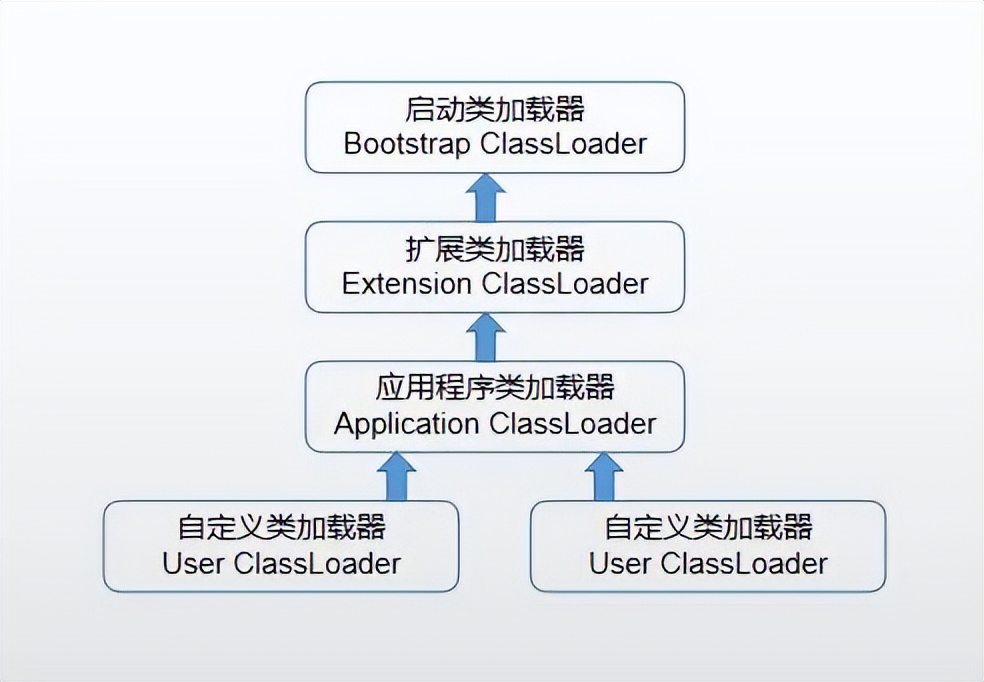
| 类加载器 | 加载类 | 备注 |
|---|---|---|
| 启动类加载器(Bootstrap ClassLoader) | JAVA_HOME/jre/lib | 无上级,无法直接访问 由jvm加载 |
| 拓展类加载器(Extension ClassLoader) | JAVA_HOME/jre/lib/ext | 父加载器为 Bootstrap,显示为 null 。该类由Bootstrap加载 |
| 应用类加载器(Application ClassLoader) | classpath | 父加载器上级为 Extension,该类由Bootstrap加载 |
| 自定义类加载器 | 自定义路径 | 父加载器为 Application,该类由Application ClassLoader加载 |
1.类加载器继承结构
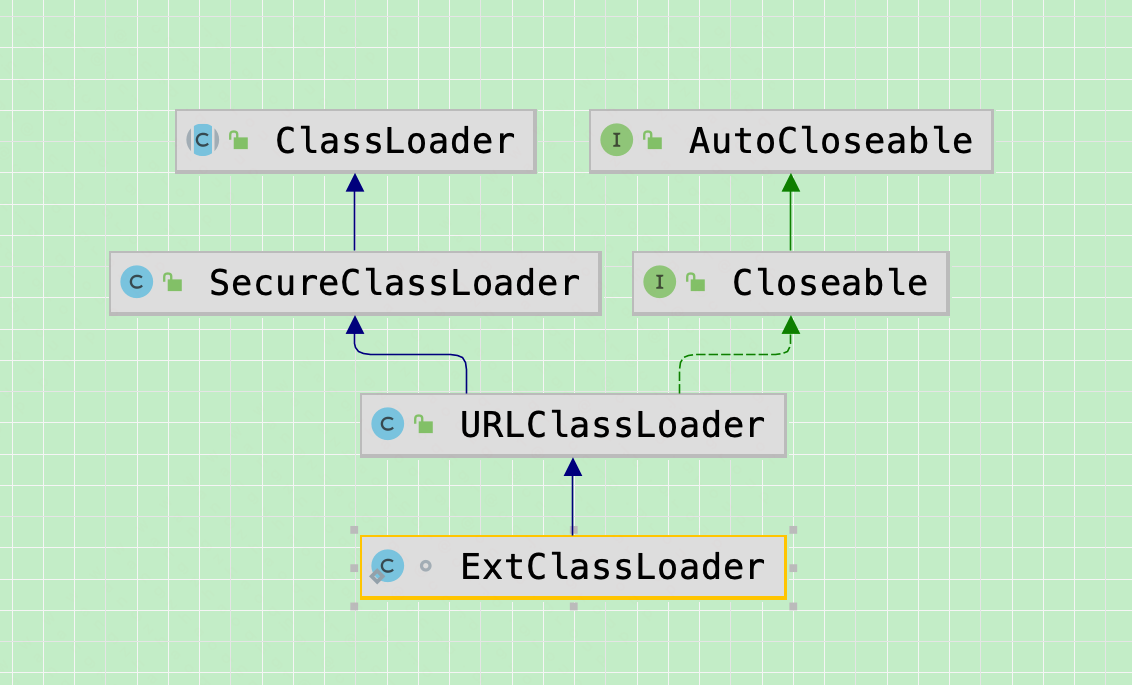
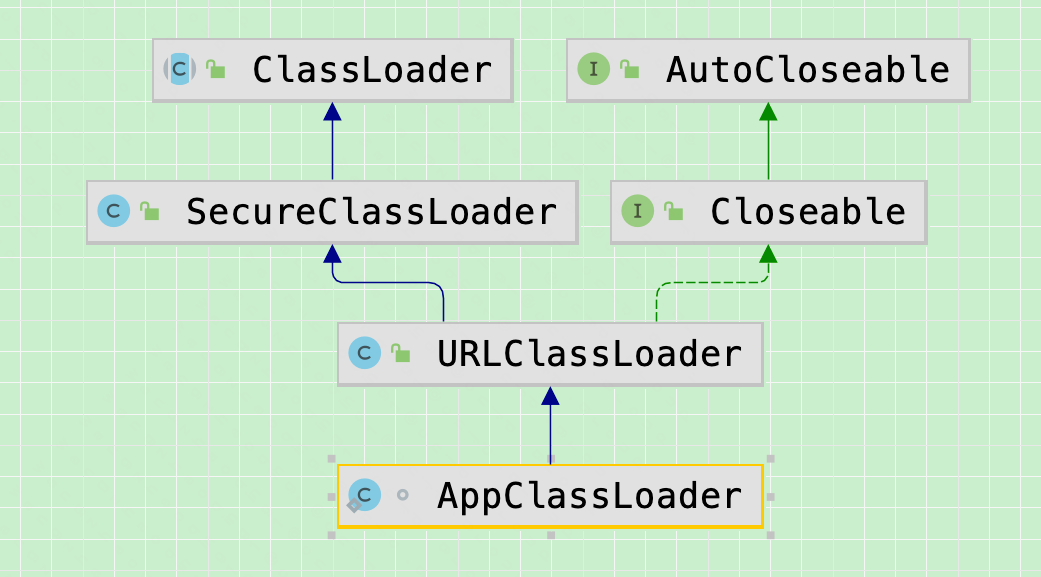
2. 类加载器的核心方法
| 方法名 | 说明 |
|---|---|
| getParent() | 返回该类加载器的父类加载器 |
| findClass(String name) | 查找名字为name的类,返回的结果是java.lang.Class类的实例 |
| loadClass(String name) | 加载名为name的类,返回java.lang.Class类的实例 |
| defineClass(String name,byte[] b,int off,int len) | 根据字节数组b中的数据转化成Java类,返回的结果是java.lang.Class类的实例 |
3. Launcher类源码解析
1public class Launcher {
2    private static URLStreamHandlerFactory factory = new Factory();
3    private static Launcher launcher = new Launcher();
4    // 启动类加载器加载路径
5    private static String bootClassPath =
6        System.getProperty("sun.boot.class.path");
7
8    public static Launcher getLauncher() {
9        return launcher;
10    }
11
12    private ClassLoader loader;
13
14    public Launcher() {
15        // Create the extension class loader
16        ClassLoader extcl;
17        try {
18            // 获取扩展类加载器
19            extcl = ExtClassLoader.getExtClassLoader();
20        } catch (IOException e) {
21            throw new InternalError(
22                "Could not create extension class loader", e);
23        }
24
25        // Now create the class loader to use to launch the application
26        try {
27            // 获取应用类加载器
28            loader = AppClassLoader.getAppClassLoader(extcl);
29        } catch (IOException e) {
30            throw new InternalError(
31                "Could not create application class loader", e);
32        }
33
34        // Also set the context class loader for the primordial thread.
35        // 设置线程上下文类加载器为应用类加载器
36        Thread.currentThread().setContextClassLoader(loader);
37    }
38
39
40    /*
41     * The class loader used for loading installed extensions.
42     */
43    static class ExtClassLoader extends URLClassLoader {
44
45
46        private static volatile ExtClassLoader instance = null;
47
48        /**
49         * create an ExtClassLoader. The ExtClassLoader is created
50         * within a context that limits which files it can read
51         */
52        public static ExtClassLoader getExtClassLoader() throws IOException
53        {
54            if (instance == null) {
55                synchronized(ExtClassLoader.class) {
56                    if (instance == null) {
57                        instance = createExtClassLoader();
58                    }
59                }
60            }
61            return instance;
62        }
63        /**
64         * 获取加载路径
65         */
66        private static File[] getExtDirs() {
67            // 扩展类加载器加载路径
68            String s = System.getProperty("java.ext.dirs");
69        }
70
71    }
72
73    /**
74     * The class loader used for loading from java.class.path.
75     * runs in a restricted security context.
76     */
77    static class AppClassLoader extends URLClassLoader {
78
79        public static ClassLoader getAppClassLoader(final ClassLoader extcl)
80            throws IOException
81        {
82            // 应用类加载器加载路径
83            final String s = System.getProperty("java.class.path");
84            final File[] path = (s == null) ? new File[0] : getClassPath(s);
85            return AccessController.doPrivileged(
86                new PrivilegedAction<AppClassLoader>() {
87                    public AppClassLoader run() {
88                    URL[] urls =
89                        (s == null) ? new URL[0] : pathToURLs(path);
90                    return new AppClassLoader(urls, extcl);
91                }
92            });
93        }
94}
95
96
97
98
99
100
101
4. ClassLoader类源码解析
1public abstract class ClassLoader {
2
3   protected Class<?> loadClass(String name, boolean resolve)
4        throws ClassNotFoundException
5    {
6        synchronized (getClassLoadingLock(name)) {
7            // First, check if the class has already been loaded
8            // 从系统缓存中获取
9            Class<?> c = findLoadedClass(name);
10            if (c == null) {
11                long t0 = System.nanoTime();
12                try {
13                     // 委托父加载器加载
14                    if (parent != null) {
15                        c = parent.loadClass(name, false);
16                    } else {
17                        c = findBootstrapClassOrNull(name);
18                    }
19                } catch (ClassNotFoundException e) {
20                    // ClassNotFoundException thrown if class not found
21                    // from the non-null parent class loader
22                }
23
24                if (c == null) {
25                    // If still not found, then invoke findClass in order
26                    // to find the class.
27                    long t1 = System.nanoTime();
28                    // 自己加载,从指定路径
29                    c = findClass(name);
30
31                    // this is the defining class loader; record the stats
32                    sun.misc.PerfCounter.getParentDelegationTime().addTime(t1 - t0);
33                    sun.misc.PerfCounter.getFindClassTime().addElapsedTimeFrom(t1);
34                    sun.misc.PerfCounter.getFindClasses().increment();
35                }
36            }
37            if (resolve) {
38                resolveClass(c);
39            }
40            return c;
41        }
42    }
43
44    // 自定义类加载器需要重写该方法
45    protected Class<?> findClass(String name) throws ClassNotFoundException {
46        throw new ClassNotFoundException(name);
47    }
48
49}
50
51
52
53
54
55
5. 双亲委派机制优缺点
优点:
1、保证安全性,层级关系代表优先级,也就是所有类的加载,优先给启动类加载器,这样就保证了核心类库类
2、避免类的重复加载,如果父类加载器加载过了,子类加载器就没有必要再去加载了,确保一个类的全局唯一性
缺点:
检查类是否加载的委派过程是单向的, 这个方式虽然从结构上说比较清晰,使各个 ClassLoader 的职责非常明确, 但是同时会带来一个问题, 即顶层的ClassLoader 无法访问底层的ClassLoader 所加载的类
通常情况下, 启动类加载器中的类为系统核心类, 包括一些重要的系统接口,而在应用类加载器中, 为应用类。 按照这种模式, 应用类访问系统类自然是没有问题, 但是系统类访问应用类就会出现问题。
二.spi接口及线程上下文类加载器
1.spi接口定义及线程上下文加载的作用
Java提供了很多核心接口的定义,这些接口被称为SPI接口。(Service Provider Interface,SPI),允许第三方为这些接口提供实现。常见的 SPI 有 JDBC、JCE、JNDI、JAXP 和 JBI 等。
这些 SPI 的接口由 Java 核心库来提供,而这些 SPI 的实现代码则是作为 Java 应用所依赖的 jar 包被包含进类路径(CLASSPATH)里。SPI接口中的代码经常需要加载具体的实现类。那么问题来了,SPI的接口是Java核心库的一部分,是由启动类加载器(Bootstrap Classloader)来加载的;SPI的实现类是由系统类加载器(System ClassLoader)来加载的。引导类加载器是无法找到 SPI 的实现类的,因为依照双亲委派模型,BootstrapClassloader无法委派AppClassLoader来加载类。而线程上下文类加载器破坏了“双亲委派模型”,可以在执行线程中抛弃双亲委派加载链模式,使程序可以逆向使用类加载器。
1    类加载传导规则:JVM 会选择当前类的类加载器来加载所有该类的引用的类。例如我们定义了 TestA 和 TestB 两个类,TestA 会引用 TestB,只要我们使用自定义的类加载器加载 TestA,那么在运行时,当 TestA 调用到 TestB 的时候,
2TestB 也会被 JVM 使用 TestA 的类加载器加载。依此类推,只要是 TestA 及其引用类关联的所有 jar 包的类都会被自定义类加载器加载。通过这种方式,我们只要让模块的 main 方法类使用不同的类加载器加载,那么每个模块的都会使用 main
3方法类的类加载器加载的,这样就能让多个模块分别使用不同类加载器。这也是 OSGi 和 SofaArk 能够实现类隔离的核心原理。
4
5
6
7
8
9
2. spi加载原理
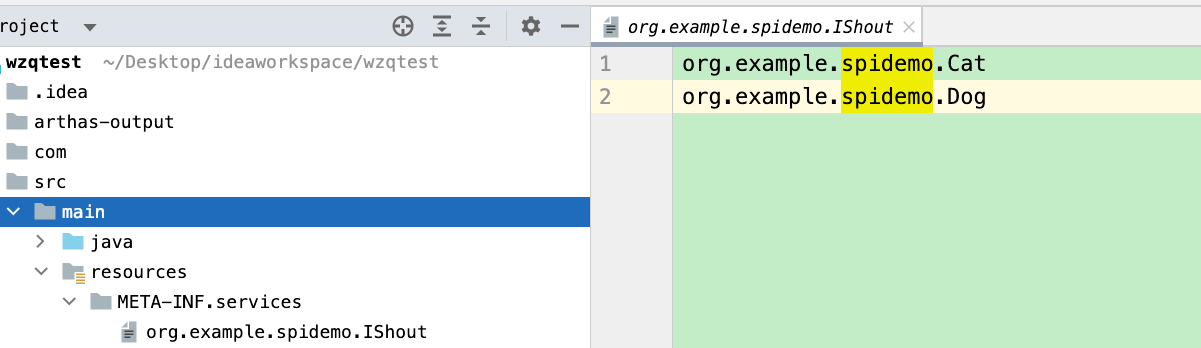
当第三方实现者提供了服务接口的一种实现之后,在jar包的 META-INF/services/ 目录里同时创建一个以服务接口命名的文件,该文件就是实现该服务接口的实现类。而当外部程序装配这个模块的时候,就能通过该jar包 META-INF/services/ 里的配置文件找到具体的实现类名,并装载实例化,完成模块的注入。
JDK官方提供了一个查找服务实现者的工具类:java.util.ServiceLoader
1public final class ServiceLoader<S>
2    implements Iterable<S>
3{
4
5     // 加载spi接口实现类配置文件固定路径
6    private static final String PREFIX = "META-INF/services/";
7   /**
8     * Creates a new service loader for the given service type, using the
9     * current thread's {@linkplain java.lang.Thread#getContextClassLoader
10     * context class loader}.
11     *
12     * <p> An invocation of this convenience method of the form
13     *
14     * <blockquote><pre>
15     * ServiceLoader.load(<i>service</i>)</pre></blockquote>
16     *
17     * is equivalent to
18     *
19     * <blockquote><pre>
20     * ServiceLoader.load(<i>service</i>,
21     *                    Thread.currentThread().getContextClassLoader())</pre></blockquote>
22     *
23     * @param  <S> the class of the service type
24     *
25     * @param  service
26     *         The interface or abstract class representing the service
27     *
28     * @return A new service loader
29     */
30    public static <S> ServiceLoader<S> load(Class<S> service) {
31        // 线程上下文类加载器
32        ClassLoader cl = Thread.currentThread().getContextClassLoader();
33        return ServiceLoader.load(service, cl);
34    }
35}
36
37
38
39
40
41
3.示列代码
代码:
1public interface IShout {
2    void shout();
3}
4
5public class Dog implements IShout {
6    @Override
7    public void shout() {
8        System.out.println("wang wang");
9    }
10}
11public class Cat implements IShout {
12    @Override
13    public void shout() {
14        System.out.println("miao miao");
15    }
16}
17
18public class Main {
19    public static void main(String[] args) {
20        ServiceLoader<IShout> shouts = ServiceLoader.load(IShout.class);
21        for (IShout s : shouts) {
22            s.shout();
23        }
24    }
25}
26
27
28
29
30
31
32
配置:
4.MySQL驱动类加载
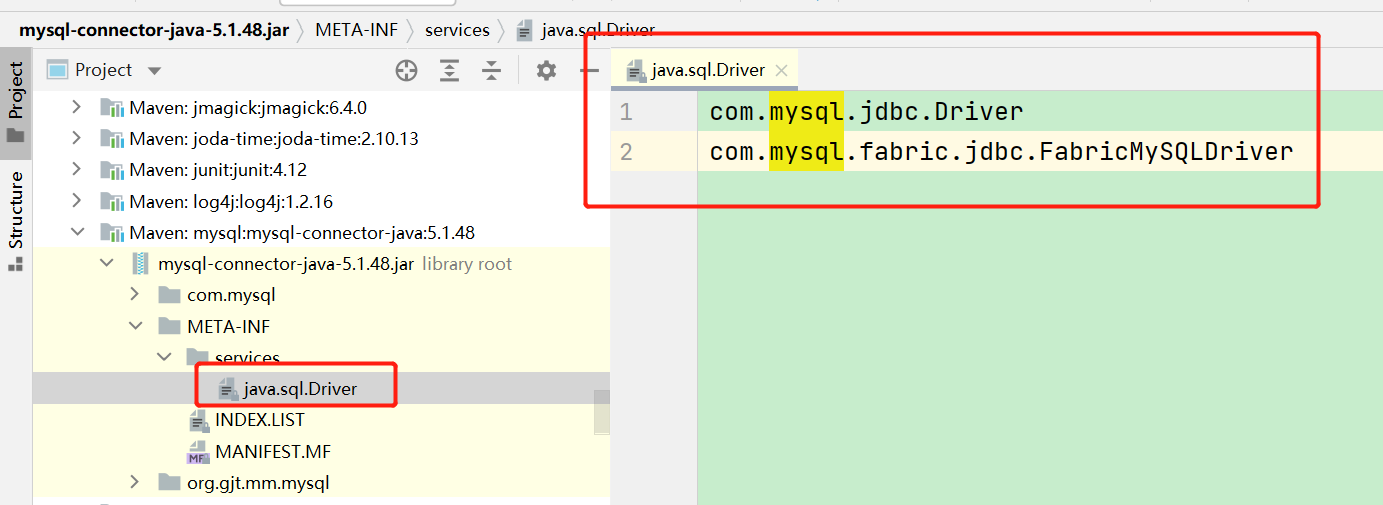
1// 加载Class到AppClassLoader(系统类加载器),然后注册驱动类
2//Class.forName("com.mysql.jdbc.Driver").newInstance();
3String url = "jdbc:mysql://localhost:3306/testdb";
4// 通过java库获取数据库连接
5Connection conn = java.sql.DriverManager.getConnection(url, "name", "password");
6
7
8
9public class DriverManager {
10    static {
11        loadInitialDrivers();
12        println("JDBC DriverManager initialized");
13    }
14private static void loadInitialDrivers() {
15         。。。。。。。
16        AccessController.doPrivileged(new PrivilegedAction<Void>() {
17            public Void run() {
18
19                ServiceLoader<Driver> loadedDrivers = ServiceLoader.load(Driver.class);
20                Iterator<Driver> driversIterator = loadedDrivers.iterator();
21
22                /* Load these drivers, so that they can be instantiated.
23                 * It may be the case that the driver class may not be there
24                 * i.e. there may be a packaged driver with the service class
25                 * as implementation of java.sql.Driver but the actual class
26                 * may be missing. In that case a java.util.ServiceConfigurationError
27                 * will be thrown at runtime by the VM trying to locate
28                 * and load the service.
29                 *
30                 * Adding a try catch block to catch those runtime errors
31                 * if driver not available in classpath but it's
32                 * packaged as service and that service is there in classpath.
33                 */
34                try{
35                    while(driversIterator.hasNext()) {
36                        driversIterator.next();
37                    }
38                } catch(Throwable t) {
39                // Do nothing
40                }
41                return null;
42            }
43        });
44
45        println("DriverManager.initialize: jdbc.drivers = " + drivers);
46
47        if (drivers == null || drivers.equals("")) {
48            return;
49        }
50        String[] driversList = drivers.split(":");
51        println("number of Drivers:" + driversList.length);
52        for (String aDriver : driversList) {
53            try {
54                println("DriverManager.Initialize: loading " + aDriver);
55                Class.forName(aDriver, true,
56                        ClassLoader.getSystemClassLoader());
57            } catch (Exception ex) {
58                println("DriverManager.Initialize: load failed: " + ex);
59            }
60        }
61    }
62}
63
64
65
66
67
68
三.自定义动态类加载器
1.示例代码
1public class DynamicClassLoad extends ClassLoader{
2
3    public static void main(String[] args) {
4
5        Executors.newSingleThreadScheduledExecutor().scheduleAtFixedRate(new Runnable() {
6            @Override
7            public void run() {
8                try {
9                    DynamicClassLoad myClassLoad = new DynamicClassLoad();
10                    Class clazz = myClassLoad.findClass("/Users/wangzhaoqing1/Desktop/MyTest.class");
11                    Object obj = clazz.newInstance();
12                    Method sayHello = clazz.getDeclaredMethod("sayHello");
13                    sayHello.invoke(obj, null);
14                } catch (Throwable e) {
15                    e.printStackTrace();
16                }
17            }
18        }, 1, 2, TimeUnit.SECONDS);
19    }
20
21
22    @Override
23    protected Class<?> findClass(String name) throws ClassNotFoundException {
24        File file = new File(name);
25        try {
26            byte[] bytes = FileUtils.readFileToByteArray(file);
27            Class<?> c = this.defineClass(null, bytes, 0, bytes.length);
28            return c;
29        } catch (Exception e) {
30            e.printStackTrace();
31        }
32        return super.findClass(name);
33    }
34}
35
36// DynamicClassLoad启动后,修改本类重新编译
37public class MyTest {
38
39    public void  sayHello(){
40        System.out.println("hello wzq 6666666666");
41    }
42}
43
44
45
46
47
48
作者:京东零售 王照清
来源:京东云开发者社区 转载请注明来源