
简介
- Netty中的 I/O 操作是异步的, 包括 Bind、Write、Connect 等操作会简单的返回一个ChannelFuture。
- 调用者不能立刻获得结果, 而是通过Future-Listener 机制, 用户可以方便的主动获取或者通过通知机制获得IO操作结果。
- Netty的异步模型是建立在future和callback之上的。callback就是回调。
- Future的核心思想是: 假设一个方法func(), 其计算过程可能很耗时, 等待func()返回不合适。那么就可以在调用func()的时候, 立马返回一个Future, 后续可以通过Future去监控方法func()的处理过程(即: Future-Listener机制)
Future说明
- 表示异步的结果, 可以通过它提供的方法来检测执行是否完成, 比如检索计算等。
- ChannelFuture是一个继承了Future类的接口, public interface ChannelFuture extends Future<Void> {}。可以添加监听器, 当监听的事件发生时, 就会通知到监听器。
ChannelFuture类注释
1/**
2 * The result of an asynchronous {@link Channel} I/O operation.
3 * 异步I/O操作的执行结果
4 * <p>
5 * All I/O operations in Netty are asynchronous.
6 * Netty中的所有 I/O操作都是异步的
7 * It means any I/O calls will return immediately with no guarantee that the
8 * requested I/O operation has been completed at the end of the call.
9 * 这意味着 任意 I/O 调用都会直接返回, 但是不能保证请求的I/O 操作在被调用前能够完成。
10 *
11 * Instead, you will be returned with a {@link ChannelFuture} instance which gives
12 * you the information about the result or status of the I/O operation.
13 * 但是, 会有一个能提供该I/O操作的结果或状态的ChannelFuture类实例被返回。
14 * <p>
15 *
16 * A {@link ChannelFuture} is either <em>uncompleted</em> or <em>completed</em>.
17 * channelFuture的状态可以是未完成的也可以是完成的。
18 *
19 * When an I/O operation begins, a new future object is created.
20 * 当一个 I/O 操作开始, 一个新的对象被创建。
21 *
22 * The new future is uncompleted initially - it is neither succeeded, failed, nor
23 * cancelled because the I/O operation is not finished yet.
24 * 新的future一开始是未完成状态, 它不是成功的, 失败的, 或取消的, 因为 I/O 操作并没有完成。
25 *
26 * If the I/O operation is finished either successfully, with failure, or by
27 * cancellation, the future is marked as completed with more specific information,
28 * such as the cause of the failure.
29 * 如果 I/O 操作是成功完成的, 失败的 或是 被取消状态, future就被标记为带有特定信息的完成状
30 * 态, 比如导致失败的原因。
31 *
32 * Please note that even failure and cancellation belong to the completed state.
33 * 请记住, 即使是 失败 和 取消 都是完成状态
34 * <pre>
35 *                                      +---------------------------+
36 *                                      | Completed successfully    |
37 *                                      +---------------------------+
38 *                                 +---->      isDone() = true      |
39 * +--------------------------+    |    |   isSuccess() = true      |
40 * |        Uncompleted       |    |    +===========================+
41 * +--------------------------+    |    | Completed with failure    |
42 * |      isDone() = false    |    |    +---------------------------+
43 * |   isSuccess() = false    |----+---->      isDone() = true      |
44 * | isCancelled() = false    |    |    |       cause() = non-null  |
45 * |       cause() = null     |    |    +===========================+
46 * +--------------------------+    |    | Completed by cancellation |
47 *                                 |    +---------------------------+
48 *                                 +---->      isDone() = true      |
49 *                                      | isCancelled() = true      |
50 *                                      +---------------------------+
51 * </pre>
52 *
53 * Various methods are provided to let you check if the I/O operation has been
54 * completed, wait for the completion, and retrieve the result of the I/O
55 * operation.
56 * 有许多方法提供给你来检查 此I/O 操作是否完成, 在等待完成, 并取回 I/O 操作的结果。
57 * It also allows you to add {@link ChannelFutureListener}s so you
58 * can get notified when the I/O operation is completed.
59 * 它还允许你添加 ChannelFuture监听器, 所以你能够在I/O 操作完成时被通知。
60 *
61 * <h3>Prefer {@link #addListener(GenericFutureListener)} to {@link #await()}</h3>
62 *
63 * It is recommended to prefer {@link #addListener(GenericFutureListener)} to
64 * {@link #await()} wherever possible to get notified when an I/O operation is
65 * done and to do any follow-up tasks.
66 * 当一个 I/O 操作被完成 并且 有接下来的任务要做时, 推荐使用 addListener(添加监听器)而不是
67 * await() 方法, 因为使用监听器的方式可以被通知。
68 * <p>
69 * {@link #addListener(GenericFutureListener)} is non-blocking.
70 * addListener 方法是非阻塞的
71 *
72 * It simply adds the specified {@link ChannelFutureListener} to the {@link
73 * ChannelFuture}, and I/O thread will notify the listeners when the I/O operation
74 * associated with the future is done.
75 * 它仅仅添加了特定的ChannelFutureListener到ChannelFuture中, 并且 I/O 线程会在 与future
76 * 相关联的 I/O 操作完成时通知监听器。
77 *
78 * {@link ChannelFutureListener} yields the best performance and resource
79 * utilization because it does not block at all, but it could be tricky to implement
80 * a sequential logic if you are not used to event-driven programming.
81 * 由于本身不阻塞, ChannelFutureListener(监听器) 能提供最好的效用 和 最好的资源利用率, 但
82 * 是如果内没有习惯于事件启动编程模型, 实现一系列逻辑时可能会比较tricky。
83 *
84 * <p>
85 * By contrast, {@link #await()} is a blocking operation.
86 * 相比较之下, await() 方法是一个阻塞操作。
87 * Once called, the caller thread blocks until the operation is done.
88 * 一旦被调用, 在操作结束之前, 调用者线程会一直阻塞。
89 * It is easier to implement a sequential logic with {@link #await()}, but the
90 * caller thread blocks unnecessarily until the I/O operation is done and there's
91 * relatively expensive cost of inter-thread notification.
92 * 以await() 方法实现一系列的逻辑会相对简单, 但是调用者线程在I/O操作间有不必要的阻塞 以及
93 * 线程内部通信代价很高。
94 * Moreover, there's a chance of dead lock in a particular circumstance, which is
95 * described below.
96 * 此外, 在特殊情况下, 还有可能会产生死锁, 描述如下。
97 *
98 * <h3>Do not call {@link #await()} inside {@link ChannelHandler}</h3>
99 * 不要在 ChannelHandler 中调用 await() 方法
100 * <p>
101 * The event handler methods in {@link ChannelHandler} are usually called by
102 * an I/O thread.
103 * ChannelHandler中的事件处理方法通常是由 I/O 线程调用的。
104 *
105 * If {@link #await()} is called by an event handler method, which is called by the
106 * I/O thread, the I/O operation it is waiting for might never complete because
107 * {@link #await()} can block the I/O operation it is waiting for, which is a dead
108 * lock.
109 * 如果 await() 方法是被一个事件处理方法以 I/O 线程的形式调用的, 该 I/O 操作会因为await()
110 * 方法阻塞了此 正在被等待的 I/O 操作, 从而导致死锁。
111 * <pre>
112 * // BAD - NEVER DO THIS 千万别做以下操作
113 * {@code @Override}
114 * public void channelRead({@link ChannelHandlerContext} ctx, Object msg) {
115 *     {@link ChannelFuture} future = ctx.channel().close();
116 *     future.awaitUninterruptibly();
117 *     // Perform post-closure operation
118 *     // ...
119 * }
120 *
121 * // GOOD 好的操作
122 * {@code @Override}
123 * public void channelRead({@link ChannelHandlerContext} ctx, Object msg) {
124 *     {@link ChannelFuture} future = ctx.channel().close();
125 *     future.addListener(new {@link ChannelFutureListener}() {
126 *         public void operationComplete({@link ChannelFuture} future) {
127 *             // Perform post-closure operation
128 *             // ...
129 *         }
130 *     });
131 * }
132 * </pre>
133 * <p>
134 * In spite of the disadvantages mentioned above, there are certainly the cases
135 * where it is more convenient to call {@link #await()}.
136 * 尽管await()方法的缺点已经在上列出, 还是肯定会有使用它跟方便的情况
137 * In such a case, please make sure you do not call {@link #await()} in an I/O
138 * thread.
139 * 在此情况下, 请确保你没有在I/O线程中调用await()
140 * Otherwise, {@link BlockingOperationException} will be raised to prevent a dead
141 * lock.
142 * 此外 BlockingOperationException(阻塞操作异常) 会被抛出来预防死锁
143 *
144 * <h3>Do not confuse I/O timeout and await timeout</h3>
145 * 不要将 I/O 超时 和 await 超时 弄混
146 *
147 * The timeout value you specify with {@link #await(long)},
148 * {@link #await(long, TimeUnit)}, {@link #awaitUninterruptibly(long)}, or
149 * {@link #awaitUninterruptibly(long, TimeUnit)} are not related with I/O
150 * timeout at all.
151 * 你使用 await(long), await(long, TimeUnit), awaitUninterruptibly(long) 或
152 * awaitUninterruptibly(long, TimeUnit)方法时的延时与 I/O 延迟无关。
153 *
154 * If an I/O operation times out, the future will be marked as
155 * 'completed with failure,' as depicted in the diagram above.
156 * 如果 I/O 操作延时, 该future 会被标记为 完成且失败, 就像途中描述的那样。
157 *
158 * For example, connect timeout should be configured via a transport-specific
159 * option:
160 * 比如, 连接事件应当通过特定的传输选项配置
161 * <pre>
162 * // BAD - NEVER DO THIS 不要做以下操作
163 * {@link Bootstrap} b = ...;
164 * {@link ChannelFuture} f = b.connect(...);
165 * f.awaitUninterruptibly(10, TimeUnit.SECONDS);
166 * if (f.isCancelled()) {
167 *     // Connection attempt cancelled by user
168 *     // 连接请求被用户取消
169 * } else if (!f.isSuccess()) {
170 *     // You might get a NullPointerException here because the future
171 *     // might not be completed yet.
172 *     // 你可能会得到一个空指针, 因为该future没有被完成。
173 *     f.cause().printStackTrace();
174 * } else {
175 *     // Connection established successfully
176 *     // 连接建立成功
177 * }
178 *
179 * // GOOD 好的操作
180 * {@link Bootstrap} b = ...;
181 * // Configure the connect timeout option.
182 * <b>b.option({@link ChannelOption}.CONNECT_TIMEOUT_MILLIS, 10000);</b>
183 * {@link ChannelFuture} f = b.connect(...);
184 * f.awaitUninterruptibly();
185 *
186 * // Now we are sure the future is completed.
187 * // 此时我们可以确认该future已完成
188 * assert f.isDone();
189 *
190 * if (f.isCancelled()) {
191 *     // Connection attempt cancelled by user
192 *     // 连接请求被用户取消
193 * } else if (!f.isSuccess()) {
194 *     f.cause().printStackTrace();
195 * } else {
196 *     // Connection established successfully
197 *     // 成功建立连接
198 * }
199 * </pre>
200 */
工作原理示意图
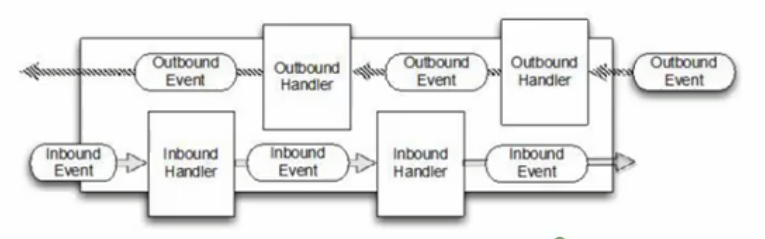
- inBound: 入栈
- outBound: 出栈
- 说明:
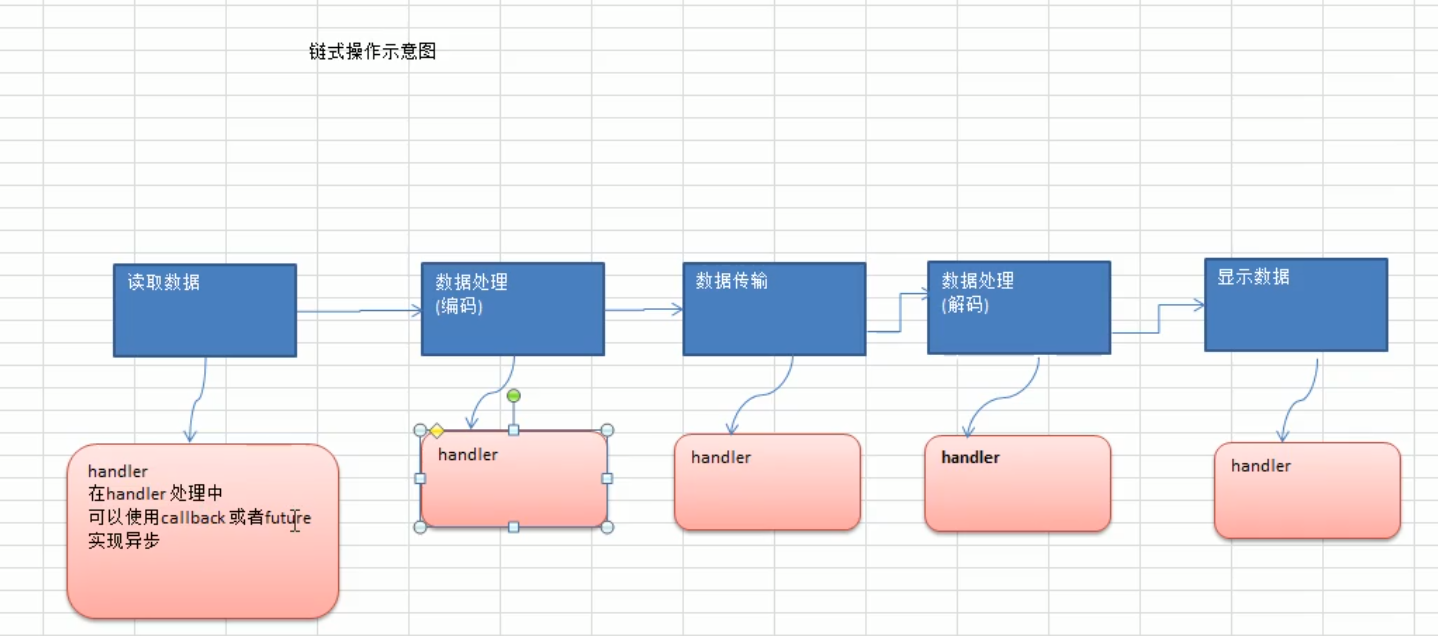
- 在使用Netty进行编程时, 拦截操作和转换出入栈数据只需要提供callback 或 利用future即可。
- 这使得链式操作简单、高效, 并有利于编写可重用的、通用的代码。
- Netty 框架的目标就是让你的业务逻辑从网络基础应用编码中分离出来。
Future-Listener机制
- 当Future对象刚刚创建时, 处于非完成状态, 调用者可以通过返回的ChannelFuture来获取操作执行的状态, 注册监听函数来执行完成后的操作。
- 常见操作
- 通过 isDone 方法来判断当前操作是否完成;
- 通过 isSuccess 方法来判断已完成的当前操作是否成功;
- 通过 getCause 方法来获取已完成的当前操作失败的原因;
- 通过 isCancelled 方法来判断已完成的当前操作是否被取消;
- 通过 addListener 方法来注册监听器, 当操作已完成(isDone 方法返回完成), 将会通知指定的监听器; 如果 Future 对象已完成, 则通知指定的监听器