stepchain 通用业务流程流水线处理框架。
类似于Commons Chain和Commons Pipeline这样的Java Pipeline Step Chain用于组织复杂处理流程执行的流行技术。
Java Pipeline Step Chain like Apache Commons Chain and Commons Pipeline。 A popular technique for organizing the execution of complex processing flows is the "Chain of Responsibility" pattern。
gitee: https://gitee.com/zengfr/stepchain
github: https://github.com/zengfr/stepchain/
Repositories Central Sonatype Mvnrepository
Feature: 1、支持通用业务job、services子流程无限制拆分。 2、支持业务子流程串行化、业务子流程并行化,可配置化。 3、支持Config业务子流程开启或禁用、配置串行或并行以及并行数的统一配置。 4、支持业务流程以及子流程任意无限嵌套。 5、支持配置中心、缓存、统一数据接口、redis、Es、日志Trace等。 6、支持并行分支,支持条件分支if/else、switch、loop子流程. 7、支持Processor定时调度FixedRate、FixedDelay。 备注:只开源了通用部分(不影响使用),去除了有关框架组件包括:配置中心、缓存中心、数据接口以及业务相关DataMiddle等部分API。
Maven Dependency: Maven(Not Use Spring Boot): <dependency> <groupId>com.github.zengfr.project</groupId> <artifactId>stepchain</artifactId> <version>0.0.7</version> <dependency> Maven(Use Spring Boot): <dependency> <groupId>com.github.zengfr.project</groupId> <artifactId>stepchain-spring-boot-starter</artifactId> <version>0.0.7</version> <dependency> Gradle: compile group: 'com.github.zengfr.project', name: 'stepchain', version: '0.0.7' compile group: 'com.github.zengfr.project', name: 'stepchain-spring-boot-starter', version: '0.0.7'
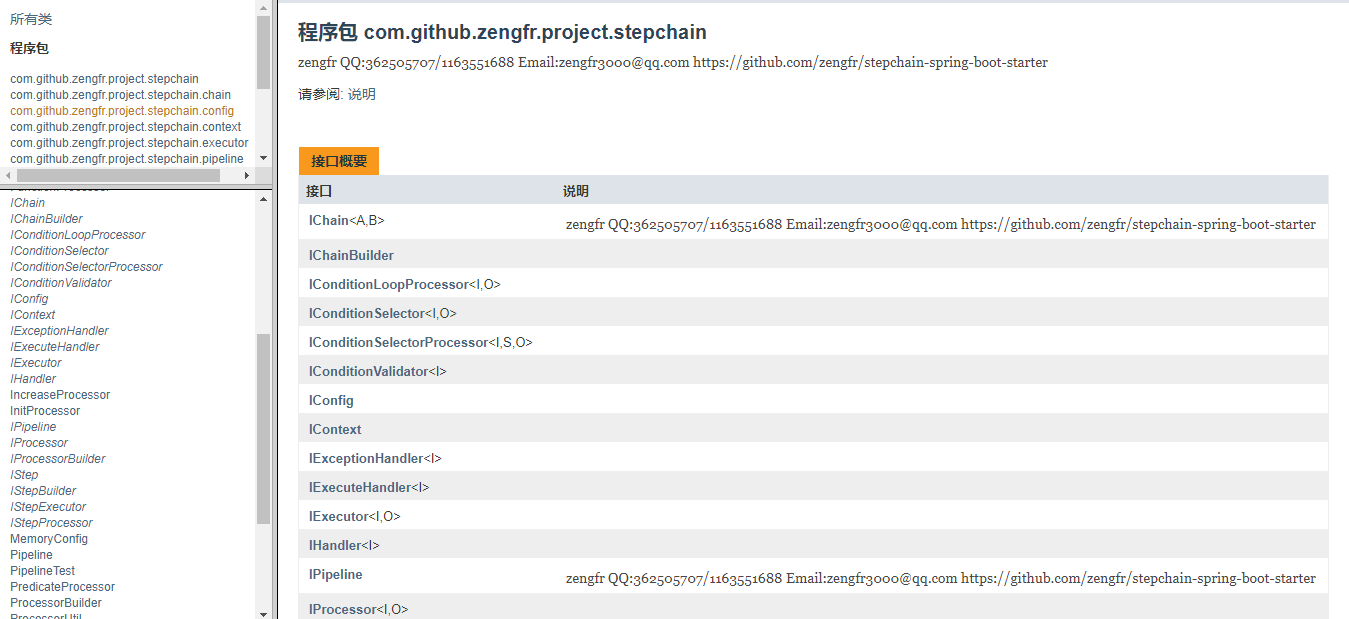
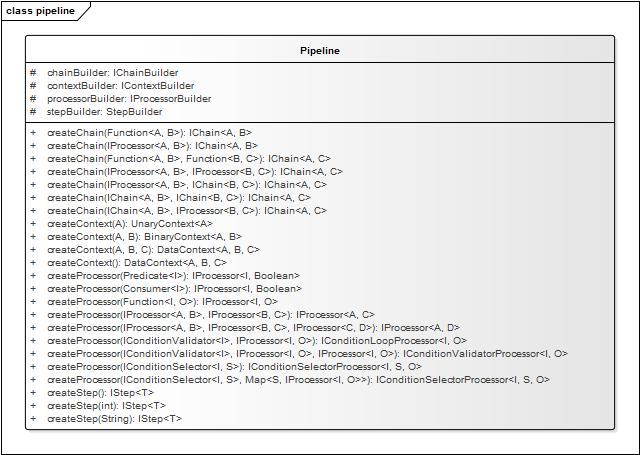
interface Pipeline ChainBuilder StepBuilder Step Chain javadoc api文档 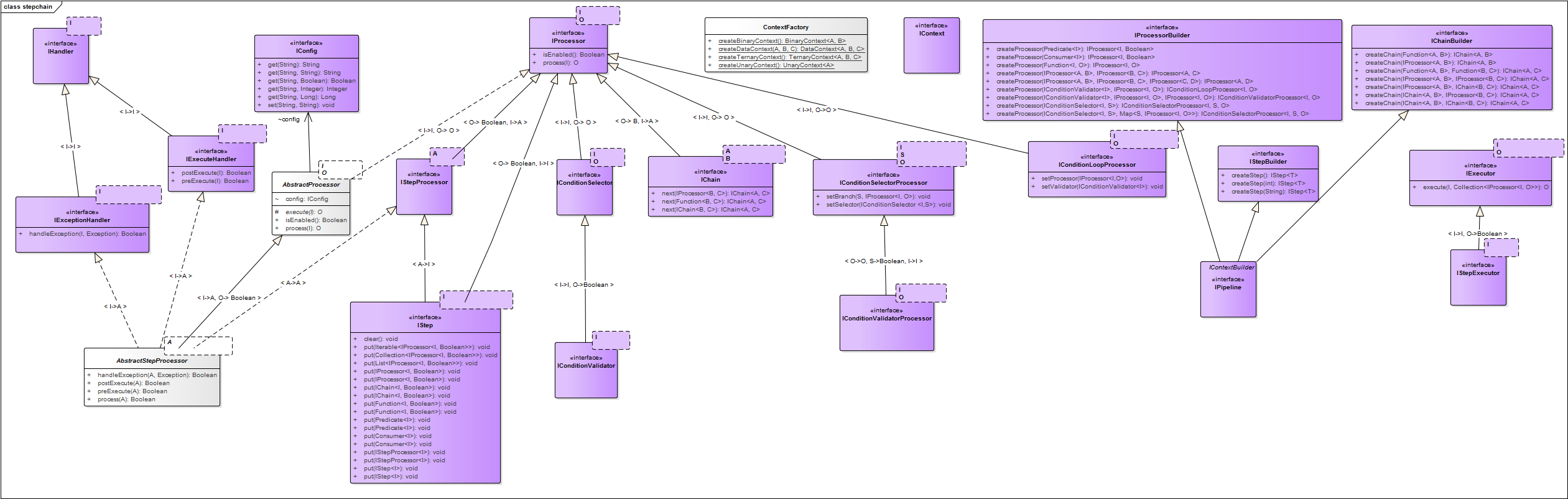
1、StepChain 的中心思想是什么?如何做到通用的? 答: 1.1、任何业务逻辑处理抽象成1\input输入 2\ processor处理器 3\output输出.中间过程结果产生和组合成dataMiddle。 1.2、任何业务逻辑处理使用多个processor组合执行。
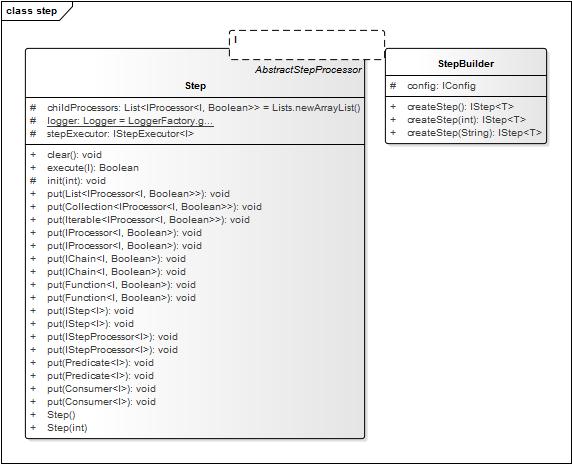
2、StepChain 如何并行和串行执行多个processor? 答: 串行step=pipeline.createStep();step.put(processors);//processors串行执行. 并行step=pipeline.createStep(4);step.put(processors);//processors同时4个并行执行.
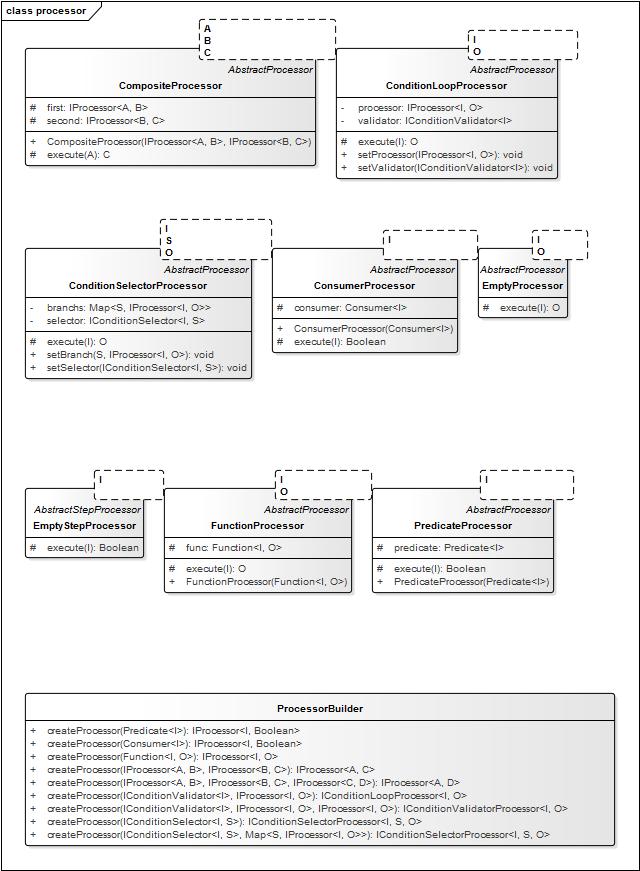
3、Stepchain 如何创建processor? 3.1、实现 IProcessor 接口。 3.2、使用IProcessorBuilder: <I> IProcessor<I, Boolean> createProcessor(Predicate<I> predicate); <I> IProcessor<I, Boolean> createProcessor(Consumer<I> consumer); <I, O> IProcessor<I, O> createProcessor(Function<I, O> func);
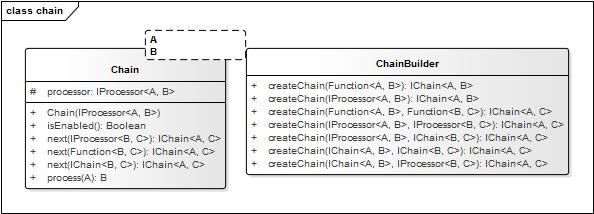
4、StepChain 如何复用和组合processor? 4.1、使用IChainBuilder、IChain: 4.2、使用IProcessorBuilder: <A, B, C> IProcessor<A, C> createProcessor(IProcessor<A, B> first, IProcessor<B, C> second); <A, B, C, D> IProcessor<A, D> createProcessor(IProcessor<A, B> processor1, IProcessor<B, C> processor2, IProcessor<C, D> processor3);
5、StepChain 如何按条件复用和组合processor? 答: case1、已有trueProcessor\falseProcessor2个 创建 validator 则按条件执行2则之1. IConditionSelectorProcessor<String, Boolean, String> p3 = pipeline.createConditionValidatorProcessor(validator, trueProcessor, falseProcessor);
case2、已有processor 创建 validator 创建循环执行体,validator 返回false时终止执行。 IConditionLoopProcessor<String, String> p2 = pipeline.createConditionLoopProcessor(validator, processor);
case3、已有processor创建 switch 逻辑,根据selector返回的key执行某1分支branchProcessor如果返回的key不在分支中 则执行默认key对应的分支branchProcessor。 IConditionSelectorProcessor<String, String, String> p1 = pipeline.createConditionSelectorProcessor(selector); p1.setBranch(S key, IProcessor<I, O> processor); p1setDefaultBranch(S key);
case4、已有processor创建 if/else if/else 逻辑,根据validator返回的结果与result对比一致则执行分支branchProcessor,如果没有返回一致的 则执行默认分支branchProcessor。 pipeline.createConditionValidatorSelectorProcessor(); public interface IConditionValidatorSelectorProcessor<I,O> extends IProcessor<I, O> { void setBranch(IProcessor<I, Boolean> validator,Boolean result,IProcessor<I, O> processor); void setDefaultBranch(IProcessor<I, O> processor); }
public interface IStep<I> extends IStepProcessor<I> { void put(IStepProcessor<I> processor);
1void put(IStepProcessor<I>... processorArray);
2
3void put(Collection<StepProcessor<I>> processors);
4
5void put(IProcessor<I, Boolean> processor);
6
7void put(IProcessor<I, Boolean>... processorArray);
8
9void put(IChain<I, Boolean> chain);
10
11void put(IChain<I, Boolean>... processorArray);
12
13void put(Function<I, Boolean> func);
14
15void put(Function<I, Boolean>... processorArray);
} public interface IChain<A, B> extends IProcessor<A, B> { <C> IChain<A, C> next(IProcessor<B, C> process);
<C> IChain<A, C> next(Function<B, C> func);
} public interface IChainBuilder { <A, B> IChain<A, B> createChain(Function<A, B> func);
1<A, B> IChain<A, B> createChain(IProcessor<A, B> processor);
2
3<A, B, C> IChain<A, C> createChain(IProcessor<A, B> processor1, IProcessor<B, C> processor2);
} public interface IStepBuilder { <T> IStep<T> createStep();
1<T> IStep<T> createStep(int parallelCount);
2
3<T> IStep<T> createStep(String parallelCountConfigName);
}
PipelineTest.java
Demo&Test you can use AbstractProcessor AbstractStepProcessor
import com.github.zengfr.project.stepchain abstract class AbstractProcessor<I, O> implements Processor<I, O>{} abstract class AbstractStepProcessor<A> extends AbstractProcessor<A, Boolean> implements StepProcessor<A>{}
import com.github.zengfr.project.stepchain.Chain; import com.github.zengfr.project.stepchain.Pipeline; import com.github.zengfr.project.stepchain.Step; import com.github.zengfr.project.stepchain.context.ContextBuilder; import com.github.zengfr.project.stepchain.context.UnaryContext; import com.github.zengfr.project.stepchain.test.context.SetProductContext; import com.github.zengfr.project.stepchain.test.context.SetProductDataMiddle; import com.github.zengfr.project.stepchain.test.processor.DiscountProcessor; import com.github.zengfr.project.stepchain.test.processor.FeeProcessor; import com.github.zengfr.project.stepchain.test.processor.IncreaseProcessor; import com.github.zengfr.project.stepchain.test.processor.InitProcessor; import com.github.zengfr.project.stepchain.test.processor.TaxProcessor;
public class PipelineTest { public static void testPipeline(IPipeline pipeline) throws Exception { //Demo精简版 只开源了通用部分(不影响使用) SetProductRequest req = new SetProductRequest(); SetProductResponse resp = new SetProductResponse(); SetProductDataMiddle middle = new SetProductDataMiddle();
1SetProductContext context = new SetProductContext(req, middle, resp);
2IStep<SetProductContext> step = pipeline.createStep();
3step.put(new InitProcessor());
4step.put(new TaxProcessor());
5step.put(new FeeProcessor());
6step.put(new IncreaseProcessor());
7step.put(new DiscountProcessor());
8step.put((c) -> {
9	c.middle.Price += 10;
10	return true;
11});
12step.process(context);
13System.out.println(context.middle.Price);
14}
15
16public static void testPipeline2(IPipeline pipeline) throws Exception {
17Function<UnaryContext<Integer>, Boolean> func = (context) -> {
18		if (context.context == null)
19			context.context = 1;
20		context.context += 1;
21		return true;
22
23	};
24	Function<UnaryContext<Integer>, String> func3 = (context) -> {
25		if (context.context == null)
26			context.context = 1;
27		context.context += 1;
28		return JSON.toJSONString(context.context);
29
30	};
31	UnaryContext<Integer> context = pipeline.createContext(12345678);
32	IStep<UnaryContext<Integer>> step = pipeline.createStep();
33	IStep<UnaryContext<Integer>> step2 = pipeline.createStep();
34	IChain<UnaryContext<Integer>, Boolean> c2 = pipeline.createChain(func);
35
36	IChain<UnaryContext<Integer>, String> c3 = pipeline.createChain(func3);
37	Function<String, Integer> func4 = null;
38	Function<Integer, String> func5 = null;
39	Function<String, Boolean> func6 = null;
40	IChain<String,Integer > c4 = pipeline.createChain(func4);
41	IChain<Integer, String> c5 = pipeline.createChain(func5);
42	IChain<String, Boolean> c6 = pipeline.createChain(func6);
43	IChain<UnaryContext<Integer>, Boolean> c7 = c3.next(c4).next(c5).next(c6);
44
45	step2.put(c2);
46	step2.put(step);
47	step2.put(func);
48	//step2.put(c7);
49
50	step2.process(context);
51	System.out.println(context.context);
52}
53public static void testPipeline3(IPipeline pipeline) throws Exception {
54	IProcessor<String, String> selector = null;
55	IProcessor<String, Boolean> validator = null;
56
57	IProcessor<String, String> processor = null;
58	IProcessor<String, String> first = null;
59	IProcessor<String, String> second = null;
60
61	IConditionSelectorProcessor<String, Boolean, String> p3 = pipeline.createConditionValidatorProcessor(validator, first, second);
62	IConditionLoopProcessor<String, String> p2 = pipeline.createConditionLoopProcessor(validator, processor);
63
64	IConditionSelectorProcessor<String, String, String> p1 = pipeline.createConditionSelectorProcessor(selector);
65}
@RunWith(SpringRunner.class) @SpringBootTest(classes = StepChainTestApplication.class) public class StepChainSpringBootTest { @Autowired protected IPipeline pipeline; @Test public void testPipeline() throws Exception { PipelineTest.testPipeline(pipeline); } @Test public void testPipeline2() throws Exception { PipelineTest.testPipeline2(pipeline); }